| Author |
 Replies: 64 / Views: 10,625 Replies: 64 / Views: 10,625 |
|
|
|
Bedrock of the Community
United States
62064 Posts |
The dime stock metal was cut with blanks the quarter size on the dime stock. That is the correct material on the error. The weak strike is what to look for on this error. 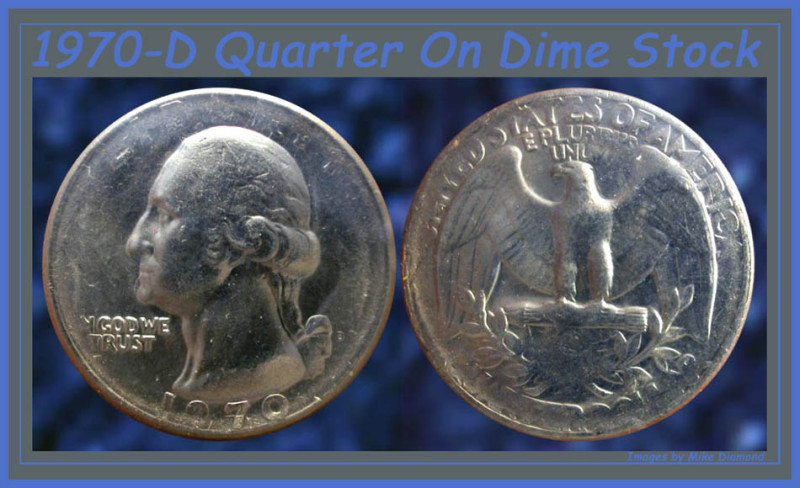 |
|
Pillar of the Community
 United States
7174 Posts |
That's a really nice find
|
|
Pillar of the Community
United States
7376 Posts |
I also have a 1970 D struck on a 10¢ stock...no weight given on the slab....but looks the same...great (understatement) find...   |
|
Pillar of the Community
United States
2408 Posts |
 Really nice find. |
|
Moderator
United States
108657 Posts |
Very nice find (purchase) - now I need to go get one too.
|
|
Pillar of the Community
 United States
3013 Posts |
KsFreelancer, no worries, I realized why the mods had to lock the thread you started. Kinda cool how you got yours... I wondered why I recognized that title  Merclover, I do want this certified by PGCS, but in a bulk submission with other high value coins of mine.  |
|
Pillar of the Community
Canada
6244 Posts |
The difference between tinny planchet and the wrong planchet denomination.
Given the fact that the clad foils are equal for all denomination's, the difference it is in the high of the coin (the core CU is tinnier or thicker).
I wait to see what the graders will say on this coin, but I am skeptical to be dime planchet. In any ways it is an very nice find and wished coin to have in the collection. Absolut sure not many coins like this are around.
|
|
Pillar of the Community
United States
7174 Posts |
Silviosi, as stated above they produced 20,000 to 100,000 before the error was discovered.
|
|
Pillar of the Community
Canada
6244 Posts |
@Cu, who state was produce? Was an hypotheses of production on the calculus of a hole roll use if was. Till now not so many was discovered, and believe me if are 20K around we know.. For this year the mint has just a few foreign planchet coins strike. In general they will mention those major errors and made the coins to be not legal tender coin. They manage between collector interest and the market production. This it is the policy.
For you: last two photos show that the quarter is thicker then a dime. Could be thicker strike on dime planchet? We have to analyze the facts and the ways they produce the coins.
In 1970 at Denver they produce the quarters before the Dimes because the demand for quarters was bigger then dimes, was three month between the two strikes (from the Mint report)
|
|
Pillar of the Community
United States
5904 Posts |
Quote:
... but I am skeptical to be dime planchet. It isn't a dime planchet. It's a quarter planchet cut from rolled dime stock. (The planchet was the diameter of a quarter but as thin as a dime planchet.) Words of encouragement are one of the major food groups.
We need to consume them regularly to thrive and grow.
|
|
Pillar of the Community
Canada
6244 Posts |
@Pete: On the mint production the planchet it is the roll and the cut roll with the diameter of the coin. The reason is use same name it is because it is the same material with no others interventions (chemical or mechanical). For me is hard to change my vocabulary, sorry, I try but it is really hard.
|
|
Pillar of the Community
United States
3013 Posts |
Yeah, it is dime (thinner) stock vs quarter (thicker) stock here, like this: 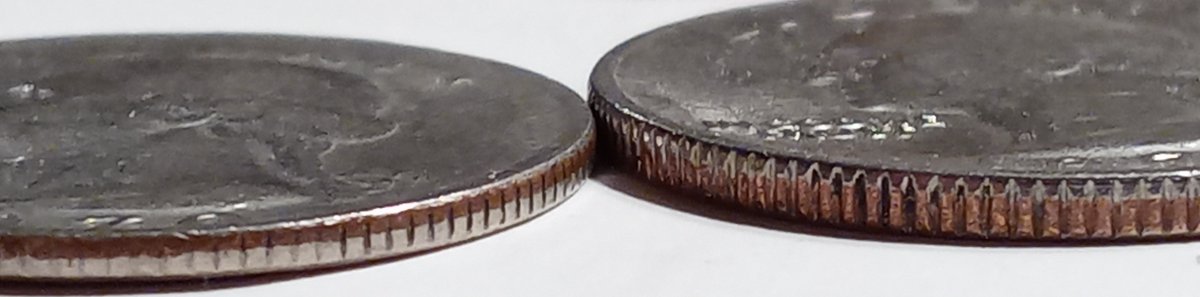 My 70-D on dime stock is on left, another quarter on right.  |
|
Pillar of the Community
Canada
6244 Posts |
@MR: thanks to confirm me mine impressions. Is not a dime planchet, but still be a rare tinny planchet coin. I will look to see what foreign coins clad was strike in 1970 at Denver (I will have some homework to do)
Edited by silviosi
07/12/2022 8:53 pm
|
|
Pillar of the Community
United States
5905 Posts |
Could it be quality control at the Mint recovered and destroy most of it once they found out? That's why there are very few that went into circulation.
Excellent purchase!
|
|
Pillar of the Community
Canada
6244 Posts |
@MAC Sorry to tell you but the QC do not look at this kind of variety. For the mass production they look randomly coins to see the quality of the strike and eventually if the dies must be re-align. You state maybe the destroy many because they find out. I thing you do not catch that this coin was not struck on dime roll, was just on tinny planchet. Basic the first and last 4 feet of every roll is cutoff to eliminate the crack planchet exfoliation and tinny planchet. Theoretically is enough, but it is not necessary the 4 feet cut an milestone for this in the case of quarters. 5 feet for halves and dullards and 3 feet for nickel, dime and penny.
Hope help you in some ways of the deeper Mint production process.
PS. If the QC find one coin which do not fit the parameters, the all batch is direct to the recycle bin. (2000 coins)
|
| |
Replies: 64 / Views: 10,625 |




 First Page
 Previous Page


 Posted 04/11/2022 4:54 pm





