|
This page may contain links that result in small commissions to keep this free site up and running.

Welcome Guest! Registering and/or logging in will remove the anchor (bottom) ads. It's Free!
To participate in the forum you must log in or register. | Author |
 Replies: 12 / Views: 1,510 Replies: 12 / Views: 1,510 |
|
|
Pillar of the Community
Australia
1333 Posts |
Now this question was sparked from a different forum asking about when the earliest coins that were actually minted in Australia (1916 aside from holey) would be other than gold coins which where small. Adelaide pound, Kangaroo office coins and Sydney mint sovereign being the earliest but gold coins. reason they ask was because they found a in the NSW government website in reference to the Sydney mint "The Sydney Branch expanded its production in 1868 to bronze coins and again in 1879 to issue Imperial silver coinage." https://apps.environment.nsw.gov.au...x?ID=5045802yes, I know of no other reference yet they claim they also saw such a reference in Sydney museum.  I also found out that museum of victoria had a counter to this "The Melbourne Branch of The Royal Mint had been established in 1872 to strike small diameter gold coins with dies provided from London and in 1901 that was still the situation. None of the branches of The Royal Mint (there were three in 1901 after the opening of Perth in 1899) was capable of designing or preparing dies for a Commonwealth coinage, and none had the machinery necessary for striking the larger diameter silver and bronze coins that would be needed." https://collections.museumsvictoria...rticles/3777yet I doubt they kept the most accurate records for another mints machinery prior to its own establishment.  So I left with an open feeling that even tho I have my doubt that Sydney mint made any silver coins or copper, I still would be intriguing that they made some for the British Empire.  Who know maybe something can be uncovered, hopeful someone from the British coin forum also take a look. Maybe even some accurate ship manifest? |
|
|
|
Moderator
 Australia
16963 Posts |
Definitely not. Prior to the 1900s no Australian mint produced anything other than gold coinage. The Sydney Mint collapsed in the 1920s because it had trouble transitioning from a gold-coins-only mint to one that mass-produced bronze and copper coins. The machinery needed to make coins of the tougher alloys is more resilient than that required for gold, and Sydney simply never had it. They would not have suffered from this transition if they already had the equipment needed. The main Royal Mint in London had all the steam-powered high-pressure presses needed for mass-production of silver and copper coins for Britain itself, and (they reckoned) for the rest of the Empire as well. They zealously guarded this privilege; they only relented in establishing the branch mints in Australia on the condition that they were only used to strike goldrush gold into urgently needed trade coinage. If the Australian colonies had had access to a local source of regal coinage, there wouldn't have been a colonial coinage shortage and thus wouldn't have been any tradesman tokens. The Sydney mint might have requested permission to expand their operations and start striking British silver and copper coins in Australia, to help alleviate the aforementioned coin shortage, but such permission was never granted, and non-gold coinage dies were never created and sent to Australia. After the brouhaha with the "Sydney Mint" sovereign design, the Australian branch mint would never have been trusted to create their own silver and copper coin dies from scratch, as they had neither the equipment nor expertise for this. Nor were the coinage presses in Sydney upgraded to cope with silver and copper output. And finally, if such coins had been struck, it wouldn't have been a secret; the coins would no doubt have been mintmarked, just like the gold coins (and the subcontracted coins from Heaton and King's Norton mints in Britain and other colonies). I ran a Google search for the phrase "The Sydney Branch expanded its production in 1868 to bronze coins", and found a whole bunch of third-party websites that all seem to be copying each other; I assume your NSW government website simply copied from one of those. I don't know who originally came up with the "Sydney minted silver and bronze coins" story, but they were talking through their hat. Don't say "infinitely" when you mean "very"; otherwise, you'll have no word left when you want to talk about something really infinite. - C. S. Lewis
|
|
Bedrock of the Community
Australia
21789 Posts |
From what I have been able to find, the earliest bronze tokens were produced in Australia in 1852, - Campbells Tea stores.
Thornthwaite Sydney made the dies
None of the popular catalogues on Australian coinage indicate that mints in Australia produced any official bronze or copper coinage until 1911.
|
|
Pillar of the Community
4628 Posts |
Stokes and Co Melbourne were making copper penny and halfpenny tokens for Australia and New Zealand at least in the 1850s like these 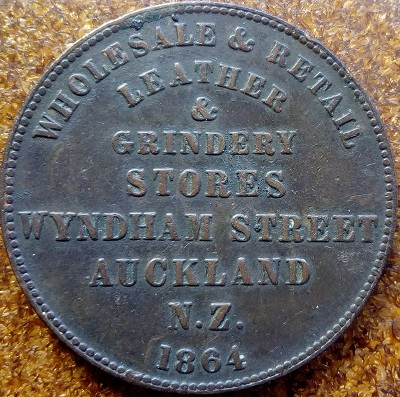 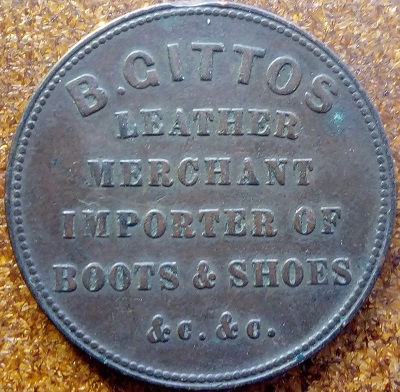 1864 for NZ tradesperson 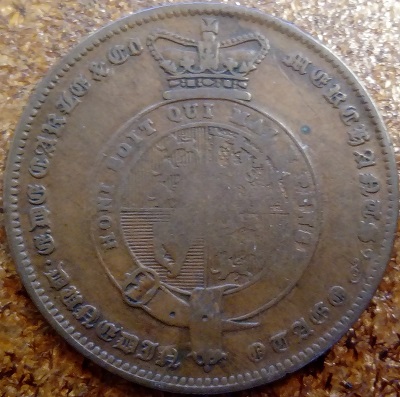 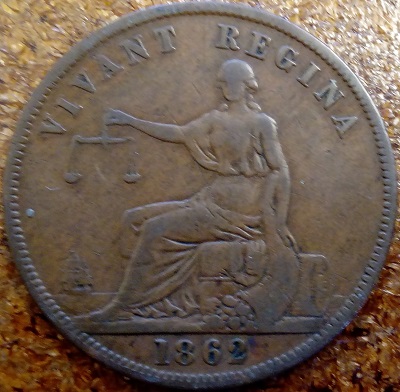 1862 for NZ tradesperson, but this trader was precviously in Melbourne and had tokens made in 1853 and 1855 by Stokes as well. Generally they were the cheaper option and were making tokens for NZ producers long after they were illegalised in Victoria (1868). The latest Kiwi tokens I have by them are 1874 and 1875. Although tokens they were accepted as pennies and halfpence at a time of shortages of these coins from England. |
|
Pillar of the Community
Australia
852 Posts |
Sel, you wrote 1911 for bronze coinage minted in Australia, shouldn't that be 1919?
|
|
Bedrock of the Community
Australia
21789 Posts |
You are correct; all issues 1911-1918 were minted in London, Birmingham or Calcutta.
|
|
Pillar of the Community
4628 Posts |
From what I see, first Australian coins minted in Australia itself.
1st altered coins - Holey Dollars - 1813
First Gold, Adelaide assayed pounds etc - 1852
First Bronze Tokens - 1853
First Gold sovereigns and Halves for British Empire - 1855 Sydney, 1871 Melbourne, 1899 Perth
First Australian silver coins - 1916 Melbourne Mint
First Australian bronze - 1919
First Decimal coins - 1964/65 but dated 1966.
Mints - Sydney, Melbourne, Perth and later Canberra?
Australian coins minted in the UK, Canada, USA (WW2 Silver) or India did happen after these dates. I think some NCLT is made by the mint in Germany called Kungstermans gmbh or something.
Please feel free to correct or add to this list.
Edited by Princetane
06/16/2022 12:21 am
|
|
Pillar of the Community
Australia
2180 Posts |
I think the branch mints definitely looked into striking silver coins in the 1800s but I don't think it got any further than discussions.
|
|
Bedrock of the Community
Australia
21789 Posts |
Just as Australia had British coinage, - so did New Zealand. It makes a lot of sense that before 1910, New Zealanders should also study and collect British coinage for the period 1840-1932, because those coins also form a vital part of New Zealand coinage heritage. That is why I have a particular interest in British coinage for the period 1825-1910, in the Australian context. It was in 1825 that the Sydney Colony received it's first substantial shipment of new coins from The Royal Mint. It also makes some sense that New Zealanders should collect Australian coinage, because although a 'foreign' coinage, it seems that it was freely available in the period, of at least up 1933. After 1933, the Australian silver coinage would have been withdrawn, due to Gresham's Law. |
|
Pillar of the Community
4628 Posts |
Preaching to the choir,
Have you seen my collections of British, Australian and New Zealand coinage.
However I do like to collect all 3 coinages outside of their usage in New Zealand in these ways
1. New Zealand Tradesmen and Special Purpose tokens issued between 1857 and the 1920s
2. Australian coinage after 1934
3. British coinage before 1840 (When our first "official" shipments arrived) and 1935 (When all silver was demonitised) and 1967 (Bronze was, although we had our own Pence and Halfpence from 1939 onwards - 1940 dated coins were released in Nov 1939, Britannia coins remained in circulation).
New Zealand also officially used Australian coinage between 1910 and 1919 for silver (Because the UK debased their coins in 1920, we were encouraged to not use higher purity Australian ones - but it did not work). New Zealand also officially used Australian minted gold coins from 1855 to 1932 and in 1932 a plan to circulate Australian florins in place of British Halfcrowns never took off - because due to the devaluation of the Australian pound, these coins were worth less than sterling coins.
In 1931 there was a period of coin smuggling in New Zealand, when our pound was devalued to 16/- British and this meant any British coin was worth 10% more in Australia and 25% in Britain.
Between 1931 and 1934, smuggling of English coins, especially half crowns led to NZ's coin supply being depleted and several people arrested for smuggling. One man smuggled £1200 worth of half crowns and made £100 of it. Not bad in the Depression when £1 was a decent weekly wage. Coins were smuggled on steamers to Sydney and London in gas canisters, frozen chickens, hat boxes, cardboard suitcases full of holes and through stewards who were paid 10/- each to smuggle £50 worth of coins into Australia for an immediate £5 bonus which gave the smuggle £4/10- after expenses.
NZ's first coin the Halfcrown was finally issued in late November 1933 and the British Halfcrown was immediately made illegal and worthless (About 10d in scrap silver). The rest of our silver coins arrived between Feb and May 1934 and by March 31st 1935, all British silver was made illegal and only New Zealand silver coins could be used.
In the early 1960s, stories started of Australian silver coins being smuggled to New Zealand and melted down with the silver sold for a profit. Most was by Chinese migrants and jewellers who were all arrested and several Chinese deported.
Despite NZ getting its own coins, none were ever minted here, which put us at a major disadvantage compared to Australia and meant we were at the mercy of the UK and Canada and in WW2 this caused problems.
|
|
Pillar of the Community
4628 Posts |
New Zealand came into being on February 6 1840 with the signing of the Treaty of Waitangi and had been kind of protected since 1835 when James Busby a British resident under the orders of King William IV was sent here to keep peace.
However at the time, full colonial status was not granted until September 1841. Between Feb 1840 and Sep 1841, we were officially part of the colony of New South Wales and Captain William Hobson was a "Lieutenant Governor". Only in Sep 1841 was New Zealand made a full colony of its own and Hobson was elevated to full "Colonial Governor".
All New Zealanders, Maori and Pakeha became automatic subjects of the British Empire and were to acknowledge Queen Victoria as the Head of State.
Coins arrived in New Zealand from the 1810s onwards and included coins from India, America, the Spanish colonies, French Francs and Britain. Many were brought over by sailors and traders and all were legal, like in Australia, unofficial barter values were established and in 1841 these were crystallised into values in Sterling currency.
In September 1841, however official coins started arriving from the UK, but supplies were always poor and foreign coins circulated. Despite this in 1844, all foreign coins except those of Great Britain were made illegal here. These laws were poorly enforced as New Zealand was a frontier until the 1880s and in the interim foreign coins circulated freely along with tradesmen's pennies and halfpence between 1857 and 1887.
Only after 1887, did reliable supplies of imperial coinage arrive and did foreign coinage finally fall out of usage. Many coins were brought here in barrels from Sydney or London and they were used as ballast. Most of our coins were used and not the best quality except for Australian minted gold half and full sovereigns (Cheaper to ship them from Australia than UK).
The 1902 Elingamite shipwreck is proof of this, it sank with some £17,000 of coins aboard for New Zealand, most of the English silver was at least 2 years old and VF or lower, but a handful of 1902 dated Sydney half sovereigns were brand new.
|
|
Pillar of the Community
Australia
2577 Posts |
Again, a fascinating tale, thanks Princetane
The Ox moves slowly, but the Earth is patient.
|
|
Pillar of the Community
4628 Posts |
You're welcome, its all from my wonderful book I brought "New Zealand's History Coined" by Robert Pepping. It is the first proper update on our coin history since a book from 1981!
Also my avatar coin, a 1929 British Halfcrown in gEF grade was likely one of the last ones sent to New Zealand and no doubt ended its days being stuffed in a frozen chicken or was supplanted in 1934 by a local coin and hence why finding high grade 1927 - 1932 British coins is quite easy here.
Seriously, my British collections, my 1927 - 1932 silver coins are mostly high grade, but my post 1932 ones are meh!
Edited by Princetane
07/23/2022 05:00 am
|
| |
Replies: 12 / Views: 1,510 |
|
To participate in the forum you must log in or register.
Disclaimer: While a tremendous amount of effort goes into ensuring the accuracy of the information contained in this site, Coin Community assumes no liability for errors. Copyright 2005 - 2026 Coin Community Family- all rights reserved worldwide. Use of any images or content on this website without prior written permission of Coin Community or the original lender is strictly prohibited.
Contact Us | Advertise Here | Privacy Policy / Terms of Use
|
| Coin Community Forum |
© 2005 - 2026 Coin Community Forums |
| It took 0.42 seconds to rattle this change. |
 |
|
| |
| |







 Posted 06/07/2022 02:35 am


