| Author |
 Replies: 21 / Views: 3,694 Replies: 21 / Views: 3,694 |
|
Valued Member
United States
466 Posts |
Despite the fact we have the strongest economy in the world (we are told) what has happened to coin values have historically during past recessions?
|
|
|
|
Pillar of the Community
United States
7387 Posts |
Remember coins are discretionary spending. People generally buy coins when there basic necessities are met. Recessions also are generally not created equal for all sectors of society. In most recessions the lowest paid workers are usually the ones laid off and while white collar and higher incomes wage earners are affected, it is usually less than the lower paid workers.
So you have people that already have extra money which in most recessions are not effected, that means that coins can still have high sales/prices in uncertain times. Coupled with the fallacy that coins are a "safe" investment and you can have coin prices rise. But not all recessions are created equally nor are all buyers created equally.
What I'm trying to say is that looking at the data, there generally is no correlation between recession and coins prices. BUT I will cavet that with the great recession of 2008/2010 prices did drop on coins and took 9 years (2019) to get back to 2008 prices.
|
|
Pillar of the Community
 United States
8038 Posts |
I'm a quant, so here is my best shot. I've taken the PCGS price index, and put bars on it for our recessions over the last 40 years. Draw your own conclusions: 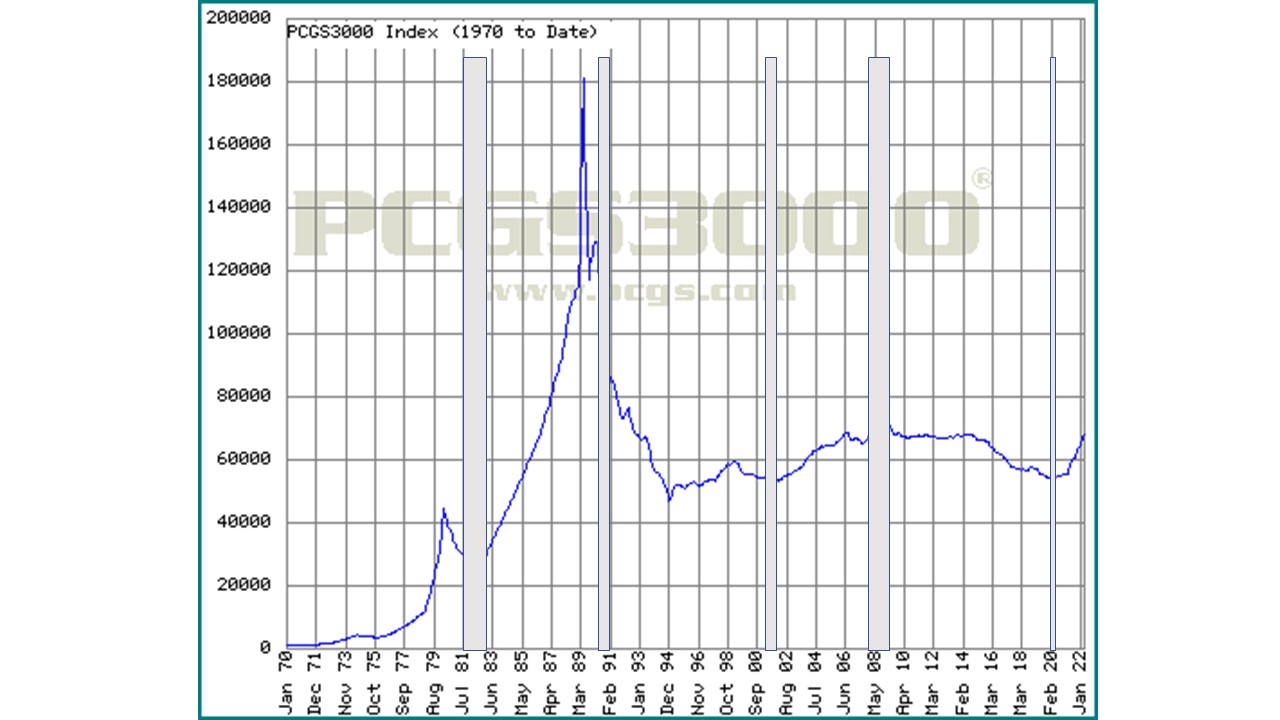 |
|
Pillar of the Community
United States
7387 Posts |
The PGCS 3000 isn't a great comparison, but I did use it in my analysis also. There just isn't a real good market data for common date coins. PCGS 3000 is tailored more to investment grade coins.
|
|
Pillar of the Community
United States
8038 Posts |
I am a world coin collector, so I am looking to take advantage of the recent 15% drop in prices of coins priced in euros  |
|
Valued Member
 United States
466 Posts |
The PCGS chart is really interesting. I wonder what caused the spike in values in about 88/89. Was that the Hunt era?
|
|
Pillar of the Community
United States
7387 Posts |
The Hunt Brothers and Silver Thursday were on March 27, 1980. The above spike is interesting. In the late 80's Investment firms got an idea that they would invest in coins. But like novice collectors they didn't know what to buy so they started buying 3rd party graded coins in investment grade (MS65+) no matter what they looked like. The investment firms caused the prices of common date high grade to go sky high, the TPG happily obliged by "loosening grading standards", hence resulting in some MS66 coins be really MS 66 and many being MS63-64. The prices kept increasing until they peaked. This resulted in a bubble, but what happens when things go to crazy prices, the collectors stopped buying the coins, coin shops didn't want to be stuck with all this overpriced inventory so they started dumping common date coins on the market, the sellers seeing the prices dropped for their overpriced coins also started selling but dealers would only give 50% or less of current market value. When the investment firms saw the price dropped they dumped all there coins and this caused prices to crash even further. For about 2 years, no one would offer anywhere near market for common date coins. And as you can see the prices as of yet have not recovered to that time period. You can read more about it here: http://www.antiquesage.com/obscure-...-late-1980s/ |
|
Pillar of the Community
United States
943 Posts |
I didn't start collecting NGC and PCGS graded coins like Morgan, Peace, and classic commemoratives until maybe 5 years ago. Prices for these graded coins have about doubled the past few years.
|
|
Moderator
 Australia
16964 Posts |
To answer the OP's question, that chart shows that in the past five recessions, only one of them saw coin prices crash - and that's because coins were in the middle of a bubble, and the "recession we had to have" (as it was called here in Australia) caused that bubble to burst. The other four, prices stayed much the same.
I think we are unlikely to see a crash happen again right now, as coins aren't in a "bubble". Speculators rushed into coins as a safe haven after the 1989 stock market crash, because they looked at that decade of growth in the 1980s and thought (and hoped) that "coins would never go down, only up". They were wrong. Speculators mostly got spooked away from coins during that crash, realising that coins weren't a magic bullet and were just as prone to boom-and-bust bubblification as anything else.
The "fundamentals" of the demand side for coin pricing is driven by collectors. Collectors decide which coins are "rare and valuable", and therefore deserve to attain high prices, using their own kind of arcane logic. Speculators/investors in the market watch and imitate, but don't really understand the reasons why the market moves the way it does. The bubbles only happen if and when speculators flood the market and hold many more coins than the collectors do. As far as I'm aware, that's not the case right now.
It could happen again, if those past couple of years of price growth continues for another decade.
Don't say "infinitely" when you mean "very"; otherwise, you'll have no word left when you want to talk about something really infinite. - C. S. Lewis
|
|
Pillar of the Community
Australia
3840 Posts |
I think people need to realize that if prices keep going up, there will be a correction eventually. Look at bitcoin.
That said in the last two years, I've been seeing quite a few key or scarce coins that appear out of nowhere that I have been chasing for the last 5 to 10 years.
Perhaps collectors and or investors think a downturn is about to appear and maybe it's a good time to cash out? I don't know.
|
|
Pillar of the Community
United States
8038 Posts |
Quote:
To answer the OP's question, that chart shows that in the past five recessions, only one of them saw coin prices crash - and that's because coins were in the middle of a bubble, and the "recession we had to have" (as it was called here in Australia) caused that bubble to burst. The other four, prices stayed much the same.
Well, whatever that chart tells us, the stock market was a better bet, Coins are my hobby and my pleasure. But NOT my future financial security  |
|
Pillar of the Community
United States
5288 Posts |
Edited by NumisEd
07/18/2022 12:46 am
|
|
Valued Member
United States
152 Posts |
So we are hearing inflation is around 8% but they have changed the way they calculate it over recent years.Many believe it's really around 18%.So this being said your coins could almost double in the next few years or so.But is our dollar just worth less over time or did our coins just go up or both.
I remember my parents paid $35.000 for a pretty nice house in the early 70's and sold it for $120.000 in the late eighties.Thats triple the original price.Thats inflation!
Edited by FlyingTiger
07/25/2022 04:48 am
|
|
Pillar of the Community
United States
3402 Posts |
Quote:
I am a world coin collector, so I am looking to take advantage of the recent 15% drop in prices of coins priced in euros That's my feeling...buy 'em up in Europe!!! KK |
|
Bedrock of the Community
United States
20753 Posts |
I have been coin collecting for about 60 + years now. I only see prices going up, up, up for coins.
|
|
Pillar of the Community
Russian Federation
1557 Posts |
I don't know for sure. Perhaps it seems to me, but after the outbreak of the war, I see more and more offers for the sale of certain coins. Maybe it's local and people just need money now, I don't know.
|
| |
Replies: 21 / Views: 3,694 |










 Posted 07/16/2022 8:48 pm


