| Author |
 Replies: 24 / Views: 4,216 Replies: 24 / Views: 4,216 |
|
New Member
United States
1 Posts |
Hi guys. According to the 2023 US Error Coin Guide, 1951D and S can be "thin". I have 2 1951 dimes that weigh 2.39 and 2.38 grams. My other 1951 Silver dimes weigh approximately 2.45 and up. Would the lighter dimes be considered thin? I'm unable to find anywhere that lists the variance for what would be considered as a thin weigh. Hoping someone may know. Thank you in advance.
|
|
|
|
Bedrock of the Community
United States
78480 Posts |
 To CCF! They are somewhat thin, but I think that there still within tolerance. Errers and Varietys.
|
|
Moderator
 United States
105745 Posts |
can we see some  to better help you? |
|
Pillar of the Community
United States
2775 Posts |
Conder101 shared this info with me sometime back. Its from the 2011 Coin World Almanac. If memory serves for dimes this year had the following listed. Thanks, Doug. US Dimes 1873 to 1964 Weight: 2.500 grams Tolerance: 0.097 grams Diameter: 17.91 (mm) Composition: 900 Ag, 100 Cu |
|
Pillar of the Community
United States
1648 Posts |
Quote:
According to the 2023 US Error Coin Guide, 1951D and S can be "thin". I have 2 1951 dimes that weigh 2.39 and 2.38 grams. My other 1951 Silver dimes weigh approximately 2.45 and up. Would the lighter dimes be considered thin? I'm unable to find anywhere that lists the variance for what would be considered as a thin weigh. Hoping someone may know. Thank you in advance. Normally should weigh 2.527g, 2.430g is the normal low within tolerance so thats interesting that they mention some for that year can be thin and below tolerance weight. You could also post a photo comparing the size thickness of your 2.38/2.39 and 2.45 and up to see if its thinner visibly as I havent paid as much attention to dimes yet compared to other denominations such as quarters https://www.coinworld.com/news/us-c...ting-wr.html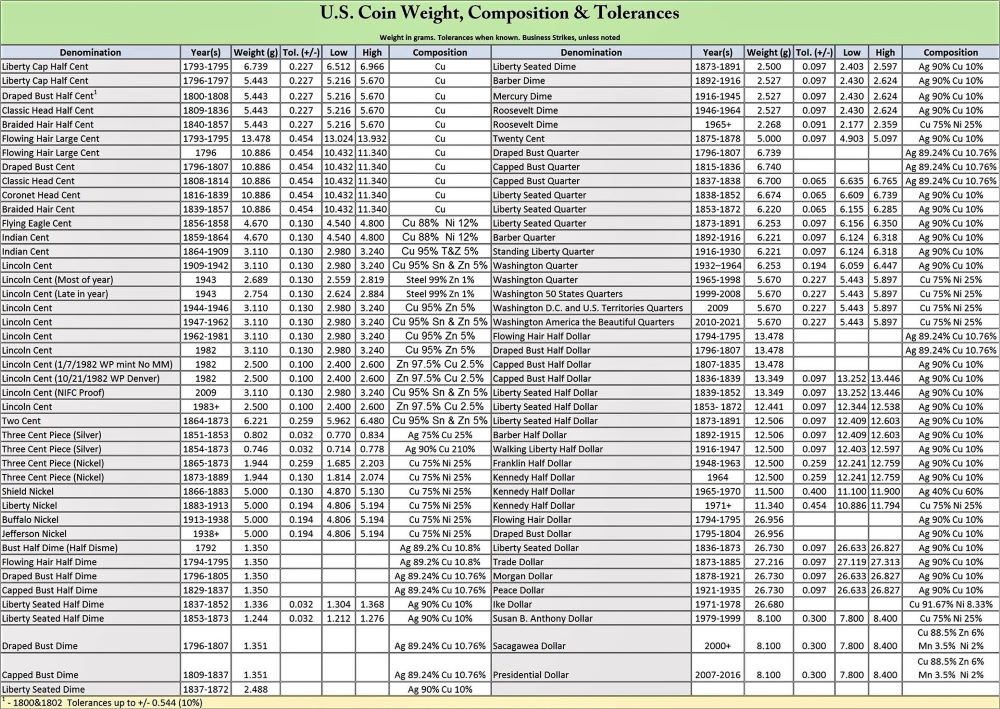 Edited by datadragon
08/26/2023 5:02 pm
|
|
Pillar of the Community
 United States
5713 Posts |
@datadragon, this is the only chart I've seen that states that the weight of a silver Roosevelt dime isn't 2.50 grams. I'm not sure where these numbers come from, but I believe by law the weight of a Barber dime, Mercury dime, and Roosevelt dime through 1964 is supposed to be 2.50 g. |
|
Pillar of the Community
United States
1648 Posts |
Quote:@datadragon, this is the only chart I've seen that states that the weight of a silver Roosevelt dime isn't 2.50 grams. I'm not sure where these numbers come from, but I believe by law the weight of a Barber dime, Mercury dime, and Roosevelt dime through 1964 is supposed to be 2.50 g. Most charts including those we normally use such as the first one below use 2.5g which may be rounded, with a tolerance of +/- 0.9g so 2.41g minimum vs 2.430g minumum from the chart I posted. Another chart of a list of the U.S. Mint's official weights and tolerances as of Dec. 1, 1947, courtesy of Roger Burdette shows 38.58 grains which I just converted to 2.499942g (2.5g rounded up) and a minimum of 37.08 grains = 2.402744g. Obviously someone can look for other official documents but those are close enough to each other for most purposes and easy to compare to the 2.268 (2.27 rounded) for the clad coins as its normally used. I was just checking if any of the OPs coins might be in tolerance as suggested and they don't appear to be although very close. Wear might be the answer for the difference which photos would help. I was not aware of 1951D or S being known to potentially be 'thin' either so its all just info to add to the convo. 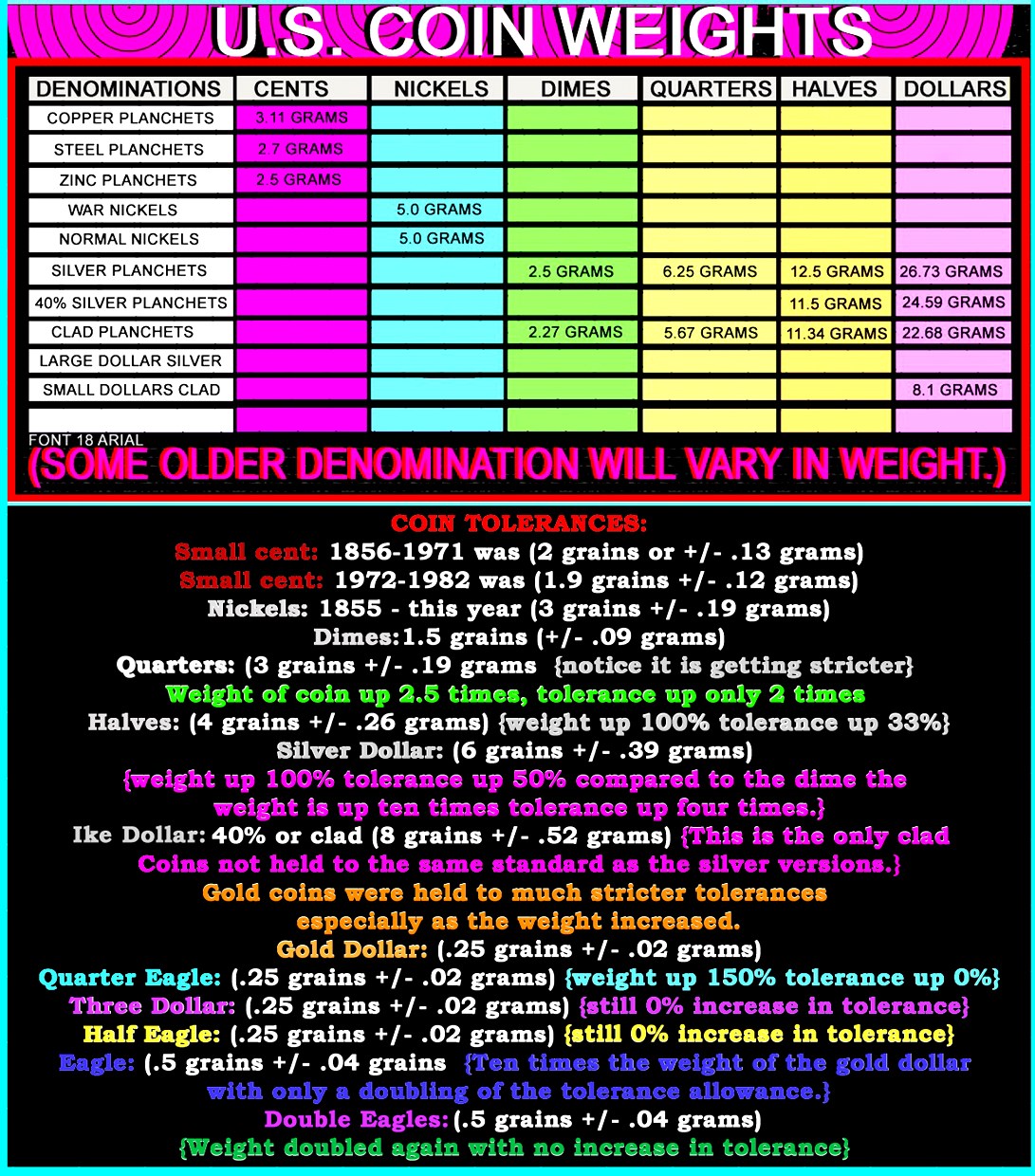 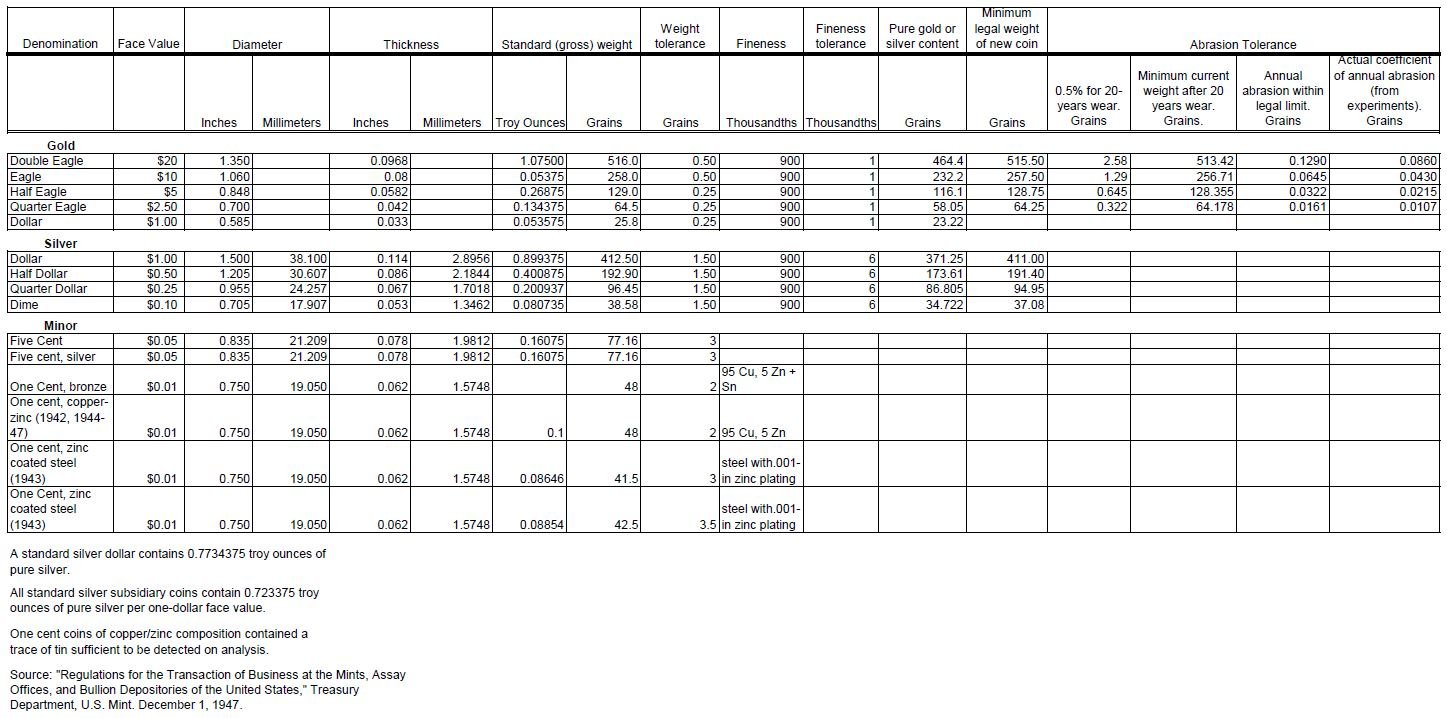 Edited by datadragon
08/26/2023 5:07 pm
|
|
Moderator
United States
194872 Posts |
to the Community! |
|
Pillar of the Community
Canada
6244 Posts |
Zurie: what DATA post first it is the most accurate. Year ago I told to my self I have to post and I am happy can help today. The 2.5 gr. was never 2.5 gr. for silver Dimes..
Edited by silviosi
08/27/2023 01:00 am
|
|
Pillar of the Community
United States
2775 Posts |
Sil & Data, good info. Would you happen to have an original source we can reference? Quote:
Zurie: what DATA post first it is the most accurate. Year ago I told to my self I have to post and I am happy can help today. The 2.5 gr. was never 2.5 gr. for silver Dimes.. Sil, DATA first ref shows 1883 -1891 at 2.500 grams. Is that not accurate as well? Tolerance listed seems steady for silver for the time period and there after. Seems 0.027 90% Au, 10% Cu grams was added to the volume. Just thought Inquiring minds would like to know more. Thanks, Doug. |
|
Pillar of the Community
United States
2015 Posts |
2.38 and 2.39 grams would be consistent with silver Roosies worn to the G-4 range.
|
|
Pillar of the Community
United States
2775 Posts |
Quote:
2.38 and 2.39 grams would be consistent with silver Roosies worn to the G-4 range. Been wondering if any circulation wear is or is not in play myself. Thanks, Doug. |
|
Pillar of the Community
United States
1648 Posts |
Quote:
2.38 and 2.39 grams would be consistent with silver Roosies worn to the G-4 range.
Been wondering if any circulation wear is or is not in play myself. Thanks, Doug. Yes, one of my thoughts as well. I mentioned "Wear might be the answer for the difference which photos would help." in earlier post which could explain the small variance below the different weight minimums. There are rolled thin planchets and of course foreign planchets etc but this is just below the tolerances. The book he said mentioned 1951 D+S can be thin and I have never looked into that before either. A coin struck on a planchet punched out of stock that was rolled too thin on the rolling mill is called a rolled thin planchet but as an example, a 1974 quarter was struck on a rolled-thin planchet. It weighs 4.92 grams instead of the normal 5.67 grams (non silver normal weight 5.67) just for some more info as these do have value so might be worth looking. Maybe can look for any rolled thin planchet 1951 D+S in heritage archive for a comparison or anything of value related to a foreign or off metal planchet error for that year https://varietyerrors.com/wrong-pla...price-guide/Quote:
Sil & Data, good info. Would you happen to have an original source we can reference?
I don't know the source of 2.527 from that document vs 2.5 as typically mentioned in others. The official document from the treasury from 1947 (mentioned at the bottom) the last document was taken from in grains when converted is 2.499942g (2.5g rounded) so that may be an official source so far. Thats another thing someone can look for if desired as mentioned. Edited by datadragon
08/27/2023 11:01 am
|
|
Pillar of the Community
United States
5713 Posts |
This is from an article in SDBullion: Quote:"The U.S. first began minting dimes in 1796 following the Coinage Act of 1792. In the original piece of legislation, the dime was called a "disme." The first dime was issued at a weight of 2.70 grams (0.095 ounces) and was composed of 89.25% silver and 10.75% copper. These Draped Bust dimes kept this weight and metallic content until 1809. From 1809 to 1837, the U.S. minted the Capped Bust dime, which weighed 2.41 grams (0.085 ounces). From 1837 to 1891, the Seated Liberty dime was minted, although the weight changed twice during that time. The metallic composition was changed to 90% silver and10% copper, and the weight changed to 2.67 grams (0.094 ounces). Between 1853 and 1855, the weight was reduced to 2.49 grams (0.087 ounces) due to rising silver prices. The Coinage Act of 1873 changed the weight to 2.50 grams (0.088 grams), where it stayed until the Coinage Act of 1965." Agree that 2.38 g is minimally below tolerance for a 1951 Rosie, but consistent with circulation wear. Edited by Zurie
08/27/2023 3:30 pm
|
|
Pillar of the Community
Canada
6244 Posts |
So I will post here again the original 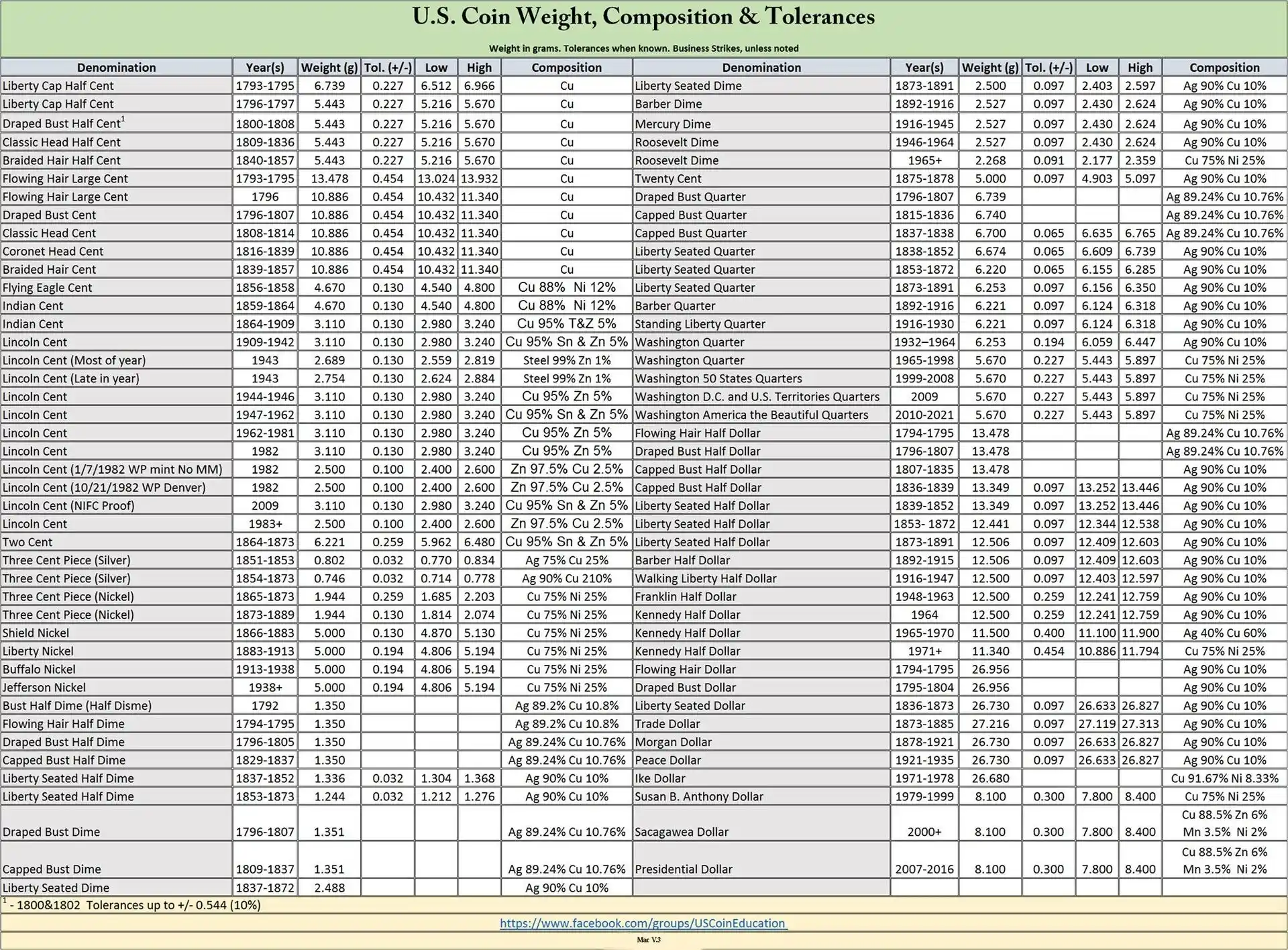 |
|
Pillar of the Community
United States
5713 Posts |
Quote:
So I will post here again the original So the original source for this chart is a Facebook post? |
| |
Replies: 24 / Views: 4,216 |










 Posted 08/26/2023 10:44 am


 Uncirculated American Silver Eagles


