| Author |
 Replies: 21 / Views: 1,878 Replies: 21 / Views: 1,878 |
|
Pillar of the Community
United States
1101 Posts |
I recently found this 1882-H Canadian cent with what appears to be "T. Buffey" counterstamp. Does anyone have any information on who T. Buffey might be? 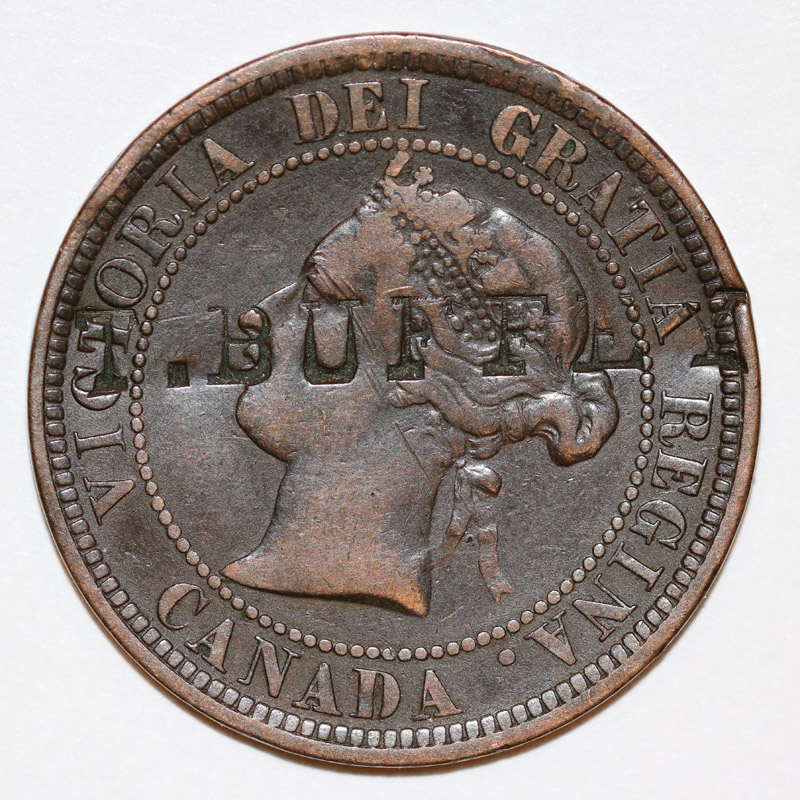 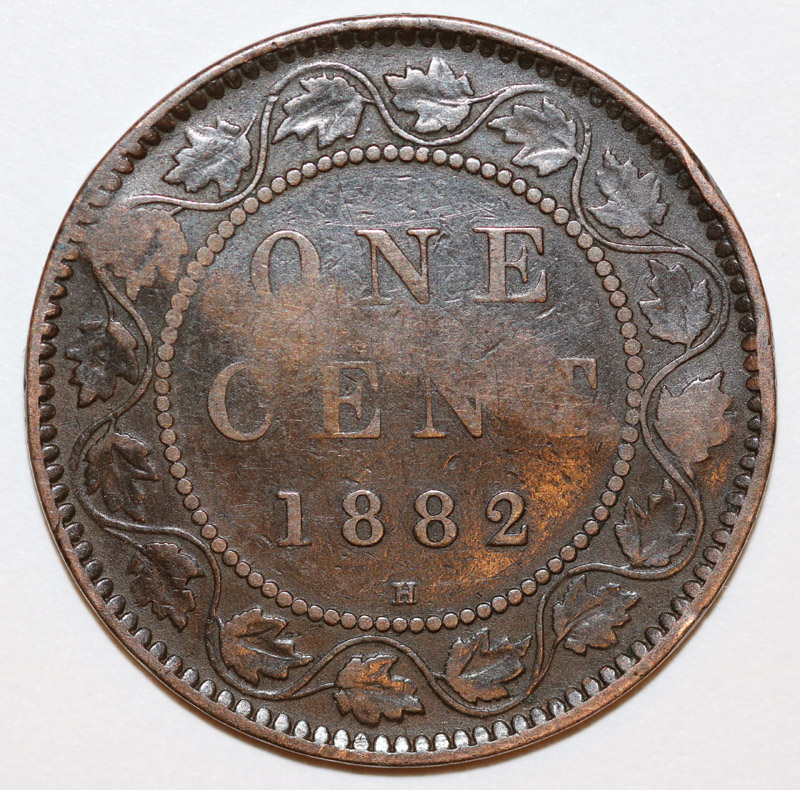 |
|
|
|
Valued Member
United States
419 Posts |
Interesting, Buffey is not listed in Brunk.
|
|
Moderator
 United States
198004 Posts |
Very interesting!  |
|
Pillar of the Community
 United States
1101 Posts |
I've tried looking up a possible first name for the T. on internet searches, and the only one that I've had any luck with was Thomas Buffey. I've seen several, including one from the Ontario area about the right time. Didn't see any occupation listed for him though.
I imagine a lot of counterstamps remain mysteries.
|
|
Pillar of the Community
United Kingdom
709 Posts |
Maybe T Buffey was from the USA.
In the UK in the mid 19th century advertising stamped on coins became quite a problem, so various Acts of Parliament were passed banning it. These Acts only covered current coins of the realm. The result was that advertisers imported foreign bronze coins, stamped them and circulated them. These coins were largely French 10 centime coins from the time of Napoleon III, because these coins were about the size of the British penny. The key point is that the drive to stamp the French coins didn't originate in France.
Was this Canadian coin found in the US? Were there similar US laws which would make an American advertiser stamp a Canadian coin?
If this stamped coin was circulated in the US, what US coin would it have replaced? Would it have been economically viable? The French 10c coins were imported into Britain at 252 to the pound. Circulating them as pennies would have made a profit of 1 shilling in the pound as well as doing the advertising.
By the way, re the comment from dar76124, what is "Brunk"?
Edited by Anaximander
02/26/2024 1:43 pm
|
|
Valued Member
United States
419 Posts |
Merchant and Privately Countermarked Coins: Advertising on the World's Smallest Billboards by Gregory Brunk (2003-01-01) Out of print I believe but still available from Amazon although at a high price. |
|
Pillar of the Community
United Kingdom
709 Posts |
I found a reference on the net that shows from 1879 when the US returned to the gold standard, until 1914, the CAD and USD circulated at par. So circulating a marked Canadian coin in the US was viable.
I found a copy of Brunk on Abe books, but at nearly £400 including shipping, that is not economically viable ( for me ). Looked very interesting.
Edited by Anaximander
02/26/2024 2:33 pm
|
|
Pillar of the Community
United States
1101 Posts |
Quote:
Was this Canadian coin found in the US? It was purchased by me in the US. Of course in it's 142 years there's no telling where it has traveled. There were also some Thomas Buffey's I found in the UK, so it could have been counterstamped there as well. |
|
Pillar of the Community
United Kingdom
709 Posts |
I found details of a Canadian book which may help you. Apparently only 150 copies were produced so cost might be prohibitive.
Marked Impressions: A Catalogue of the Joseph Foster collection of 19th century Canadian countermarked coins
Warren Baker
Montreal 2006
2 volumes, text and plates
Anyone on this forum have a copy?
I am waiting for a book on British countermarked coins to arrive in the post. When it does, if it has anything relevant I will let you know.
|
|
Pillar of the Community
United States
1101 Posts |
Thanks Anaximander. I appreciate the help!
|
|
Valued Member
United States
419 Posts |
I found a copy of "Marked Impressions" at a somewhat reasonable price (I seem to be collecting numismatic books now) and there is no Buffey in there either. We may never know the origin.
|
|
Pillar of the Community
United Kingdom
709 Posts |
I looked in :
British Countermarks on Copper and Bronze Coins
J Gavin Scott
No mention of your countermark, and no mention of a Canadian coin.
|
|
Pillar of the Community
United States
1101 Posts |
Thanks dar76124 and Anaximander for checking those resources!
As you said, we may never know who this T. Buffey is.
|
|
Pillar of the Community
 United States
1503 Posts |
Here's a longshot or Buckley's Chance: Perhaps the grandson of William Buffy, Philip T. Buffey, became the owner of William Buffy's tavern at some time before or near the date of your coin; and perhaps Philip used his middle name instead of his first name (as some are known to do); and perhaps T. Buffey stamped coins for his tavern. Philip T. Buffey (Canada 1876-1959), son of George M. Buffy (Canada 1827-1900), son of William Buffey (Canada 1798-1873) Source: https://freepages.rootsweb.com/~rcj...f.html#15081Then there's this: "Brampton, Ontario", a.k.a. "Village of Brampton" a.k.a "Buffy's Corners" Source: https://www.thecanadianencyclopedia...cle/bramptonAnd this: Prior to 1834, the only building of consequence at the corner of Hurontario Street and the 5th Sideroad (now Main and Queen Streets in the centre of Brampton), was William Buffy's tavern. In fact, at the time, the area was referred to as "Buffy's Corners". Most business in Chinguacousy Township took place one mile distant at Martin Salisbury's tavern. By 1834, John Elliott laid out the area in lots for sale applied the name "Brampton" to the area, which was soon adopted by othersSource: https://en.wikipedia.org/wiki/History_of_Brampton |
|
Pillar of the Community
United States
4433 Posts |
I'm late to the party on this posting. I've not before seen this T. BUFFEY counterstamp. There were many c/s's issued in that province. That said, many New Englanders, typically residing in border states, stamped Canadian coins. The Ontario carpenter who died in 1887 is a distinct possibility, but there are others. Presently, this piece looks like a maverick to me, yet to be positively attributed. A great many of the 19th century men whose name appears as a c/s were metalsmiths and/or masons. If they didn't create a stamp themselves, a fellow mason would do it for them. The stamp could then be utilized for a commercial purpose or simply personal use, such as marking their tools or other property. Many a mason carried a pocket piece, being a stamped or engraved coin to be shown to others; this, as a conversation starter, a form of brotherly introduction. Eventually, die struck, official-looking Chapter Pennies, often personalized with a member's name, were utilized.Thus, a carpenter, bricklayer or other simple laborer might possess a masonic penny ID, a badge of sorts. A good way to research pieces like this is to do a google search for "T. BUFFEY" .... "THOMAS BUFFEY" .... "TIMOTHY BUFFEY" in 19th century books; and, in this case narrowing the time from say 1870 to 1910 or so. Then, try attaching words to each name, like "PATENT" .... "MASON" .... "MASONIC" .... This method boils down to trial and error. Another approach would be "BUFFEY, THOMAS" or "BUFFEY, T" .... attaching the word "DIRECTORY" or "GAZETTEER"- This method has often helped me derive a first name from a simple initial. That said, some solutions have taken me a decade or more to solve!  Good luck, Randy!     I'm rootin' for ya! |
|
Pillar of the Community
United States
1101 Posts |
Thanks igwt79 for the suggestions to check out. I'll do some studying on the links you provided.
ExoGuy, Those are great tips on how to go about researching this counterstamp. I'm going to keep working on it. You know you are the reason I got interested in counterstamps in the first place. Your posts on this forum are always interesting and informative. I decided to get in on the fun. Thanks Bill.
|
| |
Replies: 21 / Views: 1,878 |




 Posted 02/25/2024 2:48 pm





