| Author |
 Replies: 13 / Views: 1,045 Replies: 13 / Views: 1,045 |
|
|
New Member
United Kingdom
10 Posts |
There is a coin being offered for sale on an auction site that is identified as being from Ionia Greece around 650 BC and is bronze - were bronze coins around this early ? Thank you.
|
|
|
|
Moderator
 United States
34575 Posts |
Hmm good question. I thought that those very early coins were all electrum, but I certainly could be wrong. Can you please provide a link to the auction? Thx.
"If you climb a good tree, you get a push."
-----Ghanaian proverb
"The danger we all now face is distinguishing between what is authentic and what is performed."
-----King Adz
|
|
New Member
 United Kingdom
10 Posts |
I'd rather not post a link to the site but I did try posting a picture of the coin but this site says file is too big - I also thought they were all electrum at that time - I've asked them to double check their listing.
|
|
Moderator
United States
34575 Posts |
For what it is worth, here is another person's opinion: Quote:
Period III. B.C. 413-346. The defeat of the Athenians was fol- lowed by an extraordinary outburst of artistic activity on the part of the great Sicilian cities, especially Syracuse. Syracuse and Agrigentum now issued their magnificent dekadrachms. The following names of engravers, among others, occur on coins of this period: at Syracuse, Euainetos, Kimon, Eukleidas, Parmenidas; at Agrigentum, Myr...; at Camarina, Exakestidas; at Himera, Mai...; at Messana, Kimon, Anan (?)...; at Naxus, Prokles; and at Catana, Herakleidas, Choirion) and Prokles.
One of the most striking peculiarities of Sicilian coins is the frequency with which personifications of Rivers and Nymphs are met with. Thus on coins of Himera the type is that of the Nymph of the warm springs; on a coin of Naxus we see the head of a river Assinos (probably the same as the Akesines); at Catana we get a full-face head of the river Amenanos; at Gela and Agrigentum we see the rivers of those towns, the Gelas and the Akragas; while at Camarina the head of the Hipparis appears. On the coins of Selinus the rivers Hypsas and Selinos are represented as offering sacrifice.
In the archaic period the Sicilian rivers usually take the form of a man-headed bull, but in the transitional and fine periods they more often assume the human form, and appear as youths with short bulls' horns over their foreheads.
Among the nymphs represented on Sicilian coins are Himera, Arethusa, Kyane (?), Kamarina, and Eurymedusa.
The Carthaginian invasion at the close of the fifth century spread ruin through the island and put an end to the coinage almost every- where. Syracuse alone of all the Greek silver-coining cities continued the uninterrupted issue of her beautiful tetradrachms and dekadrachms, and it was these which served as models for the Siculo-Punic currency of the Carthaginian towns.
It was probably at the beginning of this period that gold and bronze coins were first struck in Sicily, at any rate in considerable quantities. At the time of Dion's expedition electrum was also introduced, and at Syracuse a large bronze litra was issued, the size of which shows that it was intended as real money and not as a token of artificial value. https://snible.org/coins/hn/sicily.html#117"If you climb a good tree, you get a push."
-----Ghanaian proverb
"The danger we all now face is distinguishing between what is authentic and what is performed."
-----King Adz
|
|
New Member
United Kingdom
10 Posts |
Thank you - I appreciate the assistance.
|
|
Valued Member
United States
227 Posts |
I'd like to see examples of bronzes from that time. I know of AV/AR/EL, but I don't know ancients all that well.
|
|
Pillar of the Community
United States
2365 Posts |
SiHawks, you could copy paste the coin here, someone may know it's time period. Did the auction place provide a reference number? I looked at my Sear reference books, I looked at Lydia, Ionia and other areas like Athens, Syracuse, Aegina etc. The oldest Greek bronze/copper coins I saw date to 4th cent. BC. There are some major reference books online and in some Libraries. You could contact the American Numismatic Society or British Museum, ask them. The coin may not be 650 BC, likely newer. I have a collection of ancient Greek coins that date 4th-1st cent BC. I've posted some on CCF. Edited by livingwater
06/14/2025 10:49 pm
|
|
New Member
United Kingdom
10 Posts |
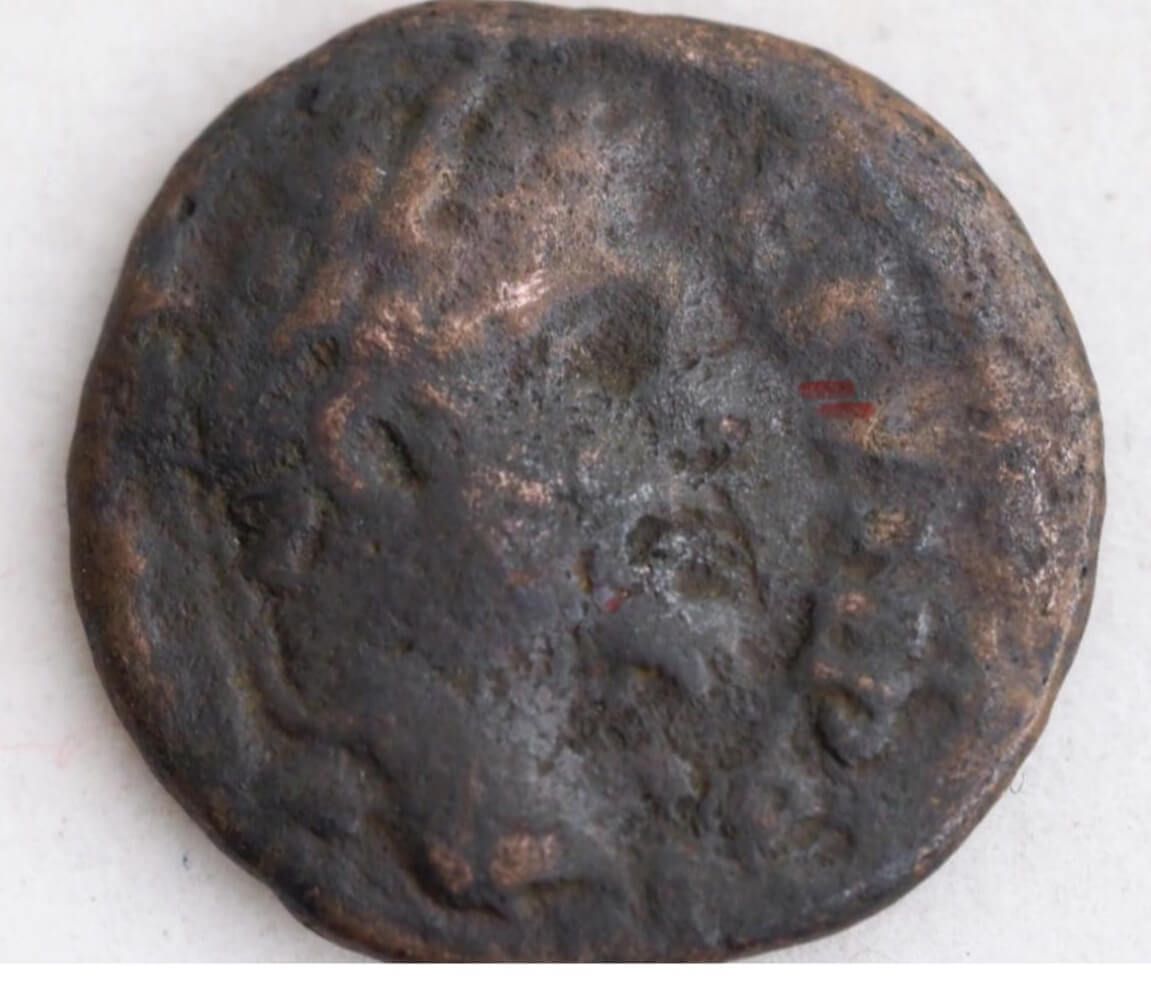 This is the coin - finally worked out how to reduce size ! |
|
Pillar of the Community
United States
2365 Posts |
That looks Roman to me, one of the emperors, not Greek, not 650 BC. It's very worn and pitted, not worth much. You can buy cheap ancient bronze coins on Vcoins.com and from dealers in UK and on ebay. Some ancient coins on ebay are genuine, some are fake, so buy from honest dealers that allow returns. A pic of the reverse may help further ID it, but honestly not worth buying or the time to ID it in my opinion. Edited by livingwater
06/15/2025 09:07 am
|
|
Moderator
United States
34575 Posts |
100% agree @liv. This piece appears to have an inscription to the right of the bust which places it later than 650 BC.
"If you climb a good tree, you get a push."
-----Ghanaian proverb
"The danger we all now face is distinguishing between what is authentic and what is performed."
-----King Adz
|
|
Pillar of the Community
Russian Federation
5186 Posts |
 likely Roman, with that beard probably 2nd or 3rd century. I'm not good at portraits and can't read enough lettering so not sure who specifically that is. [EDIT: if I had to guess, the legend looks a bit like SEV IMP so it might be Septimius Severus - which was my guess in the first place except I didn't think he did much bronze.] I hope they have pics of the other side. But unless it's a very rare emperor, and/or a very rare type, it's probably hardly worth anything as it's in pretty bad condition. |
|
Moderator
Australia
17035 Posts |
Quote:
... identified as being from Ionia Greece around 650 BC and is bronze - were bronze coins around this early ? Thank you. Short answer: no, not in the Greek world. The Chinese were making bronze monetary objects that early, but were not yet making "coins". Bronze coins did not appear in the Mediterranean until the Sicilian colonists started making them circa 400 BC. When they did appear, they didn't have writing around the portrait like that - that's definitely Roman or at least Roman-inspired. Conclusion: the Auction house in question doesn't know what they're talking about. Or they've just copy-pasted a consignor's description and the consignor doesn't know what they're talking about. Don't say "infinitely" when you mean "very"; otherwise, you'll have no word left when you want to talk about something really infinite. - C. S. Lewis
|
|
Moderator
United States
34575 Posts |
Maybe Cunningham's Law?
"If you climb a good tree, you get a push."
-----Ghanaian proverb
"The danger we all now face is distinguishing between what is authentic and what is performed."
-----King Adz
|
|
Pillar of the Community
United States
3370 Posts |
Coins from 650 BC don't have lettering like that.
"Two minutes ago I would have sold my chances for a tired dime." Fred Astaire
|
| |
Replies: 13 / Views: 1,045 |
|







 Posted 06/14/2025 1:08 pm


