Coin Community Family of Web Sites Join Thousands of Coin, Bullion, & Money Collectors
Join Thousands of Coin, Bullion, & Money Collectors Royal Canadian Mint products, Canadian, Polish, American, and world coins and banknotes. Specializing in Modern Numismatics 300,000 items to help build your collection! Vancouvers #1 Coin and Paper Money Dealer Coin, Banknote and Medal Collectors's Online Mall Shop for APMEX Bullion on eBay!


Username:
Password:
Save Password
Forgot your Password?


This page may contain links that result in small commissions to keep this free site up and running.

Welcome Guest! Registering and/or logging in will remove the anchor (bottom) ads. It's Free!

Die Chips And Cracks

To participate in the forum you must log in or register.
Author Previous TopicReplies: 15 / Views: 717Next Topic  
Pillar of the Community
Pete2226's Avatar
United States
3330 Posts
 Posted 10/26/2025  10:03 am Show Profile   Bookmark this topic Add Pete2226 to your friends list Get a Link to this Message Number of Subscribers
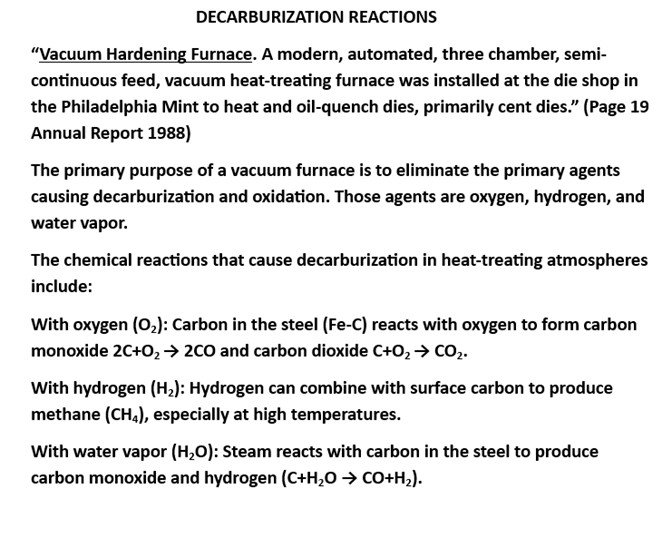
Decarburization is a major contributor to die chip and crack formation during coin striking. The process of decarburization severely weakens the surface of the die, making it highly susceptible to the fatigue cracking that leads to chipping and cracking under the repeated, high-stress impacts of the coining press.

Die Chips and Cracks typically begin in the softer, decarburized surface layer before propagating into the harder core of the steel. The interface between the soft outer layer and the hard inner metal acts as a stress concentration point, which further encourages chip and crack formation.

BACKGROUND:
Decarburization can create distinct zones of varying carbon content and hardness, with a fully decarburized, soft outer layer transitioning to a partially decarburized zone and finally to the hard steel core. This abrupt change in hardness can lead to stress accumulation at the boundaries and serve as a starting point for cracks.

Carbon is used in die steel as a hardener. The Mint uses Steel Alloy 52100 (1% carbon) for dies for small denomination coins and Steel Alloy L6 (0.70% Carbon) for quarter size and up coins.*

Decarburization of the die steel during heat treatment is often connected with unusual or erratic die wear.

Decarburization significantly reduces the hardness, strength, wear resistance, and fatigue life of these steel alloys by lowering the carbon content on its surface. This creates a soft, weakened layer that is more susceptible to wear from striking. The soft, decarburized layer can lead to plastic deformation at the root of a notch without crack initiation, but it also creates internal stresses and potential chip and crack formation during the striking process.
Chromium in a steel alloy increases its corrosion and oxidation resistance, hardens it, and improves its strength, toughness, and wear resistance. Since the Chromium content of Steel Alloy L6 (Chromium 0.70%) is half the Chromium content of Steel Alloy 52100 (Chromium 1.40%), L6 is more highly susceptible to the negative effects of decarburization.

Metallographic analysis, by the Mint, of sections of the dies routinely shows about 25.4µ to 101.6µ depth of decarburized steel at the outer surface of the die. **

FOOTNOTES:
*STEEL ALLOY COMPOSITION:
-- 52100: Carbon 1%, Silicon 0.25%, Manganese 0.30%, Chromium 1.40%, balance Iron.
-- L6: Carbon 0.70%, Manganese 0.60%, Silicon 0.25%, Chromium 0.70%, Nickel 1.40%.

** George E, Hunter, Ph.D. Assistant Director for Technology, Department of the Treasury, US Mint, Letter to Ken Potter, February 26, 1986

ABOUT DIE DEGRADATION:
Although some maintain that, during striking, any degradation of the condition of the die should be labeled Die Deterioration, I maintain that where the primary source of the die degradation is contact with an element or byproduct of the striking process, the result should be labeled as Die Damage and that where the primary source of the die degradation is the properties and/or composition of the die steel, the result should be labeled as Die Deterioration.

DIE CHIPS AND CRACKS TODAY
Many collectors today regard most die chips and cracks as being too minor to hold collectible interest, while others maintain growing collections and are willing to pay premiums. In fact, some premiums paid are outrageous enough to expose a collector who is inexperienced and gullible!

We have seen this frenzy before in the 1960s and there were even books and monographs published (The Classification and Value of Errors on the Lincoln Cent, [The Encyclopedia of Fidology], By Jean Cohen, 1967, 1969, Published by Jean Cohen, Bonita Springs. Fla.; The BIE Handbook by Howard O. Hardy, 1965). THE VALUES EVAPORATED after the excitement left and is likely to evaporate for our time also!

We know that the mint disregards minor errors:
The Mint states, in response to a coin sent to them for examination, that: "Subtle imperfections on circulating quality coins.are inherent in the coin making process. Such slight imperfections do not affect the coin's use in commercial transactions."
"As a note on coin and die inspection, operators at the press use low power magnification (3X to 7X) to inspect coins against a visual standard. Operators focus on problem areas such as crack propagation and areas known to have high wear." (From a 2005 Letter from the Mint to Ken Potter)

We also know that the mint finds more major expressions of errors unacceptable. For example, the mint considers rotated dies unacceptable and a major error, although there is a tolerance of ±6° for business strikes and ±3° for numismatic strikes. We also know that chips and cracks at a certain level are unacceptable since approximately 75% of the dies retired from use in Schuler Presses at the Denver and Philadelphia Mints were because of chips or cracks ("Piece Out Engraving" or "Cracked").

From die life tests run by the mint, we know that dies are not retired simply because there is a small piece out of the die, or even more than one, and that coins exhibiting such are considered acceptable for circulating. Many of these that are "acceptable for circulating" are the coins of interest to many collectors today and are those most likely to see today's values evaporate!

We find numerous sources promoting these "acceptable for circulating" errors by giving them names which gives an aura of legitimacy to the error. Inexperienced and gullible collectors are enticed to pay hefty premiums for this aura of legitimacy!

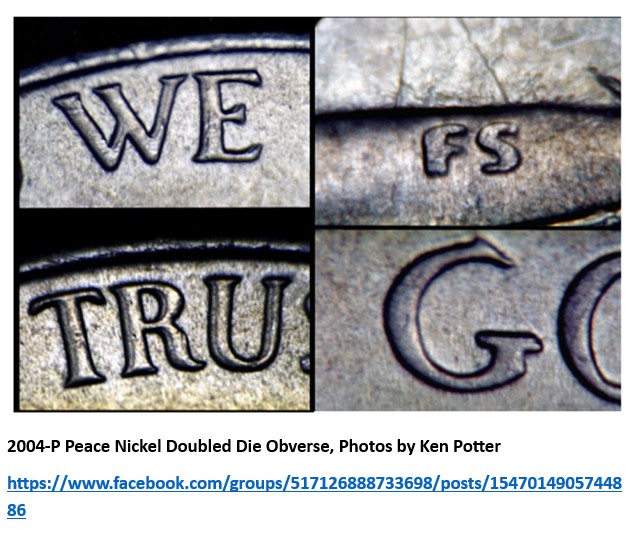
Any discussion of "acceptable for circulating" should at least mention varieties such as Doubled Dies. An added benefit for inclusion in this discussion is the availability of photos of what is acceptable for circulating:

Die-Chips-And-Cracks


Die-Chips-And-Cracks
Pillar of the Community
Learn More...
-makecents-'s Avatar
United States
8740 Posts
 Posted 10/26/2025  11:16 am  Show Profile   Check -makecents-'s eBay Listings Bookmark this reply Add -makecents- to your friends list Get a Link to this Reply

Quote:
Decarburization can create distinct zones of varying carbon content and hardness
So, are the weaker areas that we have come to notice, like the upper area of the head, going to the rim and the corners of the memorial, points that you would consider to fall under these "distinct zones"?

Die-Chips-And-Cracks

-makecents-
Pillar of the Community
Pete2226's Avatar
United States
3330 Posts
 Posted 10/26/2025  11:47 am  Show Profile   Bookmark this reply Add Pete2226 to your friends list Get a Link to this Reply

Quote:
So, are the weaker areas that we have come to notice, like the upper area of the head, going to the rim and the corners of the memorial, points that you would consider to fall under these "distinct zones"?


I understand the zones to be along the vertical axis of the die, beginning with the die surface as the most affected and softest, and transitioning towards deeper levels below the surface towards the hard core of the die.

Keep in mind that we should be thinking in microns for measurements of the zones, with about 25.4µ to 101.6µ depth of decarburized steel at the outer surface of the die.

It is within these zones, as they transition from softer to harder, that chip/crack propagation is initiated from the stresses created across the layers of transition.
Pillar of the Community
Learn More...
-makecents-'s Avatar
United States
8740 Posts
 Posted 10/26/2025  5:11 pm  Show Profile   Check -makecents-'s eBay Listings Bookmark this reply Add -makecents- to your friends list Get a Link to this Reply
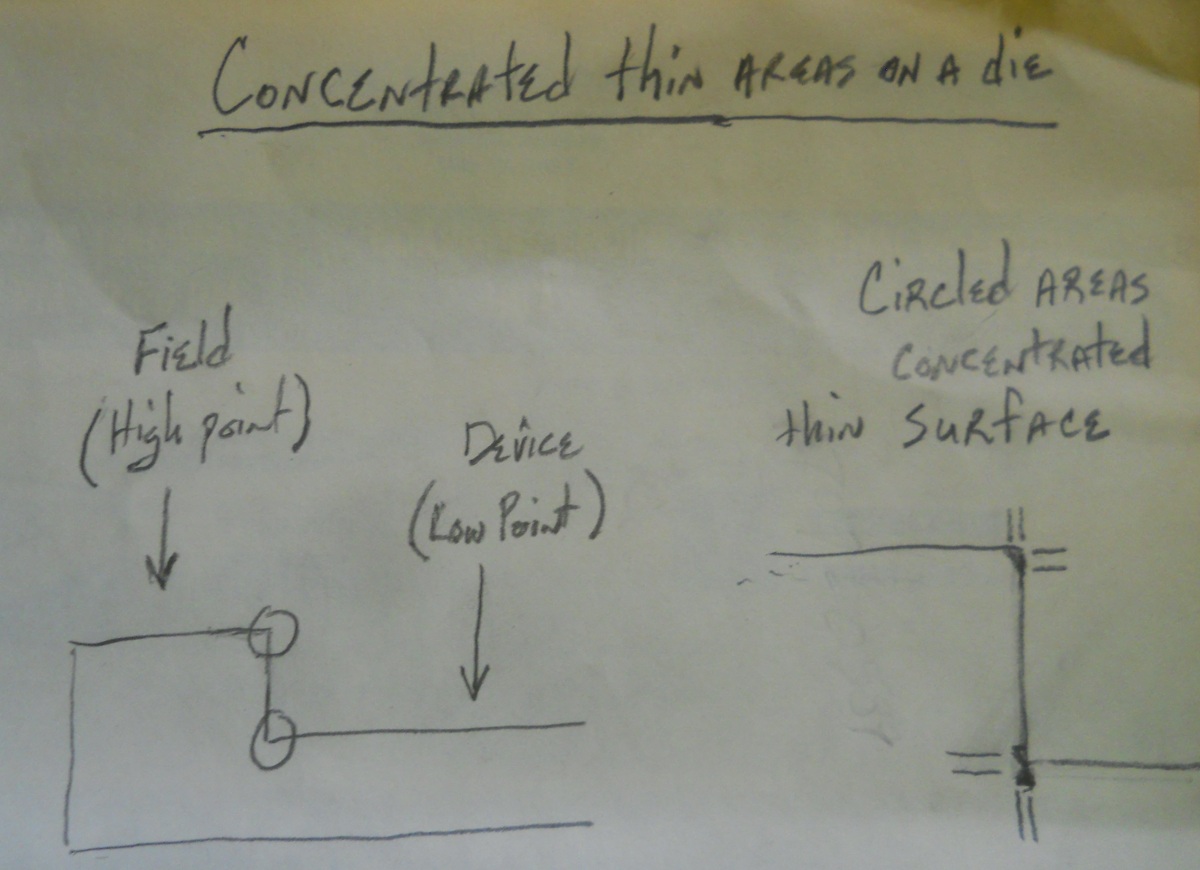
So, I have told you before, Pete, that much of what you explain is well above my head but do understand it on some lower level. Here is a simple illustration of what my thought process is, combined with yours. With the variation of the die surfaces, there are areas that in my mind, would have concentrated spots of thinness, being more vulnerable to the "decarburization", surface areas that converge in two different directions, creating this extra weakness.
See what you think.


Die-Chips-And-Cracks
-makecents-
Pillar of the Community
Pete2226's Avatar
United States
3330 Posts
 Posted 10/26/2025  5:37 pm  Show Profile   Bookmark this reply Add Pete2226 to your friends list Get a Link to this Reply

Quote:
surface areas that converge in two different directions, creating this extra weakness.


I think you are on the right track!
Pillar of the Community
United States
1248 Posts
 Posted 10/26/2025  6:00 pm  Show Profile   Bookmark this reply Add snailking1 to your friends list Get a Link to this Reply
Interesting!
Thank You for sharing that.
As I progress in my coin hunting expeditions, I am slowly understand a little bit more of what you guys are talking about - just not too much of it yet!
Moderator
Learn More...
Dearborn's Avatar
United States
95360 Posts
Bedrock of the Community
ijn1944's Avatar
United States
19134 Posts
 Posted 10/26/2025  6:43 pm  Show Profile   Bookmark this reply Add ijn1944 to your friends list Get a Link to this Reply
Very interesting conversation, yes! Not sure I agree 100% with the assertion that: some premiums paid are outrageous enough to expose a collector who is inexperienced and gullible! A collector should have their own chosen 'space' within numismatics to enjoy. Expose the gullible? I'm not so sure...
Bedrock of the Community
Learn More...
Marv65's Avatar
United States
10497 Posts
 Posted 10/26/2025  10:12 pm  Show Profile   Bookmark this reply Add Marv65 to your friends list Get a Link to this Reply

Quote:
would have concentrated spots of thinness,

Was wondering what you mean by die "Thinness" when the entire die is one piece of metal........

Die-Chips-And-Cracks
Pillar of the Community
Pete2226's Avatar
United States
3330 Posts
 Posted 10/27/2025  05:40 am  Show Profile   Bookmark this reply Add Pete2226 to your friends list Get a Link to this Reply
@Marve65

I am wondering if you have a COA for your dies and if you do would you be willing to share photos of them so I can enter the information in my database?
Pillar of the Community
Learn More...
-makecents-'s Avatar
United States
8740 Posts
 Posted 10/27/2025  08:26 am  Show Profile   Check -makecents-'s eBay Listings Bookmark this reply Add -makecents- to your friends list Get a Link to this Reply

Quote:
Was wondering what you mean by die "Thinness" when the entire die is one piece of metal........
It was in reference to the second sentence of the OP's intro.
Quote:
The process of decarburization severely weakens the surface of the die, making it highly susceptible to the fatigue cracking that leads to chipping and cracking under the repeated, high-stress impacts of the coining press.
Along with the crude diagram I made, where low and high points of the die face come together and create an even weaker area. Sorry I did not draw the entire cylinder for you, did not think it was necessary for the illustration.
-makecents-
Pillar of the Community
Pete2226's Avatar
United States
3330 Posts
 Posted 10/27/2025  09:59 am  Show Profile   Bookmark this reply Add Pete2226 to your friends list Get a Link to this Reply
I think the diagram by @makecents is helpful! (I may use it with appropriate credit!) It illustrates a process that has a more involved explanation:

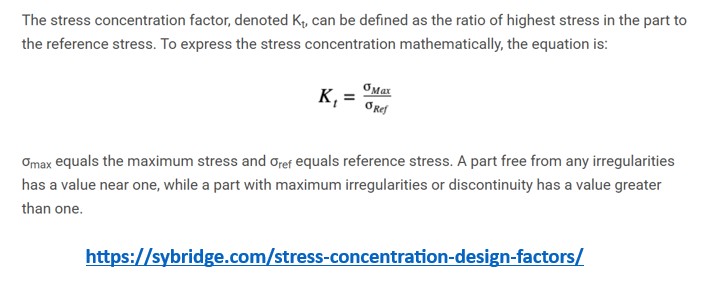
Stress Concentration

A stress concentration is a point in the part design where stress is significantly higher than in the surrounding area. Stress concentrations are most commonly caused by an abrupt change in the part's geometry, typically around sharp corners, holes, notches, or grooves.

Stress concentrations are also more likely to occur in parts with complex or sophisticated designs. Even though unique geometric shapes can increase the overall performance of the part, they also cause tortuous load transfers and increase the likelihood of stress concentrations.

When a part has stress concentrations, it is more likely to fail in two ways. First, the part tends to fail directly from the stress concentration, which typically results in cracks. Second, even if the part does not get a noticeable fracture, stress concentrations may dramatically shorten the product lifecycle by weakening the part over time.

When the strata of die metal in which stress concentrations are focused is a softer stratum, the described effects are even more likely.


Die-Chips-And-Cracks
Edited by Pete2226
10/27/2025 12:08 pm
Moderator
Learn More...
jbuck's Avatar
United States
187950 Posts
 Posted 10/27/2025  12:27 pm  Show Profile   Bookmark this reply Add jbuck to your friends list Get a Link to this Reply
Very interesting topic and thank you for sharing all the data!
Pillar of the Community
Pete2226's Avatar
United States
3330 Posts
 Posted 10/27/2025  12:34 pm  Show Profile   Bookmark this reply Add Pete2226 to your friends list Get a Link to this Reply

Quote:
Very interesting topic and thank you for sharing all the data!


Thank YOU for your support!
Pillar of the Community
Learn More...
-makecents-'s Avatar
United States
8740 Posts
 Posted 10/27/2025  7:59 pm  Show Profile   Check -makecents-'s eBay Listings Bookmark this reply Add -makecents- to your friends list Get a Link to this Reply
Bump for Marve to see if he understood.
-makecents-
Pillar of the Community
Learn More...
-makecents-'s Avatar
United States
8740 Posts
 Posted 10/27/2025  9:57 pm  Show Profile   Check -makecents-'s eBay Listings Bookmark this reply Add -makecents- to your friends list Get a Link to this Reply
Guess not....
-makecents-
  Previous TopicReplies: 15 / Views: 717Next Topic  

To participate in the forum you must log in or register.


Disclaimer: While a tremendous amount of effort goes into ensuring the accuracy of the information contained in this site, Coin Community assumes no liability for errors. Copyright 2005 - 2026 Coin Community Family- all rights reserved worldwide. Use of any images or content on this website without prior written permission of Coin Community or the original lender is strictly prohibited.
Contact Us  |  Advertise Here  |  Privacy Policy / Terms of Use

Coin Community Forum © 2005 - 2026 Coin Community Forums
It took 0.44 seconds to rattle this change. Forums