| Author |
 Replies: 15 / Views: 3,156 Replies: 15 / Views: 3,156 |
|
|
Pillar of the Community
United States
1372 Posts |
I am new to this forum, because of the last of many disagreements with a "Know it all" Administrator of another forum. I want to discuss how the rims of some coins come to look like this. I have examined the coin with an eyepiece which is actually the lense of an old microfiche reader (remember those?) Seems Phineas J Whoopie can see solder on it....except there is no solder. He claims that it's been mounted in some kind of mount intended to be used as jewelry. Gee whiz...it's an uncirculated Morgan dollar. I guess whoever got the jewelry didn't care much for it. He also "knows the motivation of every seller on ebay". Frankly, while you can tell I am still angry, I am glad to not be frequenting that site anymore. I m not a moron, and don't appreciate anybody with no respect for me....demanding respect OF me. Having dismissed the theory that this is post mint damage, what conditions exist in the coining process that lead the rim of a coin to look like this. I have seen other examples of this, and the areas are always 180 degrees apart, or diametrically opposed, whichever you prefer. Mr Whoopie's assertion is that nothing in the minting process can cause this. I say that a damaged die can and does cause the denticles to appear "smashed" on some coins, and I have a lovely 1834 large cent that has the most hideous rim you've ever seen, reminiscent of this coin, but with about 50 percent of the rim affected. Nice guy too.....after kicking me out of his little forum, he "lays down the gauntlet" saying if I submit it to a TPG and it comes back in a holder and graded....not slabbed as "genuine"...that he'll pay for the grading. Notice that was done AFTER I was excused. The membership of that little snake pit doesn't even know I told them all off and asked that my account be locked, so they look like heroes....I look like the chump. What say you seasoned collectors? I know there are folks here who have seen this condition. I've seen it more than once myself. Sorry about the venom....I'll wait while you clean up.  Chancellor Sutler 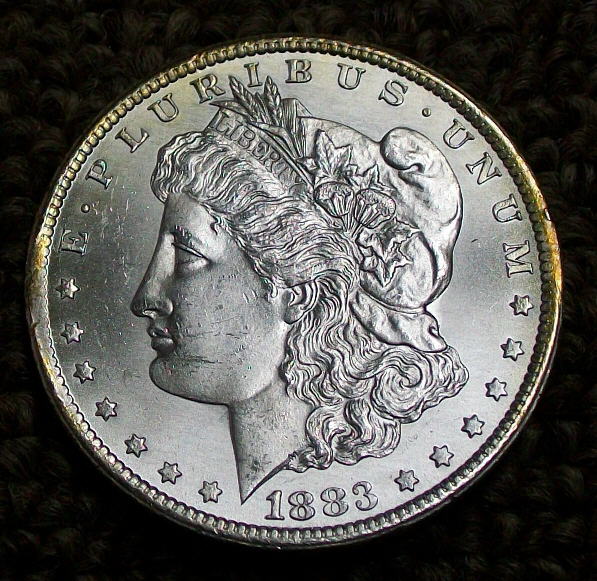 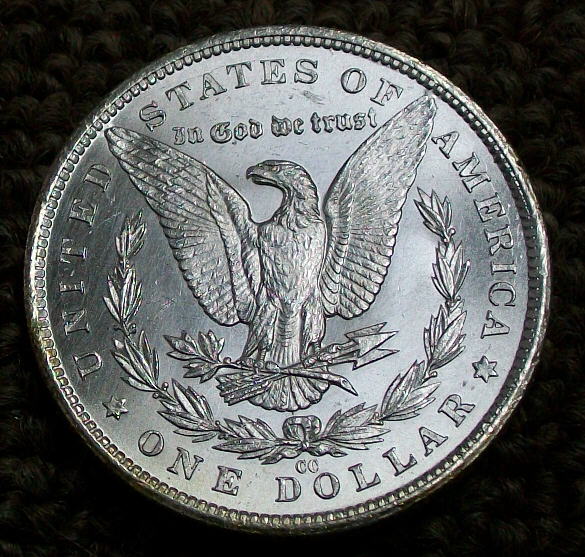 |
|
|
|
Pillar of the Community
United States
2532 Posts |
 I'll be standing by to see what the experts have to say. This is a family friendly forum with alot of nice folks. I imagine you'll get several responses with different opinions as to what's going on with this coin. I'm wondering why the color variation in the affected parts of the rim. |
|
Pillar of the Community
United States
532 Posts |
Can we ask for a picture that is more raw. Even maybe a picture of just the side profile where the rim has the issues?
|
|
Pillar of the Community
 United States
1372 Posts |
I'll take some more pictures after I grab a bite to eat. That picture was taken with a Kodak easy share 100 dollar camera. It has not been enhanced in any way. What you can't see, is that there is toning on more of the periphery of the coin than what shows up in these images. Because of the differing angle and light refraction, it's emphasized in those areas, but look closely, it goes all the way around the top edge of the coin.
Chancellor Sutler
|
|
Pillar of the Community
United States
1372 Posts |
I am having a devil of a time getting good close up images of the rim. I will continue to work on it, but check this shot out. The edge of this coin is not completely square. Was the damage caused during ejection from the die, or could the collar have been defective? Chancellor Sutler 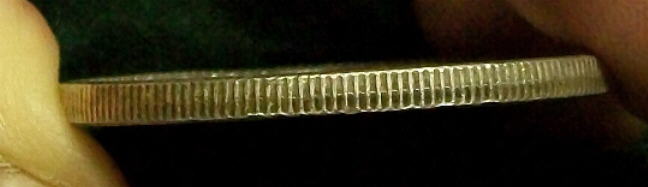 Edited by Chancellor Sutler
12/20/2009 7:04 pm
|
|
Moderator
 United States
23522 Posts |
Welcome to Coin Community. Their loss is our gain.  I will preface my comments with the statement that it is never possible to draw a conclusion with 100% certainty from a photograph, however good it may be (and yours ain't bad). OK. We have 4 possibilities for "oddness" in a coin: Mint equipment (including dies), Mint process (misfeed, clashing, broadstrikes and the ilk), planchet irregularities, and post-mint work/damage. I'll address them individually. I believe we can discount the first. Dies included the denticles, and it's unlikely that a die with weak denticles would have passes inspections at both Philadelphia and Carson City. Only 20 Carson City die pairs were produced for 1883; we can be pretty certain that nothing odd slipped through. Chancellor Sutler, the difference between your 1834 Cent and this coin is that the collar was not in use in 1834; without the collar, the rim crumbling your Cent shows a much more common feature. Crumbled denticles with Morgans are a much less common error, and almost always show at the inside of the denticles unless the die is physically broken. An error in the minting process seems unlikely. This is a powerfully-(and evenly-)struck coin; improper pressure certainly seems out of the question. A Grease Fill remains within the realm of possibility, but for that to be true, the collar would have had to hold the grease against striking pressure since the fill is at the very outside of the die. I kinda doubt it could do that, but a certain observation we'll discuss in a moment can address this. The likely candidate, if this is a "real" error, is in the planchet. The mention you make of "180 degrees apart" is the result of a clipped planchet on one side and the Blakesley Effect on the other - it is commonly noted (first by Blakesley who loaned his name to the process) that the exact opposite of a clip is weakly struck as well. Your coin seems to show this phenomenon, to an extent. I see weakness outboard of the M in UNUM opposite the denticles in question. The same effect seems to show, more weakly, on the reverse near the N in UNITED and the RI in AMERICA - is the reverse slightly rotated? The existence of the Blakeley Effect is a strong argument in favor of a "true" error. It's very difficult to fake. However, this would have to be a very weak clip indeed for it to only be prominent on the obverse. The fourth possibility is that the coin has been used (or was attempted to be used) as jewelery. A mount which touches the coin in only two spots could conceivably cause it to look like this, but I don't believe it would be used in conjunction with solder - pure mechanical clamping power would be the method, and if it were soldered it would likely have been soldered at each side. It's not out of the question that, carefully handled and not circulated afterwards, a coin could be in MS64 condition but for a jewelery mount. Coins don't wear quickly around someone's neck. A very careful examination of the rim would likely solve the problem. A clipped planchet should show thinning in that area, where solder would likely cause it to be thicker. If this is a small clip, at least some reeding should still show with relative sharpness; I think solder would have gotten in there and obscured the reeding, at least a little, had this been the case. Chances are a Grease Fill would also obscure the reeding here somewhat - if the coin seems to be otherwise of normal diameter and shape, yet the denticles and reeding are obscured in that one spot, I think it'd lend credence to the theory of a Grease Fill. So your job, should you choose to accept it, is to undertake a very detailed study of the rim at 9:00 Obverse. With enough magnification, solder will show a joint, somewhere. It won't flow into the silver without a dividing line. If a clip, I expect the thickness to be lesser here. My current theory (subject to change with more information)? I think it's a very minor clip, and a "real" error for that reason. Edit: You posted the rim pic while I was composing this. Is that the rim at exactly the point I asked about? |
|
Pillar of the Community
United States
1372 Posts |
That picture was taken of the edge of the coin at 3 o'clock, but the phenomena completely encompasses the coin. When you tilt it in the light, it appears to almost be split in 2. It's not split, and there's no solder anywhere on this coin. The eyepiece I am using is 50X....so I would see it. Here are a few more pictures of the coin. My photography skills are limited, and I don't know if you can glean anything else from these shots....but I'll include them anyway. There are actually4, but it won't upload 2 of them. Stay tuned while I try and figure out why. Chancellor Sutler. 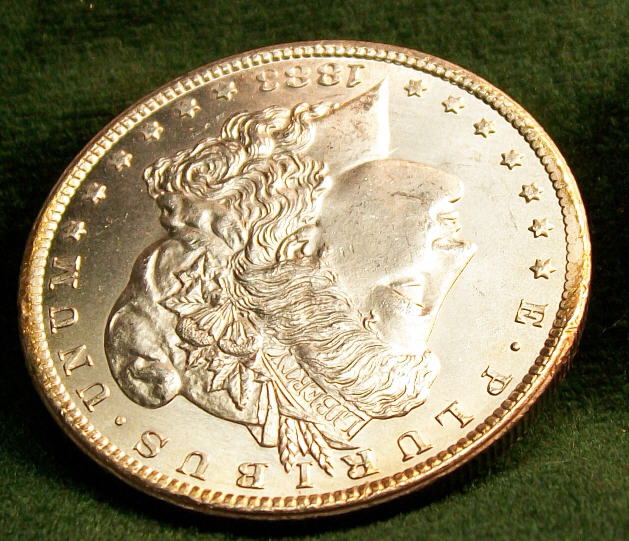 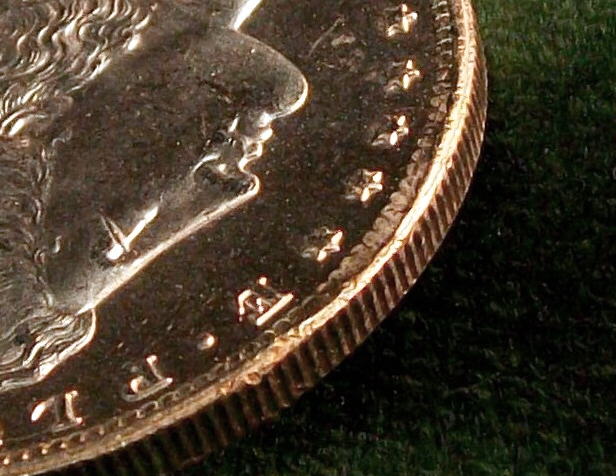 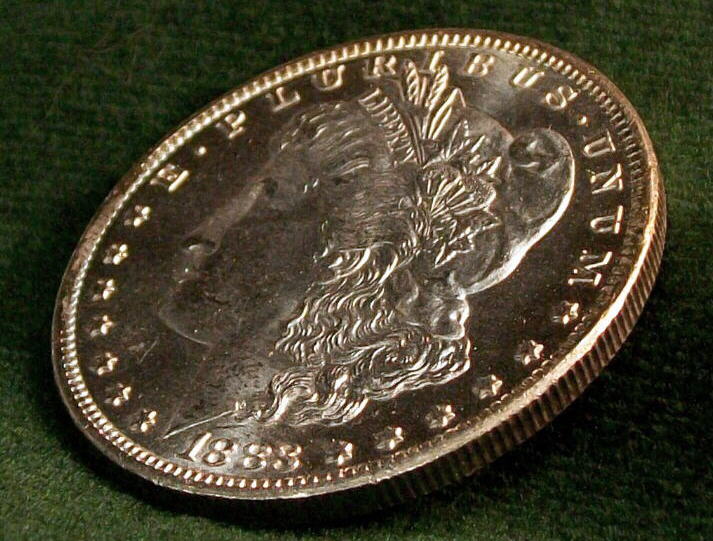 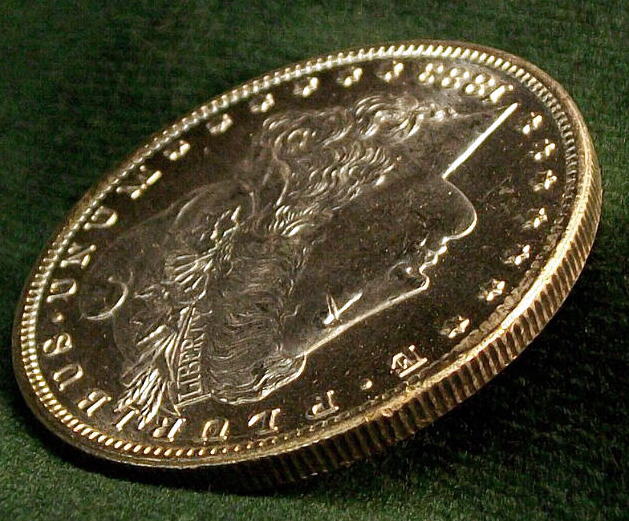 Edited by Chancellor Sutler
12/20/2009 6:23 pm
|
|
Moderator
United States
23731 Posts |
to the community, I can't comment on the error, but I can say that's a very nice coin that I would grade at MS-64. |
|
Moderator
United States
23522 Posts |
The first of the new pics looks very much to me like a minor clip, and nothing like a jewelery piece. Let me do some research regarding the line in the reeding.
|
|
Pillar of the Community
United States
1372 Posts |
I believe that it would go at least 63, and that the anomally would not keep it from grading. I could be wrong. Mr Whoopie said it was worth "melt" because it's scrap. He's one of these guys who thinks that nobody ever gets anything off ebay that's any good, because only Coin Dealers have good material. I've spent a year decimating that theory. I bought an 1850 Seated dollar for 150 dollars that NGC graded AU58, and have made more good buys on there than you can shake a stick at. Twice during the past year I have bought 1921 Peace dollars for under 20 dollars....and one of those was under 15 dollars! ...AND Thanks for the warm welcome. I appreciate that. Chancellor Sutler Edited by Chancellor Sutler
12/20/2009 6:46 pm
|
|
Pillar of the Community
United States
1841 Posts |
Perhaps "Mr Whoopie" suspects that this is a forgery made from transfer dies because of the seam along the edge. I'm assuming the dimensions and weight are correct, so he believes it is silver and thus worth only scrap value.
|
|
Pillar of the Community
United States
1841 Posts |
...or maybe I should have read the opening thread better.  Now I'll just be quiet and let SuperDave run with this. Welcome to the forum! |
|
Pillar of the Community
United States
1372 Posts |
He never saw the edge of the coin. His premise was that it was post mint damage...period, and thereby worthless. He'd been "packin' wood" for me for weeks. I finally had enough. Feel free to delete that expression if you find it offensive.
I did check the weight a bit ago, and it's spot on 26.7 grams, and I was actually hoping it would be a whisper light. It may actually...but my scale only reads tenths of a gram rather than hundredths.
Chancellor Sutler.
Edited by Chancellor Sutler
12/20/2009 8:09 pm
|
|
Pillar of the Community
United States
1372 Posts |
I measured the thickness of the coin at 9 o'clock and it is thinner. It measures .103 inches, while the unaffected areas of the rim measure .110 inches.
Chancellor Sutler
|
|
Pillar of the Community
3660 Posts |
I don't have the decades of experience looking at coins that many here have, but please allow me to interject some thoughts, since it does not seem that this thread has gone anywhere in a while, and I find it highly interesting.
While I do very much like Dave's notion of planchet clips, I have other ideas as well.
The collar is tapered on the inside (like the inside of an ice cream cone) as we all probably know.
The dies are concave at their faces, as we also know. They are also of varying relief at their fields, being created from convex hubs of nearly (but not completely) perfect proportion.
Occasionally, a pressure test or press maintenance (to address an issue with a particular press) will occur. To avoid die clash, it would not be practical to have both lower and upper dies in place for this event, and since the lower die acts as the anvil and does not move during strike anyway, it would be the logical one to remove.
Imagine the upper die (unrestricted by a lower die or planchet) lowering abruptly into what? The collar. The portion of the upper die that will contact the collar is the recessed corner of the die face (the portion of the die that shapes the rim of a coin).
The portion of the collar that will be contacted by this sharp corner of the upper die will be the inner tapered portion.
Ultimate collar clash. Result: indentation encircling the entire inner diameter of the collar.
Result for a coin struck using such an affected collar: As shown above in the rim shot photo. (The perceived 'seam' under the reeding).
As for the effect of funky rims, I have the following idea:
The press that struck the dollar size coin was quite dissimilar to the presses that struck lesser coins. Rather than the collar serving as the ejection vehicle for the stuck coin, the collar is fixed on this particular press and the lower die raises approximately 1/8th of an inch through the collar to eject the coin after strike.
The relief of opposing concave die fields could cause a planchet to 'teeter' (naturally grabbing, or favoring, two opposing points in the collar), especially if rotation became a factor, or if one of the dies was poorly proportioned.
Imagine a round planchet being squeezed between two dies at a plane less than 'perfectly' level, while wedged inside a perfectly level collar.
Due to this teetering, escaping gases (the goldish discoloration byproduct of the intense heat caused by striking, and excess silver will escape through the two directly opposing openings between planchet and coin (inherently caused by die relief imperfections).
Sorry if that was long winded and poorly explained view of the way I see things, but there it is, such as it is.
|
|
Pillar of the Community
3660 Posts |
I think that I like Dave's clip theory better than what I was thinking, and it is a lot simpler also. I am still very interested in the 'seam' in the reeding though. If my guess is correct, this same phenomena should appear on other 1883cc of the same variety. Do anyone know what VAM this is? |
| |
Replies: 15 / Views: 3,156 |
|




 Posted 12/20/2009 4:32 pm





