| Author |
 Replies: 118 / Views: 8,975 Replies: 118 / Views: 8,975 |
|
|
|
Pillar of the Community
United States
2669 Posts |
I don't think it's a clash mark, it's the place where the die failed because it was clashed there too many times. Smack it with that G 20-50xx times and a piece falls out. Could have been a bubble under there which would tend to lean the shape that way, or could have been the shape of the G (or just the opposing die) smack-banging at a weak spot right at the neck edge until it finally gave. Maybe what they are calling rust pitting is leftover teeny pieces from these chunks breaking away - particles get stuck on the die faces. (no, I'm not looking to re-open that rust debate) Think of a Cud.. only on the inside of the die rather than the edge. And actually, it *is* on an edge.. a design edge. Just some thoughts.. I'm tired so probably rambling. |
|
Pillar of the Community
United States
3076 Posts |
I have been searching for my saved overlays, to see exactly what feature is clashed in this questioned area, for both OVS and REV, the coin in question, for discussion is the 1891-0 VAM 1a1,1a2 and 1a3 for comparison.. and also to see as the point in questioned defect is o n the reverse, to know the Obverse area as well...I have too much crap on my machine,, but will find it so we can discuss this area and possible causes...Gene |
|
Pillar of the Community
3660 Posts |
Whether we come to agreement or not on a cause, I like the fact that you have an open mind and are thinking with it xshift. I like that a lot.
Good man Gene. Evidently you were able to pick up on what I was trying to say earlier. I had doubts that anyone would.
|
|
Moderator
 United States
23522 Posts |
Straight from VAMworld, 1991-O VAM-1A3: Quote:The raised dome from the VAM 1A2 stage has now ruptured forming a fairly large break along its left side. Tell me that's a cracked die. I dare you. The concept that "repeated clashing has caused die failure" is comical. Dies don't fail leaving soft edges. Zeewool, yours is the first reasonably though-out opinion I've heard on the subject. You may not be right, but your idea makes a lot more sense that a cracked die leaving a soft edge (as in the '03-O 4A). |
|
Pillar of the Community
3660 Posts |
Gene, I really hate to do this while you are searching for something on my account, but I am very, very tired and sleepy. I had a horrible day, I got my feathers ruffled early and showed my rear, took me all day to smooth out those tail feathers..... at one point I thought Dave was going to eat me (because I am crunchy and taste good with mustard......actually, I might taste pretty good even without mustard if I do say so myself). Anyway, I will try to hang for another five minutes and wait for you. Please don't be mad at me if I can't live up to that promise though.
|
|
Pillar of the Community
3660 Posts |
A very happy ending to a long, bad day Dave. THANK YOU.  |
|
Pillar of the Community
United States
3076 Posts |
First one must identify the area, in this case, I think all can agree is a common reverse "arc'ed" clash in the wreath area, arcing into the center or curved towards the center...Pic 1 an 1887 just for a common reference point of a commonly seen reverse clashing. 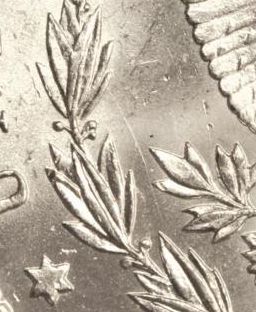 now I would point out as I look at an overlay, and this one is of the 7.2 degree's rotation, really does not influence the arc for point of reference.. the ARC is a known clashing feature. not a major feature but a re-occurring feature....LET US ALSO remember, that all the lettering and OBV and REV above the "minted" coins are actually below the surface level of the coin die, or "recessed" within the die...... I don't mean top waste time, but simply include a lot of the areas or why's which this one topic covers...this topic covers not only clashing but I will use the term "die failures" for this thread only... At this point we have only established one thing for the reverse: that this arc is a found in many vams.....Me being stupid, will now introduce the overlay.... 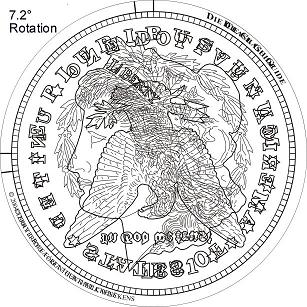 now for the life of me, I can't see where the "ARC" which IS an OBV impression from clashing showing up on the reverse die... SO from the many here, who also understand more than I, I would like to know how the "arc" or where it comes from...its not apparent from the overlay....From there we can look upon the other issues |
|
Pillar of the Community
United States
2669 Posts |
Quote:
comical Sorry.. I said from what it sounds like, but probably should have specified I was paraphrasing. goodnight sleepy zee.. here's hoping feathers stay unruffled tomorrow. night all |
|
Pillar of the Community
United States
3076 Posts |
the fact is, this clash on the reverse is a normal occurrence... its not comical. but the basis of this discussion.....If you haven't grasped that its ok..
|
|
Pillar of the Community
3660 Posts |
I copied the picture, blew it up, tried to put a crude clash ring on it, didn't work very well, I couldn't see what I was trying to do. On the previous page, I suggested separate papers for obverse and reverse, then using a compass to draw a clash line over the ovaloid, and then transfer that same clash ring to the other paper. Somehow, just typing this, makes me think that it would be an exercise in obvious futility. Why go searching for something that I know (beyond any reasonable doubt) just isn't there?
|
|
Pillar of the Community
3660 Posts |
Thanks xshift, and thanks Gene. Catch you all later.
zzzzzzzzzzzzzz, snort, snort, zzzzzzzzzzzz, snort, snort, zzzzzzzzzzzzzz
|
|
Pillar of the Community
United States
3076 Posts |
The answer to the arc, is...its the nose line, from the forehead to the end of the nose..for you that have been wondering...So lets proceed to step two....My reasoning is this: this specific area in question of the 1891-0
can not have other areas of question....so by identifing the "ARC" as a known occurrance we can get down to business:: we can agree here on this point....the nose clash causes the ARC for the 91-0....
the real point is this...the term "OVALOID" is in question...Meerley for the name or description, "or" for discussion of the cause.... the facts I bring are this....
the nose clash is highly prevalent among many years....Meaning many dies have clashed in many minted years, that do not show the 91-0 phenominum..Ya I cant speeel... since I have shown....the area is a known clashed area from many years....the 91-0 year is specific, and "must be die related".....So to step 3 we go.....
the cause is within the die.......I will leave this here...
|
|
Bedrock of the Community
Australia
21792 Posts |
You VAM guys would go well at some Numismatic Department of a major museum. That sort of attention to detail is just what is required in die linking studies with ancient coins. |
|
Pillar of the Community
United States
3076 Posts |
Thanks so much!,,,the reason we search is to know why, when major or minor questions are asked and explained, with big loop holes we wish to understand....
|
|
Pillar of the Community
3660 Posts |
Quote:You VAM guys would go well at some Numismatic Department of a major museum.  That might be true for some of the guys here, but I must take personal exception to that notion......Endowed with an extremely short attention span, a low IQ, and a ridiculously quick temper, my first day in a museum would surely end in tragedy as I threw coins and artifacts, breaking glass and physically attacking coworkers in fits of rage. I am also of very small stature, so my biggest concern would be retaliation from those who might choose to go beyond frowning on my actions.......Nope, no museum work for me. I am lucky that I am not yet banned as a mere visitor. edited for spelling Edited by zeewool
09/16/2010 09:25 am
|
| |
Replies: 118 / Views: 8,975 |








 First Page
 Previous Page


 Posted 09/15/2010 11:46 pm


