| Author |
 Replies: 49 / Views: 5,219 Replies: 49 / Views: 5,219 |
|
|
|
Pillar of the Community
3660 Posts |
Dave and Terry, I really am not sure if your words are aimed at me or not, or if your words are those of encouragement or admonishment.....If the former, I thank you and hold you in higher esteem than the rest of the pack, if the latter, it is okay anyway, as I like you guys......Russ, I am sending you an email in hopes that I can regain your email address....I have something to share with you (for your benefit) and hope that you might share with your idiot friends whom I will not lower myself to respond to.
Clarification: No idiots on this site....they congregate on another site.....and the term 'idiots' is not derogatory in this case, rather, it could be taken as a compliment.
Edited by zeewool
11/20/2010 3:02 pm
|
|
Pillar of the Community
  United States
1551 Posts |
 OK Zee |
|
Pillar of the Community
3660 Posts |
No need Russ, I have found your email and have sent you some truthful information that you have obviously been denied elsewhere..... Either come to grips with the reality of which I speak or continue laughing.
|
|
Moderator
 United States
23522 Posts |
It is intuitively obvious that the "system," as it is, lacks the solid, logical foundation imperative to properly collating what will ultimately be the largest single body of numismatic research ever accomplished. I do not say this by way of denigrating the efforts already put forth; life must be reckoned in context or it is missed entirely. If there was a Genesis mistake, I believe that mistake was an honest underestimation of the ultimate breadth and depth of what would ultimately accumulate. It is frustrating, though. Each day that goes by without the realization of these fundamental flaws at the highest levels compounds the difficulty of wrenching the existing database into some semblance of order. Worse are the arguments raised like, "well, the TPG's would have a fit if we did it." This isn't about the TPG's, it's about the coins. The TPG's should not be able to dictate anything.I'm not saying I believe we are always right when we question the existing way of doing things. We're not. But we are right to question it. Without change, there will soon come a day when the panoply of VAMs will be completely incomprehensible to everyone involved. Order and structure previously lacking must be imposed. Decisions need to be made. It's a shame that we have to offer opinion at such a vituperative level to get any attention at all. Nobody would need to express themselves with any sort of contrariness if their opinions were welcomed with an open mind; such is not the case. It is a fundamental flaw in any scientific reasoning system to accept *anything* as axiomatic. Question everything, most importantly your own stipulations. As of yet, I'm not sure the "powers that be" are even aware of the contents of the list of what they should be understanding, much less having an actual understanding of those things. They're accepting, not questioning. |
|
Pillar of the Community
3660 Posts |
You read my mind Dave, every thought, every emotion......I only wish that I had the way with words that you do.....unfortunately, I am destined to be nasty, blunt, and rude to get my point across, (but you've already pointed that weakness of mine out). Thanks for understanding.
Post that picture of the 'crack through the B' over here Russ.
|
|
Pillar of the Community
3660 Posts |
Never mind....here it is.....Die break, die crack, planchet flaw or not sure? This should be good experience for us.....take note of the metal displacement in the crack (if any).....take note of the metal blobs in the crack (if any).....take note of the flaking along the crack (if any).....take note of whether or not the crack extends into the rim....take note of what actually is the rim, and what is the edge (reeding)....There shouldn't be anyone who isn't absolutely sure about all of this and exactly what you are looking at. 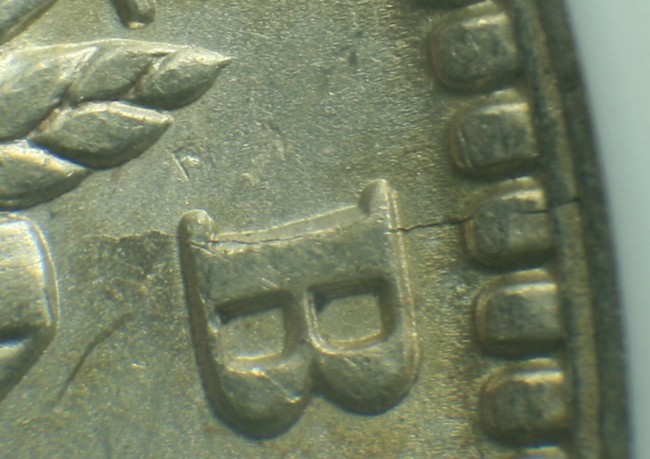 |
|
Moderator
United States
23522 Posts |
I have my opinion, but choose to reserve comment until I find out whether I'm arguing for or against.  |
|
Pillar of the Community
United States
1551 Posts |
Here you are Zee. Very good job on your layout BTW 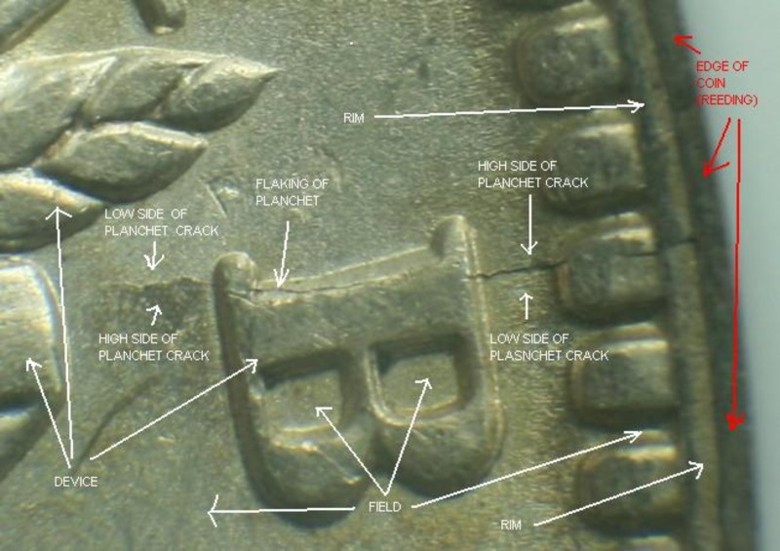 |
|
Pillar of the Community
United States
1551 Posts |
I have been married for a long time folks. according to my wife I am never right unless I agree with her. So I have an open mind, That is why I asked the question. I have found a few new types and one was a new or never logged or listed die and am over the "I Need To find One" I now look with a different perspective. It has been a fun and frustrating time since Dec. A lot of learning, and I have asked more than my share of stupid questions. But I will always ask, if someone ever calls me stupid it will be because I do not understand "not because I am not willing too ask and listen.  Edited by twohawks
11/20/2010 5:10 pm
|
|
Pillar of the Community
3660 Posts |
Thanks Russ.....You are a true gentleman, and I am very proud to call you my friend.
An honest opinion would be enough Dave, although I am quite sure that you know very well what this is.
By the way, there is another area of flaking between the B and the dentil.
|
|
Moderator
United States
23522 Posts |
As you said, zeewool, it's pretty obvious.
I'm left a Question of the Day, though:
Where does the metal which fills a specific device originate, on the planchet? Does it sit still, and the fields are "moved" metal, or vice versa? Does it all move?
A planchet starts flat, and ends up not-flat. Something has to move somewhere.
|
|
Pillar of the Community
3660 Posts |
Okay, I swear that you are messin' with me again Dave, and just in case this is a trick question, I will answer in all honesty as I see it.....like this:
Who says that the planchet is flat to begin with? It starts out on the draw bench in the form of a silver sheet, it is then stamped out into a circle plug (planchet) slightly larger in diameter than the die collar, it is then upset until it is slightly smaller in diameter than the collar, then it is annealed, then a sulfuric acid bath (this I believe might key to your question), and then riddled (dried) in sawdust.... planchet flatness is not really a concern before going into a coin press delivering that much pressure, rather softness of the planchet should be a greater concern. If a planchet has an inherent crack in it, would it not be possible that this crack may cause the planchet to appear less than flush on either side of the crack depending on the vector and depth that the crack penetrates the surface of the planchet? I liken this planchet flaw to be more akin to lamination than is the accepted numismatic definition of lamination......In other trades, lamination is the layering of similar or dissimilar materials.....kinda like shale rock....it is layered or laminated in horizontal cracks rather than the vertical cracks that we associate with coin dies......Anyway, once this crack is manifested in the planchet, no amount of pressure transferred by the press is going to weld that crack back together.....the planchet does not liquify and flow as some may understand it, rather the planchet enters the press as a solid and remains in that state through the strike and press ejection....'Displacement' is far better term to understand and use than 'flow'....if the planchet metal flowed, it would be liquid, and would leave the press in that state as well...the planchet metal is displaced (or 'moved'), and that movement is not going to weld an inherent crack......the crack will remain (in most cases associated with surface of the planchet anyway)....
The crack remains, and there is no reason to believe that this thin laminated type of silver will not raise or lower as it goes through life. Liken it to chipping or peeling paint....once the separation is manifested, there is no return to solidarity.
Yes, it all moves (as you well know)....as the steel dies move closer to each other during strike, the soft silver planchet metal is compressed at the fields of the dies and subsequently displaced into the die devices, (and) outward toward the rim......The area of rim and edge reeding is a relatively large void and requires extra planchet metal to fill in that void, and that is the rationale for upsetting the rims of the planchet.
Did I do okay?
edited to add:
I believe that the planchet both entered and left the press in state of flatness.....it is that area on either side of the crack that lifts its thin skin and reflects light to the appearance of being not flat (displaced fields).
Edited by zeewool
11/20/2010 6:04 pm
|
|
Moderator
United States
23522 Posts |
I arrived at the question while wondering why an obvious planchet flaw would not appear "complete" at the highest points of the devices. Yes, wear blending could be a factor with the pictured coin, but all the same I was left wondering in what directions metal flows during the striking process to reach the destinations we see. It was a segue, not directly connected to the specific coin at hand. Keep foremost in mind when answering my questions, zeewool - my attention span is measured in nanoseconds, exacerbated by the fact that I know I only need a moment to understand something new, and I know I don't have to remember it if the Internet can remember it for me. So, I really "know" very_darn_little about these details, in the sense that the verb "know" is related to the verb "remember." |
|
Pillar of the Community
3660 Posts |
Yeah, well I see you as an extremely intelligent individual Dave....most folks never will catch on to some concepts, despite attention spans as wide as the Grand Canyon. Mine is quite short as well....but I have a good memory, and I rely heavily on it. VAM attribution is simple memorization (if a person can believe what is dished out as fact). I learned and still remember, all known CBH varieties through concentrated memorization in a little less than two weeks, so I imagine that I could do so with a good many vams as well if I wanted to, and if I can do it, anyone can......I have seen chimpanzees adapt quite well to memorization techniques.....so I am not all that impressed with variety experts who can do little better than identify, yet still not understand the hows and whys....I think that is what separates us from the animals....(the ability to reason).....I was reminded today on another site that some of us have it, and some of us don't. By the way, I would think that metal 'flows' as does electricity (taking the path of least resistance).....an area that is being compressed, such as between two die fields, would obviously be quite resistant to an additional influx of matter, while a void (device, rim and collar area) would be far more appealing for all of those little silver atoms to find a happy home. Overall compression of the silver planchet (as a whole) will begin when all voids are filled, and it all happens in the twinkling of an eye (or maybe over a long period of time to someone with your hyper-limited attention span)...  Edited by zeewool
11/20/2010 7:10 pm
|
|
Moderator
United States
23522 Posts |
So how does one take an 1880-O VAM-6 variant, and wrench it into a logical scheme? We've already stuffed VAM-6A into another cubbyhole with a totally different number. Why does the same logic not apply to 1878, or 1896 (drawing random numbers from my head)?
|
| |
Replies: 49 / Views: 5,219 |







 First Page


 Posted 11/20/2010 3:22 pm





