Coin Community Family of Web Sites
Shop CCF Members on eBay! Coin, Banknote and Medal Collectors's Online Mall Vancouvers #1 Coin and Paper Money Dealer Specializing in Modern Numismatics 300,000 items to help build your collection! Royal Canadian Mint products, Canadian, Polish, American, and world coins and banknotes. Shop for APMEX Bullion on eBay!


Username:
Password:
Save Password
Forgot your Password?


This page may contain links that result in small commissions to keep this free site up and running.

Welcome Guest! Registering and/or logging in will remove the anchor (bottom) ads. It's Free!

The Secret Greek Euro Mintmarks

To participate in the forum you must log in or register.
Author Previous TopicReplies: 15 / Views: 11,925Next Topic  
Moderator
Learn More...
Sap's Avatar
Australia
16806 Posts
 Posted 09/12/2006  9:42 pm Show Profile   Bookmark this topic Add Sap to your friends list Get a Link to this Message Number of Subscribers
I had the opportunity to go through a bunch of nearly-uncirculated euro coins, thanks to a generous donation to a missionary group I'm involved with - whenever someone donates a coin collection to them, it's my job (as "the coin guy") to try to value it and sell it on their behalf.

In the process of going through these coins, I learned something about some little-publicised "varieties" within the Greek euro series. When making e-mail enquiries with QNS member Ben "the Euro Guy" as to what they might be worth, he said (almost as an aside) "And then of course the Greek coins come in two varieties." They do? It was the first I'd heard of it. And so the story unfolded...
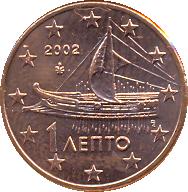
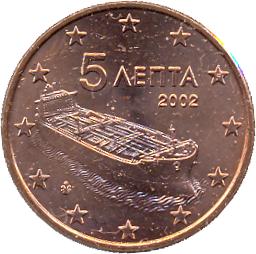
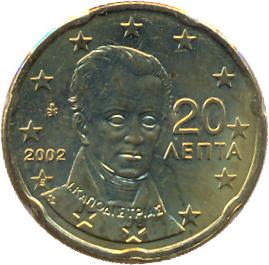
The-Secret-Greek-Euro-Mintmarks The-Secret-Greek-Euro-Mintmarks The-Secret-Greek-Euro-Mintmarks
Some Greek euro-coins: 1 cent/lepton (ancient trireme), 5 cents/lepta (modern supertanker), and 20 cents/lepta (John Kapodistrias).

Euro coins and notes are, theoretically, issued by the European Central Bank. In practice, it's the treasury departments of the various member-states that decide how many coins and notes should be issued, though the ECB retains the right to veto any member-state it feels is getting a little enthusiastic with the currency issue. Greece, however, was a latecomer to the euro - their economy was too "basket case" for the ECB to accept absorbing it. When approval to join the Eurozone was finally granted, only a year prior to the launch of the euro, the Greeks had a problem making their allotted quota of 1.3 billion coins.

As a result, Euro coins with Greek designs ended up being produced in several other European mints - exactly which mints were responsible was officially some kind of state secret, but according to several websites I found, the mints employed were The Royal Mint in Spain (mintmark "E") and the national mints in France (mintmark "F") and Finland (mintmark "S"). Other informants (such as Ben) suggested E for Spain, F for Stuttgart (Germany) and S for the Netherlands. Apparently the Greek mint and national bank were reluctant to admit its inability to perform this Herculean task, and ordered the supplying foreign mints to conceal the mintmarks indicating country of origin. There's certainly no mention of them on the official Hellenic Mint or Bank of Greece websites.

The marks can be tricky to spot, but for any collector of Spanish coins, the technique is familiar: they're hidden in the stars. (see QNS Magazine, #164, March 2000). There are 12 stars on the reverse of Greek euro coins, at the positions of the numbers on a clock face. For the foreign-sourced Greek euro coins, the location of the mintmark is in one of the stars closest to the date. Specifically, the mintmarks are found in the following locations:

1 and 2 euro: "S" in 6 o'clock star, separating date digits
50 eurocent: "F" in 8 o'clock star, above date
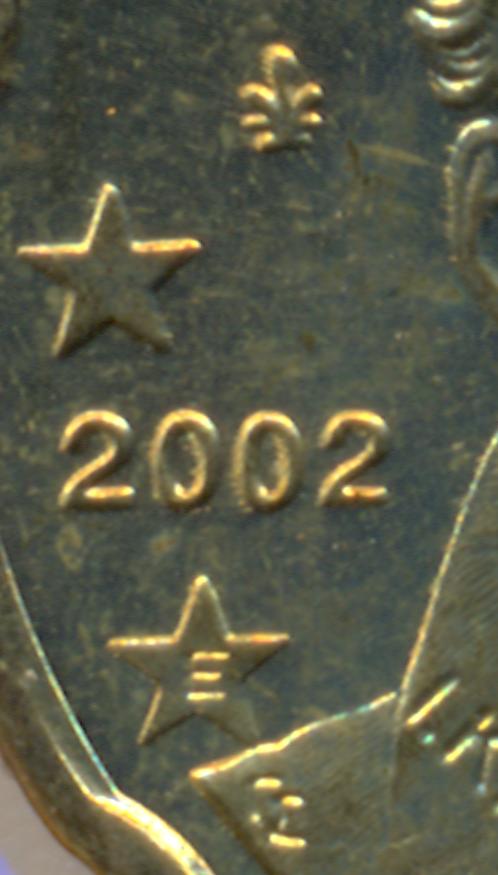
20 eurocent: "E" in 8 o'clock star ,above date
10 eurocent: "F" in 8 o'clock star, below date
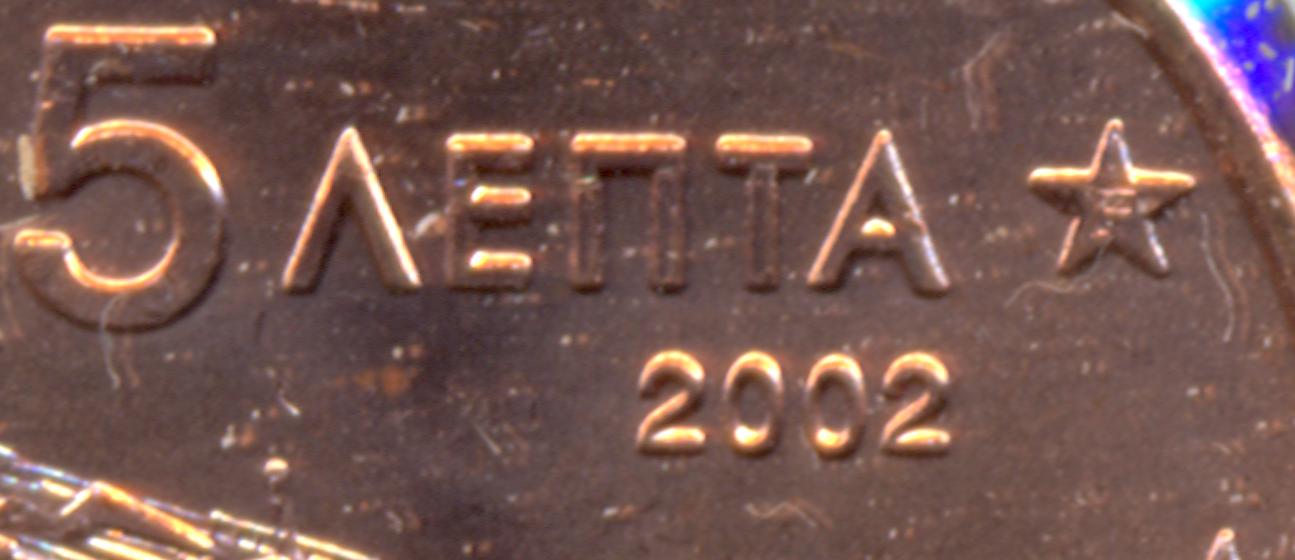
5 eurocent: "F" in 2 o'clock star, above right of date
2 eurocent: "F" in 2 o'clock star, below right of date
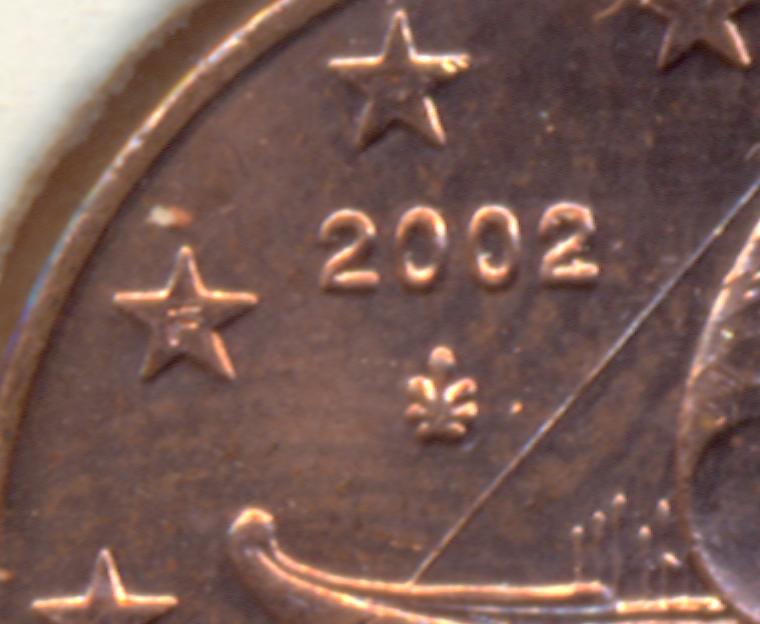
1 eurocent: "F" in 10 o'clock star, below left of date
The-Secret-Greek-Euro-Mintmarks
Mintmarked 1 cent: F in star below-left of date. Anthemion below date.

All the Greek coins, with and without the secret marks, bear the privy mark of the national Bank of Greece, a stylised anthemion flower somewhat resembling a fleur-de-lys. It can also be seen in some of the enlarged scans of the mintmark areas of Greek euro coins accompanying this article.
The-Secret-Greek-Euro-Mintmarks
Mintmarked 5 cents: F in star above-right of date.

Unfortunately, while the latest (2006) Krause catalogue mentions the secret mintmarks and their relative abundances, it gives no details as to what they mean, what mints they stand for, and why they were placed there.
The-Secret-Greek-Euro-Mintmarks
Mintmarked 20 cents: E in star below date. Anthemion above date. The 'Greek-GS' monogram of Georges Stamatopoulos, designer of the Greek euro coins, can also be seen below the "E" star.

These mintmarked coins may well be among the scarcer "regular issue" euro coins - that is, not counting the largely "for collectors only" euros of the Vatican City, Monaco and San Marino. While by no means "rare" (except by the ebay definition!), they still command a premium over unmarked Greek coins. According to Krause, while mintages for regular unmarked Greek euros are all over 100 million per denomination, mintages for the mintmarked coins are:

2 euro: 6 million
1 euro: 15 million
50 eurocent: 18 million
20 eurocent: 26 million
10 eurocent: 24 million
5 eurocent: 18 million
2 eurocent: 18 million
1 eurocent: 15 million

Compare this mintage with that of the much more highly publicised and therefore more highly sought after 1c and 2c of Finland:

2 cent: 1999 1.8 mil, 2000 13.9 mil, 2001 .5 mil, 2002 .6 mil, 2003 6.8 mil
1 cent: 1999 8.1 mil, 2000 7.6 mil, 2001 .5 mil, 2002 .6 mil, 2003 6.8 mil.

Needless to say, I was pleased to find a whole bagful of secret-mintmarked Greek euro coins in my hoard. Sadly, there weren't any 1 euro or 2 euro coins amongst them, so I'm still lacking one letter to complete my set of secret Greek mintmarks.

References:
E-mails with Ben
European Central Bank FAQ website
Fleur-de-Coin coin website
Krause Standard Catalog of World Coins, 33rd ed. (2006)


Edited to add: This article was first printed in the Queensland Numismatic Society Monthly Magazine, Issue #235 (February 2006)
Don't say "infinitely" when you mean "very"; otherwise, you'll have no word left when you want to talk about something really infinite. - C. S. Lewis

Edited by Sap
09/14/2006 01:56 am
Valued Member
habiru001's Avatar
United States
236 Posts
 Posted 09/13/2006  02:06 am  Show Profile   Bookmark this reply Add habiru001 to your friends list Get a Link to this Reply
Very interesting and informative- This makes me want to own some Euro coins. Nope as of right now-I do not own any Euro coins. I like the 1 Lepton- I will be going to the Albuquerque show Oct 7th & 8th- and to be sure, I will be looking for especially the 1 Lepton or 5 Lepta- I love ships.- This was a great show last year with over 100 tables- CoinWorld show schedule says 97 tables for this one- IT is a great show. Dewey
Valued Member
grouse12's Avatar
New Zealand
227 Posts
 Posted 09/13/2006  03:15 am  Show Profile   Bookmark this reply Add grouse12 to your friends list Get a Link to this Reply
This is a great thread sap. Thank you for posting it. I agree with Dewey this makes me want to get some euros!!!
Pillar of the Community
toast's Avatar
Australia
1091 Posts
 Posted 09/13/2006  08:46 am  Show Profile   Bookmark this reply Add toast to your friends list Get a Link to this Reply
Thanks SAP, that is excellent information...just what I was looking for. I'm thrilled!


Whooo Hooo! I found one! A 20 euro cent with an E.


So am I correct in thinking that it's only on the 2002 coins these marks will be found on the Greek coins?
Edited by toast
09/13/2006 09:10 am
Pillar of the Community
Australia
853 Posts
 Posted 09/13/2006  11:17 pm  Show Profile   Bookmark this reply Add Bigfella to your friends list Get a Link to this Reply
You are correct Toast
Valued Member
valutarick's Avatar
Netherlands
376 Posts
 Posted 06/28/2007  9:28 pm  Show Profile   Bookmark this reply Add valutarick to your friends list Get a Link to this Reply
The Belgian 1 ct 1999 comes in 2 varieties: small stars and large stars touching the rim of the coin...

The Italian 10 eurocents is marked with letters CM. You have large CM and small CM at edition 2002...

In the Finnish 1 and 2 euro 2007 there are letters above the lake and under the flowers which do not appear on other issues...

The Greek 1 euro 2005 appears with metal bloops in the eyeballs or without metal bloops: does the owl have pupils or not in his eye-sockets...

This year 2007 the Treaty of Rome delivers 13 countries with a joint commemorative. Slovenia is far most the expensive of the bunch.

Edited by valutarick
06/28/2007 9:30 pm
Valued Member
bh8006's Avatar
United States
75 Posts
 Posted 01/12/2008  6:12 pm  Show Profile   Bookmark this reply Add bh8006 to your friends list Get a Link to this Reply
Is there a web site with a comprehensive list
of know Euro varieties?
Valued Member
Jdgarst0720's Avatar
United States
259 Posts
 Posted 01/31/2008  11:39 am  Show Profile   Bookmark this reply Add Jdgarst0720 to your friends list Get a Link to this Reply
I have a set of these with and without mint marks! The Greek euros are very nice!

John
Valued Member
Ireland
498 Posts
 Posted 01/31/2008  11:53 am  Show Profile   Bookmark this reply Add josie to your friends list Get a Link to this Reply
Is there a web site with a comprehensive list
of know Euro varieties?


Not that Ive seen any site comprehensive for euro variety they are from one site to another.

http://www.fleur-de-coin.com/coinfo....asp?TID=747

Most of euro collector are in this site,Ive just joined in.

http://www.euroswapper.com/forum/index.html
Rest in Peace
Learn More...
jgfindring's Avatar
United States
1380 Posts
 Posted 02/03/2009  11:06 am  Show Profile   Bookmark this reply Add jgfindring to your friends list Get a Link to this Reply
This is a great site to learn from. Read this and checked and my Greek 10, 20 and 50 cent type euros all have the secret mintmarks!
Pillar of the Community
wd1040's Avatar
United States
3098 Posts
 Posted 02/03/2009  1:06 pm  Show Profile   Bookmark this reply Add wd1040 to your friends list Get a Link to this Reply
I sent back a Greek E 20c to Europe! I hope the receiver still has it!
Valued Member
valutarick's Avatar
Netherlands
376 Posts
 Posted 02/11/2009  10:28 am  Show Profile   Bookmark this reply Add valutarick to your friends list Get a Link to this Reply
Update: Today I have received the first 2 euro-coin of Slovakia as change, as well as the 20 eurocent and 5 eurocent from the same country. These Slovakian euro's were put into circulation approximately 14 days ago.
Valued Member
United States
62 Posts
 Posted 10/26/2010  10:36 am  Show Profile   Bookmark this reply Add mbird to your friends list Get a Link to this Reply
Fleur de Coin has a nice page with mintages, etc.
http://www.fleur-de-coin.com/euroco...nsgreece.asp
Pillar of the Community
Germany
1238 Posts
 Posted 10/26/2010  3:56 pm  Show Profile   Bookmark this reply Add chrisild to your friends list Get a Link to this Reply
First I was tempted to reply, huh, among collectors here in the euro area that is pretty common knowledge ... then I noticed the date of the initial post. Those "extra characters" occur on the 2002 coins only, due to the short period of time between Greece's joining the currency union (1-Jan-2001) and the date when the coins were needed (frontloading in fall 2001, starter kits in Dec-2001, legal tender as from 1-Jan-2002). Except for the 1 and 2 cent coins, those "foreign Greek" pieces are not really more expensive or valuable than the regular ones.

By the way, the euro notes are not issued by the single members states, nor do they control the issue volume. When it comes to coins, however, a member state will simply tell the ECB that an issue volume of so and so much is planned, and then usually get the central bank's approval.

When euro coins are produced in a country other than the issuing country, they will in some cases have "tell-tale" marks, in others they don't. The coins from Malta for example have a little F (Monnaie de Paris - France) in the "six o'clock" star. The coins from Luxembourg have a mark indicating the mint (Finland, France, Netherlands ...); with the coins from Slovenia it depends on the year. The Estonian coins (to be issued around the end of this year) do apparently not have a mintmark.

Christian
Pillar of the Community
augsburger's Avatar
Germany
1062 Posts
 Posted 10/27/2010  4:25 pm  Show Profile   Bookmark this reply Add augsburger to your friends list Get a Link to this Reply
chrisild

I'm not sure how this fits in with what you have said, but each banknote has a letter on it which corresponds to the country where it was produced. Starting in alphabetical order based on name in the native language (ie spain =espana) the letters start from z and worked down for the first 12 countries and possibly for all the Eurozone countries at the time, but I have a feeling that new countries like slovakia, slovenia etc just get the next letter along!

http://en.wikipedia.org/wiki/Euro_banknotes

These are the countries that issue the notes!

Belgium Z
Greece Y
Germany X
Denmark W
Spain V etc etc

O, Q and I are not used. And the last lot are slovakia, malta, cyprus, slovenia. The UK is J.

If you go to these countries you will see many notes from that country and a few from elsewhere.

Pillar of the Community
Germany
1238 Posts
 Posted 10/27/2010  5:12 pm  Show Profile   Bookmark this reply Add chrisild to your friends list Get a Link to this Reply
Right, it's not that the ECB itself makes or issues the notes. However, while each member state is basically responsible for the supply and production of coins, it works quite differently with the notes. The ECB - or rather the Eurosystem - decides every year which national central banks are responsible for the production of what denomination. That is called a decentralized pooling system. Next year for example, only the OeNB (Austria) will commission the production of €200 notes. See here http://www.ecb.europa.eu/stats/euro...ndex.en.html for the details. Also, new euro countries do not start making notes right away. For practical reasons, they initially "borrow" the paper money supply ...

It is a little silly to have a code for the UK in that system. Let's just say the ECB avoids both I and J. The next generation of euro notes will probably have a different system anyway. Maybe numeric, maybe the ISO codes, we will see.

Christian
  Previous TopicReplies: 15 / Views: 11,925Next Topic  

To participate in the forum you must log in or register.


Disclaimer: While a tremendous amount of effort goes into ensuring the accuracy of the information contained in this site, Coin Community assumes no liability for errors. Copyright 2005 - 2026 Coin Community Family- all rights reserved worldwide. Use of any images or content on this website without prior written permission of Coin Community or the original lender is strictly prohibited.
Contact Us  |  Advertise Here  |  Privacy Policy / Terms of Use

Coin Community Forum © 2005 - 2026 Coin Community Forums
It took 0.39 seconds to rattle this change. Forums