| Author |
 Replies: 10 / Views: 4,685 Replies: 10 / Views: 4,685 |
|
|
New Member
United States
7 Posts |
Hi, My grandfather gave me these coins awhile ago. He has a lot of old and unique items in his house, so I finally decided to find out what these were and if they're actually genuine and such. I haven't quite found out exact matches for any of the coins so far, so I was wondering if anyone here could help me out seeing as I can't read chinese. http://www.flickr.com/photos/60068045@N04/(bigger pictures, please view!) Thanks! Identified - moved to World Coins forum - SapEdited by TheBoxThief
02/28/2011 1:57 pm
|
|
|
|
Pillar of the Community
Australia
3841 Posts |
Can you post photos if possible? Chinese coins are unfortunately heavily counterfeited and I hope yours isn't the case. Welcome to coincommunity by the way.  |
|
Moderator
 Australia
17032 Posts |
Don't say "infinitely" when you mean "very"; otherwise, you'll have no word left when you want to talk about something really infinite. - C. S. Lewis
|
|
Moderator
Australia
17032 Posts |
Sorry to be the bearer of bad news, but I'm fairly certain that all of these are imitation / fantasy / replica Chinese dollars. We'll start with the most obvious one first: the "Sungarei" coin. This has been copied off an extremely scarce pattern coin from Sinkiang / Xinjiang Province. Only three genuine examples are known; Example of a genuine coin on zeno.ru. The Chinese-only side of your Sungarei coin is taken from another coin, because the genuine specimens all have seven characters in the bottom legend; yours has only six. Next, "Shen Si" or Shaanxi Province. As far as I can tell, they didn't make dollar coins at all. There aren't even any patterns listed in Krause. This one was probably mocked up so people could buy a "full set" of imitation / replica coins, one from each province. The Kiangnan and Hupeh coins both look "plausible" in that they're copies of fairly common coins, rather than ultra-rare patterns or non-existent (fantasy) coins. However, if they came from the same source, they most likely are fake as well. Kiangnan fake. Hupeh fake. To satisfy yourself that they can't be genuine, there are two simple tests you can do. First, check to see if they stick to a magnet. If they stick, they're made of some kind of steel and can't possibly be genuine silver coins. Second, check the weights: genuine Chinese dollars should weigh about the same as US silver dollars, 26.7 grams. The tourist replicas that usually turn up often weigh much less, just over 20 grams. Don't say "infinitely" when you mean "very"; otherwise, you'll have no word left when you want to talk about something really infinite. - C. S. Lewis
|
|
New Member
 United States
7 Posts |
Thanks, I'll go check that out right now.
|
|
New Member
United States
7 Posts |
Yep, they alllll stick to the magnet. Honestly, I wasn't super confident that they were real. My grandfather isn't such a great coin collector. I was just hoping to make a little extra cash if they were actually real. But thanks for all your help.
|
|
New Member
United States
4 Posts |
ok so I am looking at this coin on ebay can anyone tell if it is real or fake? 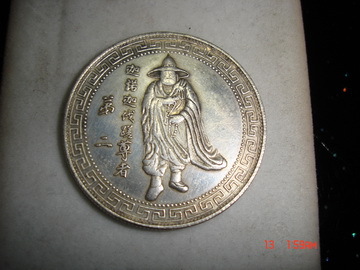 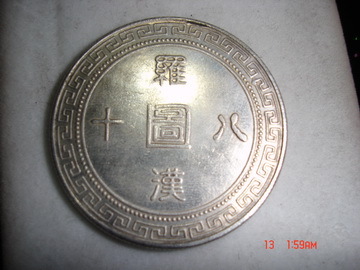 |
|
Pillar of the Community
France
1591 Posts |
Can you post a link to the auction ?
With only this pictures (small, no description/weight) , it's hard to tell ...
Not sure it's possible to tell BTW without having the coin in hand :)
|
|
New Member
United States
4 Posts |
|
|
Pillar of the Community
United Kingdom
2943 Posts |
The link to the ebay site just shows yet another of those fantasy chinese coins - indeed that one doesn't even try to ape a real coin image. |
|
New Member
United States
4 Posts |
Yes I imangine it is just some sort of medalion or cheap reproduction
|
| |
Replies: 10 / Views: 4,685 |
|




 Posted 02/27/2011 7:39 pm





