| Author |
 Replies: 18 / Views: 3,900 Replies: 18 / Views: 3,900 |
|
Pillar of the Community
Canada
1161 Posts |
I'm wondering how much credit other Canadian collectors give to some of the varieties listed for different coins on coinsandcanada.com? The coin I'm questioning at this time is the 1996 Attached "6" variety they have listed. I just found one roll searching. I notice it is a die chip and they consider it a variety with a nice posted premium. How many collectors will or do consider this a variety or just another coin with a well placed die chip? For me...I will keep it and label as the Attached 6. I'm just not sure if I should consider it a premium value coin with a variety or just a die chip? Here is the stock photo from the site. I have not taken a picture of my coin yet as I'm still searching the boxes and I'm on a schedule.  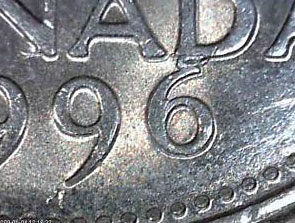 |
|
|
|
Pillar of the Community
Canada
1166 Posts |
Personally, some of their errors and varieties leave a lot to be desired. However, because of their listing them as such, the coins find themselves on auction sites and do get ridiculous prices. Die chips, die cracks etc. are common occurrences in the minting process and unless they are extremely dramatic, I don't think they should be listed as they have been.
That said, things like the extra water line and the bug tail have become part of the mainstream of collecting even though they really shouldn't have. IMO.
|
|
Pillar of the Community
 Canada
1161 Posts |
I understand what you are saying. I collect US and world coins as well. The differences between what is collectable and what is considered common between US and Canadian collectors is mind boggling at times. As a novice collector myself...I found it confusing and still do at times when I look at a Canadian coin that is posted or listed as a DD that in the US market would be considered MD. It sure keeps me on my toes. Unfortunately for Canadian collectors there is not as much reference material online as for US coins. I'm learning as I go and enjoying every minute. |
|
Pillar of the Community
Canada
1161 Posts |
Any other opinions? Looking to see who would catalog this coin as a variety as stated on coinsandcanada.com or just another die chip. Thank you in advance.
|
|
Pillar of the Community
Canada
1733 Posts |
It's not a variety, any more than an XWL is a variety because there are no new features to cause the variety. The only thing distinguishing these from their normally struck brothers is die damage. Where a high and low seven DO make a variety, die chips and cracks do not. A small bead and a large bead variance is a variety and so on. I guess though we're just quibbling over nomenclature.
Having said that, there are relatively few coins struck in Canada compared to our southern neighbours and thus every little thing that comes along gets noted and named. bug tail, arrow, XWL, attached 6 ... you know the drill. Really there so few variations when you look through the history of coins from 1906 up compared to other countries, it's no wonder we tend to name every variance no matter what it was caused by.
|
|
Pillar of the Community
Canada
1161 Posts |
So I guess that I should think of this 1996 attached 6 along the same line as the US Lincoln B"I"E.
|
|
Valued Member
Canada
248 Posts |
Curious what is a B"I"E and Quote:
It's not a variety, any more than an XWL is a variety because there are no new features to cause the variety. ---Unless the book has been changed by somebody a (XWL) is a variety for 1964 Nickels. |
|
Pillar of the Community
Canada
1733 Posts |
|
|
Pillar of the Community
Canada
1161 Posts |
|
|
New Member
Canada
6 Posts |
Does a die chip always occur at the same spot....I have several of them 96 "attached ones" with that particular "error"
|
|
Pillar of the Community
Canada
1581 Posts |
> Unless the book has been changed by somebody a (XWL) is a variety for 1964 Nickels
I think intent to release has to exist for a variety. The 1964 XWL wasn't from an intentional design. It's a die break, and thus strictly an error, like the 1936 bar 25c.
These are recognized, popular and well collected errors, to be sure, but they are still an errors and not varieties.
Now: Is a mule is a variety or not? :)
|
|
Pillar of the Community
Canada
1733 Posts |
I personally consider a mule to be in a class of it's own and a well defined type of mint error.
I don't think it'a a variety nor is it a damaged die error ala the 1996 attached six and so on. There is no intent (supposedly) to make a mule, the mint claims this is human error. Also, there could be distinct varieties and damaged die variations of a mule coin.
|
|
Bedrock of the Community
United States
12437 Posts |
Quote:
Does a die chip always occur at the same spot It can, most die designs have a point(s) of inherent weakness that will be subject to repeated chipping and cracking on the production dies as they wear out. Of course, random cracks and chips can also happen as well. Edited by biokemist6
04/28/2011 5:01 pm
|
|
Pillar of the Community
Canada
902 Posts |
I would have to say a mule has to be an intentional error, or at the very least poor control on the mint's part.
|
|
Pillar of the Community
 Canada
9906 Posts |
I believe a mule is a variety,not unlike near 6 far 6 or high 7 low 7,which would not exist if some mint employee had not erred in digit placement.
|
|
Bedrock of the Community
United States
10065 Posts |
Fast answer - nope!
But after seeing it - I think it would be neat to find one.
I admit one of my loves in the coin collecting hobby is Canadian Nickels, and I have yet to figure out why! However, when I tried to get back into coins a few years ago, I got tired of seeing all the minutiae that were being recognized and, at least I thought, considered part of a complete set. The only thing I was missing from 1922 up was a 1951 high relief. And even this was something I was not sure I wanted to pursue. I am old fashioned enough that if it is easy to see (far vs near 6, EWL, 47 dot), then I like it. But if it is obviously from a die being chipped - like this attached 6 - then it just sticks in my mind as mechanical "error" and not really a part of the "real" (to my mind) set. To me, the EWL looks like it was engraved this way, although I see from a post in this topic that this actually was a die break - oh well. This attached 6 obviously looks like the die broke.
I think what discouraged me was on varieties is that I used to go to a coin shop in Niagara Falls (at top of the hill - across from the bank - on Lundy's lane). So after re-entering the hobby, on my first visit North, I went to this shop. They had a lot of nickel varieties for sale I had not seen/heard of. I knew I had to get them to "complete" my set.
One of these was a 1963 which they had boldly written on the 2X2 that it had an "attached AD." After inquiring they said that the A preceding the D in Canada - above the date - were attached at their bases. Sure enough the letters were attached! Hmmm... only $3.00. I found it unlisted in the Charleton I had just bought. But I thought that surely something this major would be a good variety to have ... so I bought it.
I went to the bank in Canada before returning to the States and bought 100.00 worth of nickels to roll search. Every single 63 I found has the attached AD! So I spent 3.00 at the coin shop for something I found 20+ of in bank rolls! And to this day I have yet to see an "unattached AD 1963. Has anyone seen one?
Anyway, this experience taught me to be a lot more educated before buying. Granted, it was only 3.00 I threw away, but it left a bad taste in my mouth for Canadian nickels varieties. So I tend only to like the official ones listed in the book. And even these I want to be something that looks not to be caused from mechanical error/chipping. The 1951 high relief might be nice - but would I be able to pick it out of a crowd of 1951's? I do not know.
The hardest part of all this is having to recognize that the deeper the hobby goes into the micro-minute differences, the farther I get from ever being able to say I actually have a "complete set."
|
| |
Replies: 18 / Views: 3,900 |










 Posted 04/19/2011 10:20 pm


