I couldn't resist contributing to this thread, as, although I don't really collect insulators and have no glass ones (yet!), I have a handful of ceramic ones that I've picked up on holidays in New Zealand, Cuba, France and Zimbabwe! But a real British railroad insulator has always eluded me, until today. I've walked along quite a few disused railroads in England, but the only insulators I've found have been broken fragments - or still firmly attached to inaccessible telegraph poles!
Last week I went to a lunch and meeting with some fellow tour guides. I decided to go by train as I wanted a drink at lunchtime. The first part of my journey took me along a secondary line that passes through some very remote countryside. At one point the train stopped at a tiny halt that can only accommodate a single coach - any passengers are advised to travel in the front coach for that station. Looking out of the window, I spotted a complete insulator lying in woodland just beyond the platform.
Today I drove there in my car to see of I could reclaim the insulator. I got very dirty as the ground was so muddy! But I found the insulator I'd spotted, and also found a bit of telegraph pole with two pothead type insulators on it.
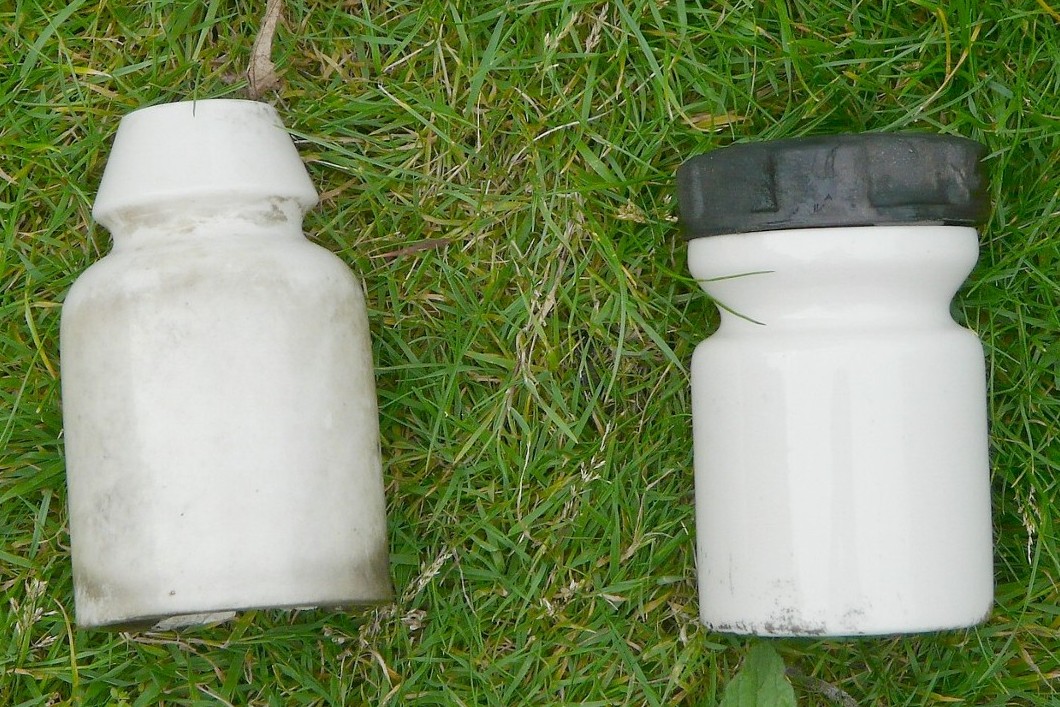
The insulator I spotted from the train on the left, one of the 'potheads' on the right:
The telegraph pole remnant with the other pothead:
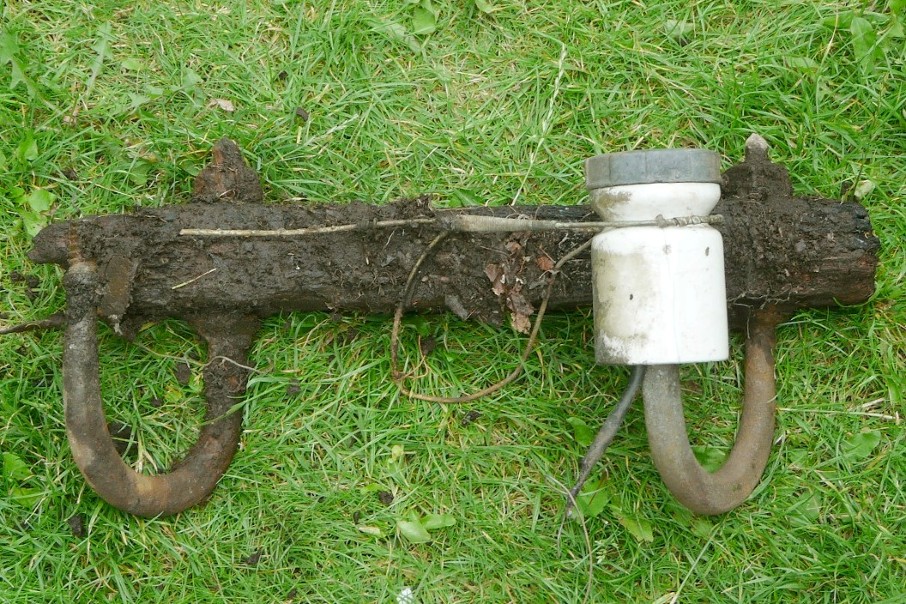
The original insulator I spotted has "Made In England" stamped on it, but I couldn't see any letters identifying the railroad company. The pothead that I've unscrewed and cleaned is dated 1956. I don't know what the potheads were used for or why they were placed there at that date - maybe one of our insulator experts can help!
A brief history of that railroad line -
1851 Opened by the South-Eastern Railway Company (SER)
1899 SER merges with another local company to form the South East & Chatham Railway (SECR)
1923 All railways in SE England merge to form the Southern Railway (SR)
1947 Railways nationalized to form British Railways (BR)
1963 Line proposed for closure
1971 Line proposed again for closure
1979 Line rationalised - signaling simplified, etc
I suspect that the pole line was dismantled in 1979. This line was listed in the infamous 'Beeching Report' as a candidate for closure. Locals protested against this and there was a stay of execution. After a second attempt to close the line was rejected, BR decided to cut costs by removing unnecessary trackwork, closing signal boxes and converting stations to unmanned halfs (although the tiny halt near where I found the insulators has always been unmanned).




 First Page


 Posted 07/08/2021 4:52 pm





