Coin Community Family of Web Sites Join Thousands of Coin, Bullion, & Money Collectors
Specializing in Modern Numismatics Royal Canadian Mint products, Canadian, Polish, American, and world coins and banknotes. 300,000 items to help build your collection! Join Thousands of Coin, Bullion, & Money Collectors Vancouvers #1 Coin and Paper Money Dealer Coin, Banknote and Medal Collectors's Online Mall Royal Estate Auctions - $1 Coin Auctions


Username:
Password:
Save Password
Forgot your Password?


This page may contain links that result in small commissions to keep this free site up and running.

Welcome Guest! Registering and/or logging in will remove the anchor (bottom) ads. It's Free!

A New Type Portrait Counterfeit/Forgery

To participate in the forum you must log in or register.
Author Previous TopicReplies: 58 / Views: 7,065Next Topic
Page: of 4
Pillar of the Community
wonghinghi's Avatar
Hong Kong
1270 Posts
 Posted 04/18/2013  10:10 am  Show Profile   Bookmark this reply Add wonghinghi to your friends list Get a Link to this Reply

Quote:
I am hoping to introduce the average coin collector to this new spectrum of forgeries that have been overlooked for decades but have existed in some cases for over 180 years.


Swamperbob, I respect/appreciate to your ambitiousness to your target so much but this must be a long way to go. I know you have some historical written materials to talk about the phenomenon of C2CC, maybe your knowledge about this field leds you go further and further, and you are going to make your contributions to the future numismatists.

IMHO, I think the first step to success is to persuade the TPGs to accept the theory of C2CC, they are the most influential group in this field with no doubt. You have said that "TPGs have even slabbed Riddell counterfeits it was not a big surprise to find a silver restrike or two slabbed." Its seems those professional graders do not recognize the concept of C2CC at all. But if I am a novice coin collector, it has no ground to me not to accept the TPG's determination on the authenticity of a coin.

To me, I collect coins from 2004. I have read a lot of books in Chinese and English. I didn't read anything about what the C2CC was before I join this forum. I suppose most of the Chinese coin collector are as equally ignorant as I am. I think very very seldom Chinese people know about the Portrait restrikes after 1830 if any. So, I will expect your new book could cover some evidence about this part of history.

To any silver coin collectors, I think the most practical and persuasive tool is to teach them how to work out the difference between the original 8R and the C2CC. This is the basis of coin collection, isn't it? Would it be another coverage in your new book?

Using advanced technical method such as XRF to work out the mint period of a coin is highly acceptable and desirable but the main point is its accuracy and reliability. Does the working principle really work? Is the database sufficient enough to prove the antiquity of a coin under investigation?

Forgive my naive opinion in this topic.
Pillar of the Community
colonialjohn's Avatar
United States
1757 Posts
 Posted 04/18/2013  11:44 am  Show Profile   Bookmark this reply Add colonialjohn to your friends list Get a Link to this Reply
XRF was valuable in that it did the following for this GNL ANS CC8R book:

1- It identified all the different off-metal Class 1 alloys such as brass, bronze, copper, german silver, etc. I believe we identified over a dozen Class 1 different metal alloys in our 1000+ specimen database.
2- It identified the various Ag levels in Class 2 counterfeits developed for the China market.
3- It identified the later Class 4 counterfeits of the modern era like the Fe/Ni plain edge 8R's from China using a cast die transfer process - predominantly.
4- It confirmed legitimate regal 8R's with ~90%Ag and good Pt/Au levels (i.e., 0.1-1.0% or more). A tool I used to indicate to me whether an 8R is a debased Class 2 or a regal specimen with GOOD silver, platinum and gold levels.

XRF is only composition. It really can't be used for determining origin with any high level of guarantee. We can make suggestions from the XRF data. Although outside the technical scope of this forum methods like Lead Isotopic Analysis, SEM/EDS on a coins internal microstructure and therefore its unique manufacturing fingerprint internal structure are showing promise in linking coins with a particular mint. A coin's make-up at the atomic level so to speak is the key to origin - not from an XRF compositional analysis ALONE. Currently papers are being published with this much higher level dual type methos (i.e., XRF & SEM/EDS, Lead Isotopic Analysis)to link coin with mint. Its mostly reserved for ancient coins at this point as ore mining sources, mint location and distribution centers are simpler for these coins than coins produced in the 18/19thC ... where MORE ore mixing is prevalent making origin determination more complex.

John Lorenzo
United States
Edited by colonialjohn
04/18/2013 11:50 am
Pillar of the Community
swamperbob's Avatar
United States
5362 Posts
 Posted 04/18/2013  11:45 am  Show Profile   Bookmark this reply Add swamperbob to your friends list Get a Link to this Reply


Quote:
it has no ground to me not to accept the TPG's determination on the authenticity of a coin


I am concerned about this attitude. The TPG's do not have a magic crystal ball. They do not always get the grade or authenticity correct. Do you believe a coin is real just because it is in a slab?

The TPGs do not make the rules nor LEAD the hobby (except in the area of grade inflation and artificial rarity).

The book is going to be published by the ANS - if they (ANS) accept the premise (which the period texts do prove) and the book is published - we hope that ANA follows suit. Then the TPG's will have to fall in line with the theory and adjust their authentication policies.

They are already starting to assemble an XRF database of their own.

The subject is controversial just like the micro-O Dollars were 10 years ago but they turned out to be forgeries (they were probably made by the same people as the 8Rs) but the fact is that millions of these coins were made after 1830. They exist. All of these silver copies are NOT MODERN counterfeits.

The Chinese in Canton and Shanghai also made silver restrikes to take advantage of the inland premium paid for the older coins. Some Chinese clearly knew - some did not. From official correspondence in the US House of Representatives, the English Parliament and official edits from the Chinese government itself - the problem was well known at one time (1825-1860).

XRF database at present can identify many of the coins made with silver refined after the 1870s fairly easily. That is when the US got involved in making these coins with Nevada silver. Prior to that England was the prime supplier along with China itself. The English used old reclaimed silver which was not fully refined so the alloy is eclectic. These will be hard to ID using XRF - visual clues will be needed.

But original mint products made in Mexican mints before 1830 can usually be identified by XRF because they used silver refined by the patio process. There is negligible old world silver in the mix. So Genuine versus counterfeit is not the same problem as dating a counterfeit to classify it as modern or not.

So it is my opinion that most counterfeits can already be detected by XRF testing but determining the age of the counterfeit is going to take time. If Class 2 coins become collectible like the micro-O dollars did a solid criteria has to be devised or modern numismatic forgeries will be included and will be new targets of forgers.

You need to be patient. I first learned of the existence of this class of coins in the 1960's from one of the men that made them. It has taken me decades to piece the evidence together and locate the proof that I have.
Pillar of the Community
colonialjohn's Avatar
United States
1757 Posts
 Posted 04/18/2013  11:58 am  Show Profile   Bookmark this reply Add colonialjohn to your friends list Get a Link to this Reply
I received a 8R in a 20thC U.S. Mint Commemorative Type Box that was a Sheffield. Having collected World CC's for over 30 years we have Class 2 CC8R with Ag levels in the low 80% level and we have silver plated CC8R made by the Birmingham Mint (Sheffields). These two CC's are probably the best CC's produced by any country in any time period. Sheffields and Class 2 CC8R's will be present in TPG's and will be sold as raw coins by major dealers for many years to come. This GNL ANS CC8R book will certainly curtail this occurance - one dilemma - coins already entombed and in UNC condition will make it Very DIFFICULT to identify Sheffields or Class 2 piece items. XRF can not read through a plastic slabs and Sheffields do not exposed the inner debased metal until circulation wear is present.

John Lorenzo
United States
Edited by colonialjohn
04/18/2013 11:59 am
Pillar of the Community
swamperbob's Avatar
United States
5362 Posts
 Posted 04/18/2013  12:57 pm  Show Profile   Bookmark this reply Add swamperbob to your friends list Get a Link to this Reply
I was wondering if in the case of known counterfeits if it would be advisable to drill in from the side to secure a "small core sample". That would be ideal for testing of the inside and it would not damage a counterfeit appreciably.
Pillar of the Community
Archraz's Avatar
United States
3499 Posts
 Posted 04/18/2013  5:30 pm  Show Profile   Bookmark this reply Add Archraz to your friends list Get a Link to this Reply
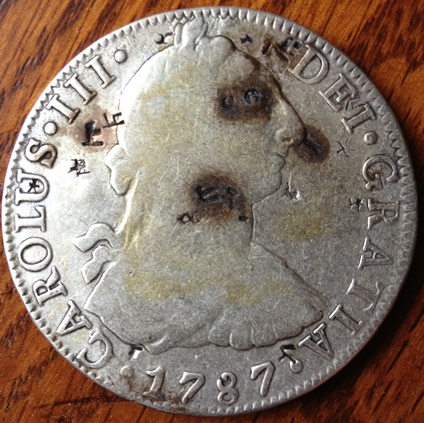
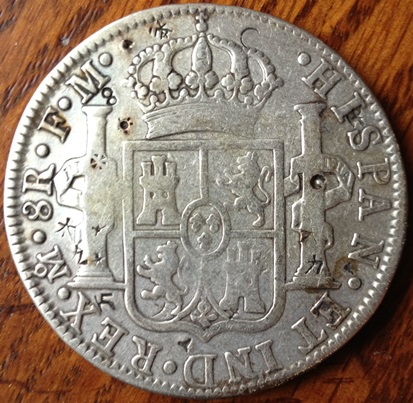
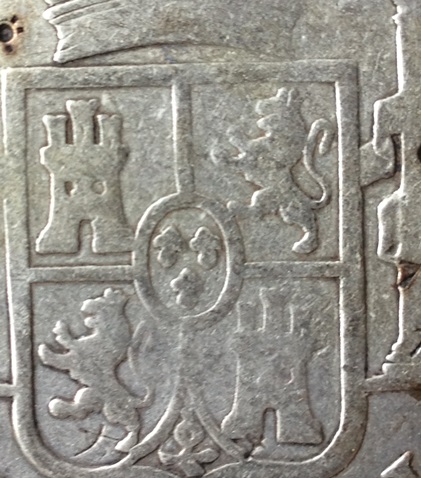
I have a question about the "Keyhole-circle" fakes. Are these only dated 1788? And how recently did you start to notice these on the market? Because back in December of 2010 I acquired a lower-grade 1787M which I thought had some slightly mushy details due to wear and a harsh cleaning. It is 26.29 grams, seems to be silver, and has a perfect rim with two overlaps exactly 180 degrees across from one another. But now I see those goofy-looking windows. Man, I feel like an idiot. So, Bob, do you and the other guys agree that I have a "Keyhole-circle" fake?


A-New-Type-Portrait-Counterfeit/Forgery

A-New-Type-Portrait-Counterfeit/Forgery

A-New-Type-Portrait-Counterfeit/Forgery
Edited by Archraz
04/18/2013 5:31 pm
Pillar of the Community
swamperbob's Avatar
United States
5362 Posts
 Posted 04/18/2013  6:26 pm  Show Profile   Bookmark this reply Add swamperbob to your friends list Get a Link to this Reply
I can't recall exactly when I first noticed this particular feature. Not too far back - possibly 5-10 years tops. There are some features I have been chasing longer but not too many. Until I had examined several categorically counterfeit examples I was uncertain. I do not want to be premature - but I also felt that this had to be done now before my personal health deteriorates any further.

There are at least 6 other features that I suspect but have yet to prove are markers of counterfeits.

I have pictures of 1786, 87, 88 and 89 examples now - all are fully formed and NONE have eroded considerably more. I also have examples from all three dates that have perfectly rectangular windows (WITH THE SAME BLOCK PATTERNS).

That last fact is critical because while it is likely that block patterns were changed on matrix blocks - the pattern is the same for BOTH types - keyhole and rectangular. It is as if a single example from a matrix block gave rise to numerous copies of itself instead of new punches being made from the original block.

If these working dies were all made using one particular punch (or even if one matrix block was damaged) and they were used for four consecutive years I would expect to see a progression in the damage from 1786 to 1789. There is NONE apparent. If anything there is some slight change in shape that is OUT OF ORDER. This presents us with the very unlikely probability that the reverse dies were cut and used years out of sequence.

In Birmingham England, there has long been a suspicion that some die makers (the professional class of engravers) actually produced punches for 8 Reales to supply many different factories with counterfeit matrix sets. To me that makes sense. In the half penny series, this same thing happened. Sometimes the punches are seen on HIGH QUALITY dies while in other cases the same punch designs appear on dies are very poorly executed.

If the punches were sold from one centrally located facility this makes sense. Conversely it would not fit a pattern of each factory making their own punches from scratch.

To date no one (that I know of) has sequenced the various punches used in making the real dies. This is just the start. Before a sequence can be generated, all collectors need to be aware that one existed and that it can be re-constructed from the coins that were made.

Once a sequence is established accurately then distinguishing between the genuine and the spurious will be much easier.

Many other counterfeits await discovery in all of our collections - mine included. As I had XRF tests done - some of the coins I have owned for years changed categories. If evidence changes about authenticity, we have to adjust our theories and move on. That is the scientific method which I seek to apply to the 8R series.

Up to this point in time - no one has examined these coins with the cold eye of science and historical fact directing the theories.

For example, at first I thought that all portrait 8Rs were copied as Class 2 silver restrikes. That was what I believed to be true until I ran into a series of quotes from the 1830's describing the preference for the FAT head with the thick ribbons. Then finally in one reference a specific quote mentioned that the coins of Ferdinand were not welcomed in China even though they were in fact identical in silver content to the Carolus coins. That meant that the Ferdinand counterfeits made of silver had to be moved into Class 1 or 3 from Class 2. A few dozen examples were effected.

All of my theories remain fluid. I am bonded to none of them. If facts change the picture, I have to modify the theory. Where I can I do and where I can not I have to abandon parts that are contrary to fact,

We all need to be prepared for changes in this part of the hobby as science moves forward. The methods and suppositions of Pradeau, and Breen and Hancock are all outdated and need to be re-examined in light of new knowledge.
Pillar of the Community
Archraz's Avatar
United States
3499 Posts
 Posted 04/18/2013  6:33 pm  Show Profile   Bookmark this reply Add Archraz to your friends list Get a Link to this Reply
swamperbob- Very intersting stuff! I do have one question though: about when do you think that the "keyhole-circle" counterfeits were produced? Honestly, I did not pay much for my 1787 example, so as long as it is not a modern Chinese piece of junk, I think that my $22 was not totally wasted.
Pillar of the Community
swamperbob's Avatar
United States
5362 Posts
 Posted 04/18/2013  7:09 pm  Show Profile   Bookmark this reply Add swamperbob to your friends list Get a Link to this Reply
I am really not 100% certain. Some look VERY modern while others look really old. I think XRF will decide.

I am leaning toward mid 1800's as a likely earliest date.
Pillar of the Community
Archraz's Avatar
United States
3499 Posts
 Posted 04/18/2013  7:31 pm  Show Profile   Bookmark this reply Add Archraz to your friends list Get a Link to this Reply
swamperbob- Thanks for the info and help! I do hope that my coin is an older "keyhole-circle" counterfeit. After all, the edges, weight and most of the details seem quite perfect. Do you think that $22 was an OK amount to pay for a 19th-century circulating counterfeit of this type?
Pillar of the Community
United States
1962 Posts
 Posted 04/18/2013  8:15 pm  Show Profile   Bookmark this reply Add realeswatcher to your friends list Get a Link to this Reply
Keyhole windows pieces - "Some look VERY modern while others look really old."

I had said to begin with that I had seemed to notice these only on modern-type fakes. SOME certainly are modern (like that 1788 with the crack across CarIII's forehead), but in digging up more from ebay, a least a few seen HAVE to have legitimate age/use to them... And Bob, your ideas about how that castle window can't be regal seems sensible. Thus... you indeed have a bullion restrike that was used as a model for modern-day forgery.

Bob, when you think about, indisputably worn "original" pieces (or original counterfeits, as it were) with something like this goofy keyhole window identifier are really the perfect proof for your bullion restrike theory. Feature doesn't make sense for "regal", but if a piece shows signs of legit circulation, what else could it be?

I will say this... The one thing I can't understand is if this Maria Theresa-like "restriking" or whatever you want to call it occurred on as a large a scale as you believe, involving many different locations and operations - which all makes perfect sense from the argument about the premium paid for the silver coinage... EVEN IF it was illicit and thus clandestine... how could this knowledge virtually disappear from the oral record and simply never exist in the modern (i.e., mid-1900's on) written record?

This has always been a popular "foreign" series in the States, and also elsewhere... AND YET, none of this large-scale operation ever made into the public consciousness? So not a single person who had first-hand knowledge ever felt like spilling their guts late in life, and/or ever relayed their juicy story to someone who did? In every scheme... there's always a person with a big mouth.

Clearly the coin market has been aware of SOME kind of counterfeits of portrait 8R for quite a while... I remember
reading 20+ years ago as a kid - before I was ever into this type of coinage - that there were lots of "fakes" around and that you should look at the king's mouth/smile one of the "tells"... Years later, I don't recall if they meant the "typical" goofy-looking contemp. ctfeits, OR modern fakes, or ? Were there really THAT many modern fakes of portrait 8R b4 the last 15 years or so? Or, if it was typical goofy CCs they were referring to... there's usually a LOT more there to give away that it's bogus besides the smile... Was this a wink-wink reference to your Class 2?


Pillar of the Community
United States
1962 Posts
 Posted 04/18/2013  8:42 pm  Show Profile   Bookmark this reply Add realeswatcher to your friends list Get a Link to this Reply

Quote:
For example, at first I thought that all portrait 8Rs were copied as Class 2 silver restrikes. That was what I believed to be true until I ran into a series of quotes from the 1830's describing the preference for the FAT head with the thick ribbons.


So, presumably they liked Charles III coins... I wonder if this could be due to the fact that Spain (rather quietly) tweaked the fineness for the Colonial issues down from .903 to .896 around 1785? This rendered most of the CharIII series as a bit more valuable hunk of metal than the CharIIII and FerdVII pieces.

Now of course, there are tons of Charles IIII pieces with Chinese chops on them, so clearly most weren't TOO picky in favoring Charles III... So maybe the second part relayed things more accurately:


Quote:
Then finally in one reference a specific quote mentioned that the coins of Ferdinand were not welcomed in China even though they were in fact identical in silver content to the Carolus coins.


Just from seeing the coins, it's true you don't see all that many Ferd.VII pieces with chops on them (though you find chops on some imaginary/military Mex 8R of 1808-11). But "were not welcomed" doesn't necessarily have to mean "were never accepted or used", does it? And does it automatically imply that Ferd.VII issues absolutely would NOT have been targeted for replication?
Pillar of the Community
swamperbob's Avatar
United States
5362 Posts
 Posted 04/18/2013  9:43 pm  Show Profile   Bookmark this reply Add swamperbob to your friends list Get a Link to this Reply

Quote:
Was this a wink-wink reference to your Class 2?


Yes I believe it might have been if you lived in an area where the coins were made and people were aware of them.

I first was warned about these silver counterfeits by my godfather. He was my mothers older brother. He was born in 1900 and knew people involved in making the coins. He introduced me to one.


Quote:
So not a single person who had first-hand knowledge ever felt like spilling their guts late in life, and/or ever relayed their juicy story to someone who did?


I guess I am that guy. At least as far as I know.

I cover what I know in detail as the basis for establishing the case for the Class 2 coins.

The story as I heard it dates back to 1957-1960 or so when I first started collecting and I wanted to collect Morgan dollars and Portrait 8Rs. My uncle told me in no uncertain terms NOT TO DO IT. He was the president of the local coin club and the forgery ring was common knowledge. He introduced me to one of the last of the forgers he knew who claimed to have made these coins. He was an old man (close friend of my uncle) and he told me stories over a period of a few years. In 1960 I finally got him to part one of his coins - one he claimed to have made in about 1920. He had a wooden box with perhaps 25 or 30 coins in it. They were ALL 1805 Mo TH - exactly identical.

This same man who died before I got out of college also warned me not to buy any Morgan dollars with a tiny O mint mark. He said he knew the group that made them. The tiny O was so they wouldn't get them back in change. I suspected he was actually involved but he never confessed to that. He knew making US dollars was counterfeiting. He objected to being referred to as a counterfeiter. He said they were doing nothing wrong and anyway they were "protected".

This was no later than 1969 but I believe it was before I got out of high school in 1965. I did not take notes. The fellow had ties to organized crime but he was a family friend. He talked a lot about the coins he was proud of them. He said the only real mistake was the smile. They could never get it right. He also said it never hurt anyone because the coins had exactly the right amount of silver in them and they were shipped to China anyway.

In college, I got away from collecting for a while and I had put the story away as a possibly tall tale of an old man to a kid who ate it up.

I took the 1805 Mo TH 8R to several dealers in Boston and they all pronounced it a real one but very common. Not really worth anything much.

Fast forward a few decades and the big revelation in 2005 that the Micro O dollars were fakes. That GOT MY ATTENTION again and I wondered if he was telling the truth.

I had been collecting counterfeit 8Rs for years by that point and had a couple thousand of them. I had seen a copy of Riddell's book as a kid and I was hooked on trying to find all of them.

So putting two and two together I started pursuing the micro O subject as a way of confirming or denying the 8R part.

The micro O dollar was first identified as a variety in a sale of the Will W. Neil collection by Max Mehl in 1947 - it was a worn example referred to as "VERY GOOD". It was first cataloged and published in a book of die varieties in 1963 by Frances Klaes. This is the same time period that I was being told to avoid buying one.

The timing of the first sale in 1947 proves the micro-O coins were made and circulated extensively for years before 1947. A date in the 1920's or 1930's is certainly possible if not necessary to cause the required wear.

Later reports in 2005 indicate that Klaes thought the coins were fakes when he published in 1963 but he never said anything in that book about it.

So how did the old man know to tell me what to avoid?

It got me thinking that if I had confirmation of one part of the story perhaps I could confirm the other parts too.

Within the past couple years, I found a second eyeball witness. He is a personal friend and a relative of a former foreman at a metal working plant. The plant was the same location cited by the old man. So one day we were talking about the old days (this fellow is 10 years older than I am) and he told me about one visit to the plant to see his relative. He was a teenager and was taken to a location in a wing of the plant where they were rolling SILVER. He saw the rolling plant and heavy presses.

That really hit me because this facility NEVER made anything that was silver. Also the location my friend described the same area of the plant that the old man had indicated as the place the 8Rs were made.

The third confirmation came from a letter I discovered that made reference to the same plant in 1893 and a charge of Counterfeiting made in San Francisco by a shipping agent who operated a California to China fleet.

That letter was part of a legal file that has been sold through several different venues over the past 15 years. The lawyer involved was the County District Attorney. The charge of counterfeiting was made against an officer of the metal working plant (who was also the State Attorney General).

Since the discovery of that first letter I have discovered 4 others tied into the same incident. They point to a US Senator as being involved as well.

This all comports very well in general with stories that the US tried to officially get permission to coin Mexican 8Rs in California in 1861 but was turned down by Mexico. Mexico wanted 15% off the top.

I do a lot of adding two and two - but here I see a plan put in place by the US government to clandestinely produce 8Rs for the China trade without telling Mexico.

So unlike the MTTs which were legally restruck - these Class 2 coins were anything but legal. However, when the shipping agent in California tried to take action for counterfeiting the case was quashed by the intervention of a Senator.

Is it proof? Perhaps not but it is the best I have up to the point of finding many historical references in rare books and documenting the physical existance of numerous silver counterfeits of the 8Rs that all share similarities with the 1805 8R that I got from the old man in 1960.

It is part of the book. You judge for yourselves.
Pillar of the Community
swamperbob's Avatar
United States
5362 Posts
 Posted 04/18/2013  10:04 pm  Show Profile   Bookmark this reply Add swamperbob to your friends list Get a Link to this Reply

Quote:
Just from seeing the coins, it's true you don't see all that many Ferd.VII pieces with chops on them (though you find chops on some imaginary/military Mex 8R of 1808-11). But "were not welcomed" doesn't necessarily have to mean "were never accepted or used", does it? And does it automatically imply that Ferd.VII issues absolutely would NOT have been targeted for replication?


The key to the reason the Class 2 coins were made in the first place was the premium OVER silver melt that they carried. Charles III, Charles IIII and the Transitional coins of Mexico City were the coins that carried a premium.

China would take the others but at far lower rates of exchange. Ferd VII might trade at 4% over silver - The US Trade dollar at 4% under but the Carolus coins from Mexico were traded at 16 to 80% over silver spot.

That is not a typo. At one point in 1856 an unchopped Carolus dollar traded for 80% OVER silver content.

The only coins treated this way were the ones with Mo. The merchants distrusted Eagle dollars - all Bolivian and Peruvian coins after Charles III and US issues.

I have even located cases where the Limae monogram was recut to read Mo. This alteration only makes sense in light of this Mo preference. They too Limae coins that would trade 5% under silver changed the mint mark at got 20% over - nice way to make a 25% profit for a little hand tooling.

Therefore Class 2 coins after Charles III are usually Mexico City. The Charles III coins are fewer in number but can come from several provincial mints. The Charles IIII and the transitional Ferdin's (which have a fat head and wide ribbons) all were acceptable AT A PREMIUM if they were also from Mexico City and had NO wear or CHOPS.

There were not that many high grade unmarked Carolus dollars in 1856. Yet that year 35,000,000 were shipped to China to pay the balance of trade deficit of the west.

This premium carried on until the first few decades of the 20th century.

The Carolus dollar was only demonetized in China in 1935 in favor of the FAT man dollar. But they were still hoarded. They only started to come back to the west after silver prices rose.

I guess old fat men like me are important in China. Maybe I should move there.

And $22 is a very good price I just paid $92 for a new one to test.
Edited by swamperbob
04/18/2013 10:06 pm
Pillar of the Community
United States
1962 Posts
 Posted 04/19/2013  12:21 am  Show Profile   Bookmark this reply Add realeswatcher to your friends list Get a Link to this Reply
Concerning the anecdotes from your local New England ring... Interesting that you've now linked it, potentially, to a higher level. Those dots seem like they could connect. If the scope was indeed that large, it's all the more fascinating that more info concerning these operation(s) didn't leak out.

You've shown that 1805 piece before... I don't recall, have you found any twins to it?

With a brief answer, WHY exactly did they not like the Ferdinand bust, even of the Mo mint? Kind of silly, when you think about it... They were picky enough to prefer the coins with the Mo mintmark... yet rejected (relatively speaking) coins with that same mark, which would test to be the same, content-wise, because they had a different picture.

Maybe they though the Charles' big schnozzes held aphrodisiac powers...
  Previous TopicReplies: 58 / Views: 7,065Next Topic
Page: of 4

To participate in the forum you must log in or register.


Disclaimer: While a tremendous amount of effort goes into ensuring the accuracy of the information contained in this site, Coin Community assumes no liability for errors. Copyright 2005 - 2026 Coin Community Family- all rights reserved worldwide. Use of any images or content on this website without prior written permission of Coin Community or the original lender is strictly prohibited.
Contact Us  |  Advertise Here  |  Privacy Policy / Terms of Use

Coin Community Forum © 2005 - 2026 Coin Community Forums
It took 0.57 seconds to rattle this change. Forums