Quote:
Is it best to do a SG to further confirm it is a Class 3 forgery?
Specific Gravity can determine silver content BUT NOT the age of a forgery. A Class 3 forgery can be made with no silver at all or can be pure silver. The better numismatic forgeries will be silver because the base metal copies do not fool collectors anymore. However, silver content is not a factor in a Class 3 forgery.
Silver content is, on the other hand a very specific determining factor for a Class 2 Counterfeit. Class 2 coins are the silver forgeries made before 1930 that did actually circulate as silver bullion coins. The issue of silver content in a Class 2 coin is critical because to be successful a Class 2 counterfeit had to pass the tests of the schroff's.
Testing methodologies used by the schroff's DID CHANGE over time and each change caused a response by the counterfeiters.
Prior to 1830 the Schroff's used weight, size, ring, color and rubbing on certain surfaces as primary determinants as to the acceptability of a coin. That meant counterfeiters could easily reduce silver content and get away with it provided they did not take out too much silver and they pickled the finished product to reduce surface copper by leaching with acid. So in that period of time (pre-1830), silver counterfeits using as little as 700 fine silver could pass as real. The schroff's apparently did not use the actual designs as a criteria.
(In the US, the mints used fire assay and specific gravity to test silver as early as 1794. They also introduced design comparison as a methodology before 1830.)
Counterfeits under 700 fine were easily detectable by these cruder methods and are classified as Class 1 counterfeits.
About 1830-1835 Chinese authorities were advised by the British that the silver counterfeits (restrikes) circulating in Canton were significantly debased. So to improve standards in the circulating coins, the Chinese introduced Specific Gravity testing as part of the standard analysis.
Silver below 850 fine can be accurately and quickly detected by SG alone. (Schroff's did need accurate quick and non-destructive test methods and SG did the trick.) This change in testing methods caused the counterfeiters to respond and raise their silver content above 850 fine.
By 1870 testing standards using acid tests and other chemical assay methods resulted in counterfeiters improving their alloy to 900 fine.
These three periods can in some cases also be confirmed by the trace contents of gold found in the coins. The higher the trace of gold the EARLIER the counterfeit (or original coin). In 1830, gold up to 2% of total weight could be present as a contaminant in silver. By 1870, this had been improved to 0.2%. By 1930 (the end of the Class 2 era) the trace of gold was under 0.02%.
So I hope that explains the distinction between the Class 2 silver counterfeits and the Class 3 numismatic forgeries.
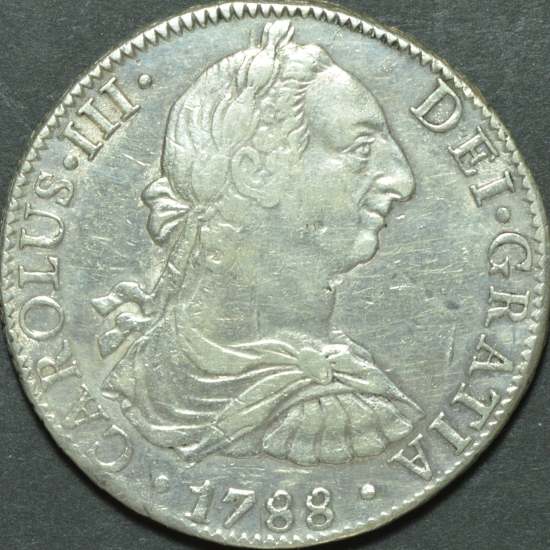
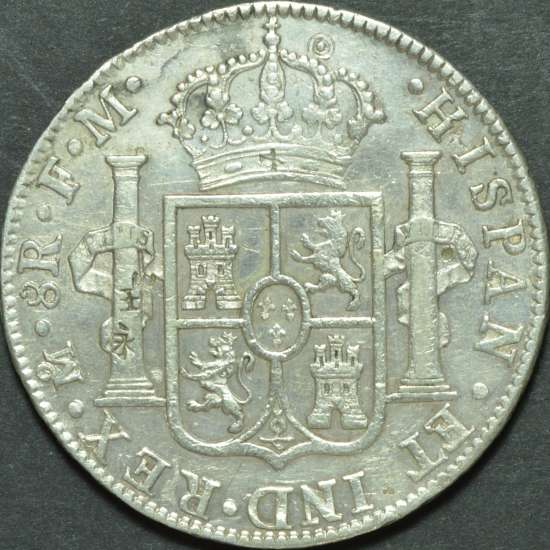
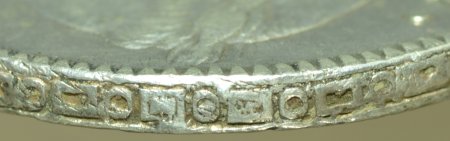
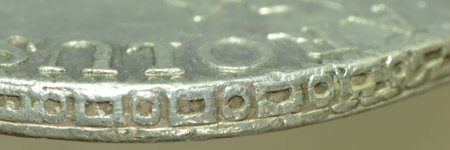
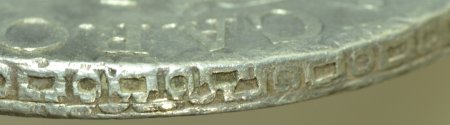
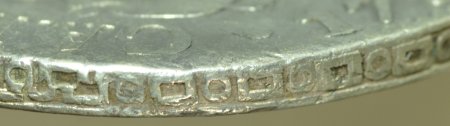
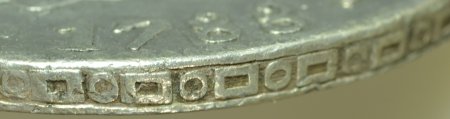
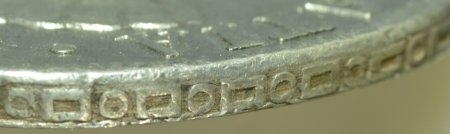
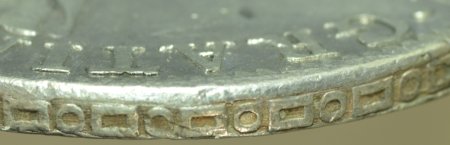
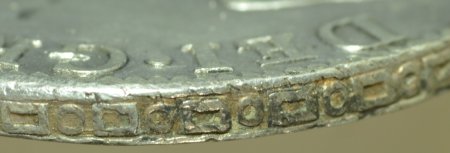
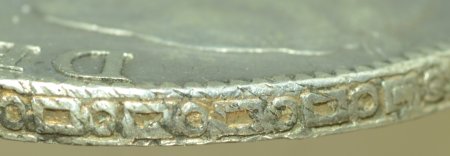
As to the 1788 coin shown last, the edge does have the characteristics of a Class 2 coin. The coin seems to have actually circulated so it is logical to consider that it could be Class 2. However, nothing proves what Class it belongs in.
The SG test result of about 80% silver is near the dividing line of the introduction of SG testing in China. At this point XRF testing could help to get a clearer picture of when it was made.
In addition, you need to look at the design of the coin at this point to determine how the dies or molds were made.
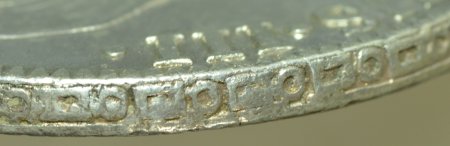
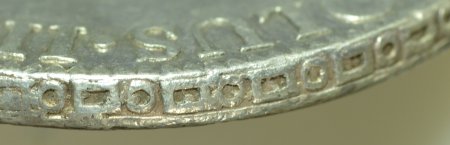
From the edge, you can see there is only one overlap that occurs between the AR of CAROLUS. From the top of the King's head to the GR in GRATIA there are grip marks diagonal cuts in the edge that appear mostly on the portion of the edge closest to the face, they are roughly parallel and they cross about 1/2 to 3/4ths of the edge width. These same diagonals are NOT seen on the rest of the edge.
That is a classic "Boston" type forgery made by the counterfeiting ring that operated near Boston, Mass until about 1930.
The coin appears die struck which is consistant with most class 2 coins.
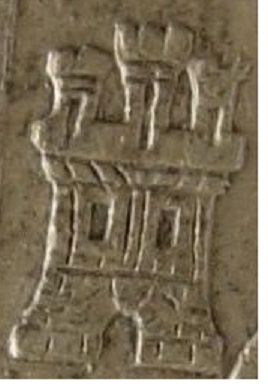
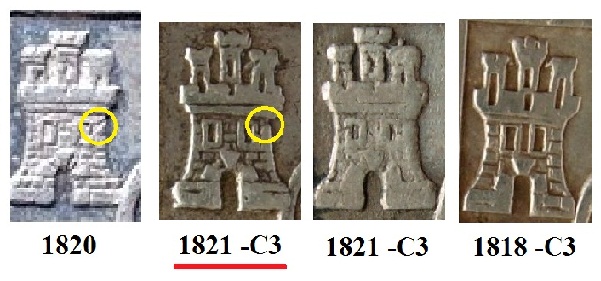
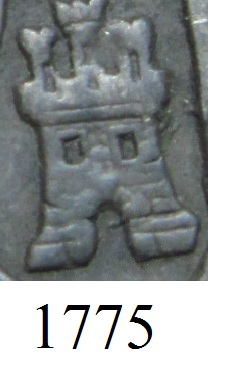
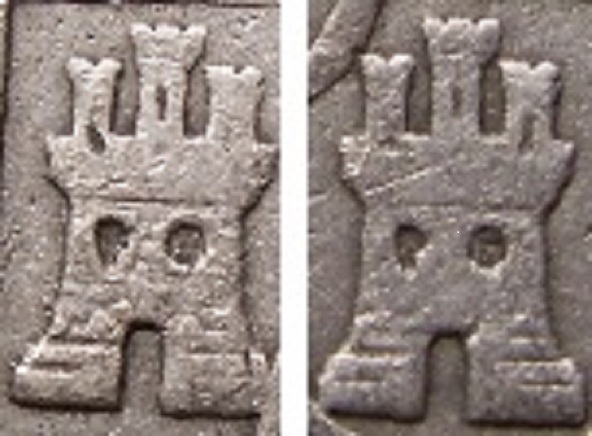
The alpha-numeric fonts used in the dies are regal in all respects. The alignment of the letters, spacings and angular positions of the letters are also correct. The elemental designs in the shield are correct and regal in style.
This leads me to the belief that a transfer technology of some type was used to make the image on the dies or molds.
There is no absolute proof either way of the priority in edging visible. So the decision on strike versus cast must be made based on a microscopic analysis of flow and erosion lines in protected surface areas.
So we are left with an open issue. Is the coin a strike or cast item? Molds used to make a forged coin usually require post strike edging to cover up seams, sprue and vent.
If the edge is applied first the coin must be a strike.
The surface texture transferred to the finished coin can at times infer the type of matrix material used to make the cast. In the 1820's sand casts were still normal but some plaster of paris duplication was possible. In the late 1830's electro-deposition made molds far more accurate. Shortly thereafter impact transfer revolutionized counterfeiting by making a transer image possible for a die or casting.
Since the image transfer in this case is near perfect - we can rule out an engraved die or even a die punched from a counterfeit punch set. These dies/molds are a copy made from an actual coin or coins.
Quote:
But it passed the old moneyer's assessment(chops present) so it should be a Class 2 Counterfeit. Do you agree?
If the chop marks are real and if they were applied by the schroff and not by a private individual then they prove circulation in China and based on the low SG it tend to push the date of fabrication earlier. However, chop marks are NOT a guarantee. Many forgers add chops to fool collectors.
So once again we have facts that point in the opposite direction. The coin appears to be die struck (my presumption) and it would appear to have been chopped. Both would point to an early date.
But this is counter balanced by the die/mold making technique which clearly looks post Civil War ca. 1865 at the very earliest.
The best I could do with this coin right now is to say that it fits best in the Class 2 category of counterfeits and that it was made anytime between 1860 and 1930.












 Posted 04/11/2013 11:52 pm




 making Scroffing tools.