op·po·site (p-zt)
Adj.
1. Placed or located directly across from something else or from each other: opposite sides of a building.
2. Facing the other way; moving or tending away from each other: opposite directions.
3. Being the other of two complementary or mutually exclusive things: the opposite sex; an opposite role to the lead in the play.
4.
a. Altogether different, as in nature, quality, or significance: The effect of the medication was opposite to that intended.
b. Sharply contrasting; antithetical: had opposite views on the subject.
5. Botany Growing in pairs on either side of a stem: opposite leaves.
N.
1. One that is opposite or contrary to another.
2. An opponent or antagonist.
3. An antonym.
Adv.
In an opposite position: They sat opposite at the table.
prep.
1. Across from or facing: parked the car opposite the bank.
2. In a complementary dramatic role to: He played opposite her.
[Middle English, from Old French, from Latin oppositus, past participle of opponere, oppose; see oppose.]Caracalla AE32 Pisidia Antioch
Obv. Young Caracalla laureate draped cuirassed bust right PIVS AVG ANTONINVS
Rv. Victory (some guy with a big nose dressed in drag ..... Klinger ?) walking left holding wreath and palm branch VICTORIAE DDD NNN COL AN with S R in fields
22.94 grams 32mm
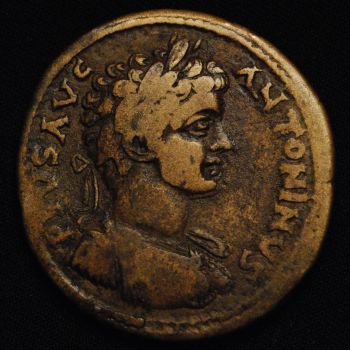
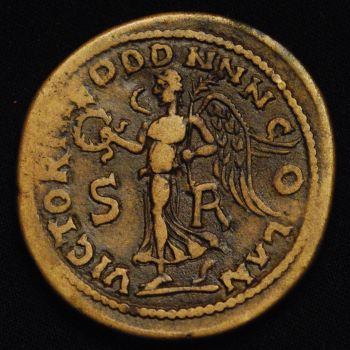 Geta AE33 Pisidia Antioch
Geta laureate bust right IMP CAES P SEPT GETA AVG
Rv. Victory ( young female this time) walking left holding wreath and palm branch VICT DD NN COL ANTIOCH with S R in fields
25.01 grams 33mm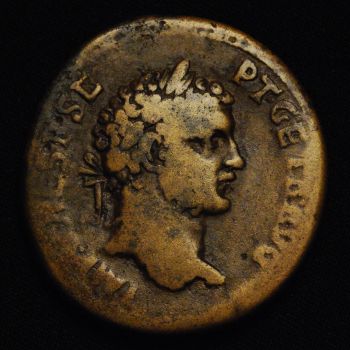
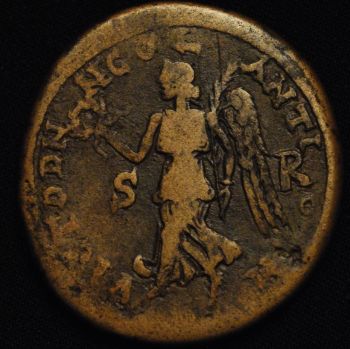
Although I bought these two as a pair almost 35 years ago they were minted several years apart. The younger brother Geta appears to be about age 20 while the elder brother Caracalla looks to be an early teen.
The Decline and Fall of the Roman Empire
Chapter VI Ambition of Caracalla The declining health and last illness of Severus
inflamed the wild ambition and black passions of Caracalla's soul.
Impatient of any delay or division of empire, he attempted,
more than once, to shorten the small remainder of his father's days,
and endeavoured, but without success, to excite a mutiny among the troops.
The old emperor had often censured the misguided lenity of Marcus,
who, by a single act of justice, might have saved the Romans from the tyranny of his worthless son.
Placed in the same situation,
he experienced how easily the rigour of a judge dissolves away in the tenderness of a parent.
He deliberated, he threatened, but he could not punish;
and this last and only instance of mercy
was more fatal to the empire than a long series of cruelty.
The disorder of his mind irritated the pains of his body;
he wished impatiently for death and hastened the instant of it by his impatience.
He expired (A.D. 211, February 4th) at York in the sixty-fifth year of his life,
and in the eighteenth of a glorious and successful reign.
In his last moments he recommended concord to his sons,
and his sons to the army.
The salutary advice never reached the heart,
or even the understanding, of the impetuous youths;
but the more obedient troops, mindful of their oath of allegiance,
and of the authority of their deceased master,
resisted the solicitations of Caracalla,
and proclaimed both brothers emperors of Rome.
The new princes soon left the Caledonians in peace,
returned to the capital, celebrated their father's funeral with divine honours,
and were cheerfully acknowledged as lawful sovereigns,
by the senate,
the people,
and the provinces.
Some pre-eminence of rank seems to have been allowed to the elder brother;
but they both administered the empire with equal and independent power.
Jealousy and hatred of the two emperorsSuch a divided form of government would have proved a source of discord
between the most affectionate brothers.
It was impossible that it could long subsist
between two implacable enemies,
who neither desired
nor could trust a reconciliation.
It was visible that one only could reign,
and that the other must fall;
and each of them judging of his rival's designs by his own,
guarded his life with the most jealous vigilance
from the repeated attacks of poison or the sword.
Their rapid journey through Gaul and Italy,
during which they never ate at the same table,
or slept in the same house,
displayed to the provinces the odious spectacle of fraternal discord.
On their arrival at Rome, they immediately divided the vast extent of the Imperial palace.
No communication was allowed between their apartments:
the doors and passages were diligently fortified,
and guards posted and relieved with the same strictness as in a besieged place.
The emperors met only in public,in the presence of their afflicted mother;
and each surrounded by a numerous train of armed followers.
Even on these occasions of ceremony,
the dissimulation of courts could ill disguise the rancour of their hearts.







 First Page




 Posted 10/09/2013 10:06 pm






.jpg)