| Author |
 Replies: 6 / Views: 18,793 Replies: 6 / Views: 18,793 |
|
|
New Member
United States
14 Posts |
I recently discovered this bracelet in a box of World War II items that my dad had evidently stashed away years ago. Unfortunately he and my mother passed away a few years ago so I can't ask either one of them. Among his collection was this bracelet, and I suspect it was a present for my mother. It has 14 three pence coins dating 1891, 1900, 1902, 1912, 1918, 1919 (2), 1921, 1932, 1935 (2), 1936, and 1938. He must have gotten it while he was in London during the war. I have no intention of trying to sell it, but I'm very curious to learn as much as I can about it. The reverse shows a crowned number 3 from 1891 through 1921, three oak leaves 1932 through 1936, and cross and shield 1938. I'd love to know anything anyone might be able to tell me.
Thanks!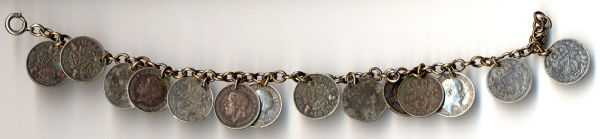
|
|
|
|
Bedrock of the Community
United Kingdom
19010 Posts |
Hi SSS and welcome to the Forum!  These coins are all standard British silver threepenny pieces. The ones dated before 1920 are of sterling (92.5%) silver and those dated after 1920 are of 50% silver. The 1891 coin has the Jubilee portrait of Queen Victoria, the 1900 one the Veiled Head. The 1902 coin is from Edward VII's reign. The coins from 1912 to 1936 all show King George V - from 1927 onwards a new reverse design by Kruger Gray replaced the crowned '3' that had been virtually the same for 200 years (and which is still used to this day on the special Maundy threepences). The 1938 coin is of King George VI. The silver threepence was last issued during his reign - a larger, 12-sided nickel-brass coin of the same value was issued concurrently with the silver 3d from 1937, and replaced it completely from 1945. I've often seen a single silver threepence on a charm bracelet, but never as many as this. Obviously the coins are ruined as far as their numismatic value goes, but are still worth their bullion content - though it would be nicer to keep them as they are. There are no rare dates among the group. As the last coin is dated 1938, it seems quite likely that the bracelet was made up during World War II from coins that were circulating at the time. Oddly enough, the silver threepences dated before 1927 are officially legal tender in the UK for three decimal pence! That is because in worn condition they cannot be distinguished from the 'Maundy' threepences that are distributed every Easter by the monarch as Maundy Money to deserving senior citizens. When the UK changed to a decimal system in February 1971, all Maundy money from 1816 onwards was revalued by a factor of 2.4 and was understood now to be denominated in decimal pence. So legally you could take these coins to the UK and spend them! Edited by NumisRob
01/21/2014 6:38 pm
|
|
Rest in Peace
United States
7075 Posts |
Keep it as it is. Do not use silver polish to clean it. If you're interested in improving its appearance there are much better options and I'm sure someone here will be willing to share their experience and knowledge about that. Is there a hallmark on the clasp? I wonder if he bought it as it is in London or if he kept the coins and had the bracelet made when he got home. |
|
New Member
 United States
14 Posts |
Wow! Thanks for such quick replies. I feel sure that my dad bought the bracelet in London as opposed to bringing the coins home. There is no hallmark visible on the clasp even under magnification. There were several other bracelets in the box, including two souvenir panel bracelets he must have bought in Paris. He was an aide to Gen. Eisenhower, so he went wherever the general's contingent went, which was mostly London and Paris. Very modest fellow, though. My brothers and I never knew who he'd worked for, only that he'd been "an aide to a general." We learned about it afterward as we sorted through belongings--it surprised us.
I've done some research on cleaning, and have been told that a non-damaging method to clean silver is to put it in a washing soda/aluminum foil bath that will cause the tarnish to detach itself from the silver while doing no harm. Don't recall what it's called--electrolysis, maybe? It's a method I've used on other silver items. Maybe someone here can tell me if it is a safe method to use. I intend to wear it and would prefer to clean it up first.
And I'd have to say it is not at all likely that I would travel to England and spend, what would it be--14 X 3 pence? A whopping 52 pennies. No--it has far too much sentimental value for that, even if there were a zero or two behind the 52.
|
|
Pillar of the Community
Canada
2805 Posts |
Don't clean them - I have tried that method myself on coins and it would turn some holed coins into some holed cleaned coins, which would have even less desirability.
|
|
Pillar of the Community
Canada
3692 Posts |
At this point they're not coins anymore; they are charms. A minority of collectors would want it, so cleaning really isn't that farfetched.
|
|
Pillar of the Community
United States
992 Posts |
Collectible coin value is nil, the only intrinsic value is the silver content, which is about $1 per Threepenny piece. It's worth much more to you as an heirloom and a bracelet, so go ahead and clean them if you want to. Take it to a coin dealer and talk to him/her about how to clean them with the least damage to the metal. Any method will do some surface removal of metal, you want the method that will do the least, and give uniform results.
|
| |
Replies: 6 / Views: 18,793 |
|







 Posted 01/21/2014 6:52 pm


