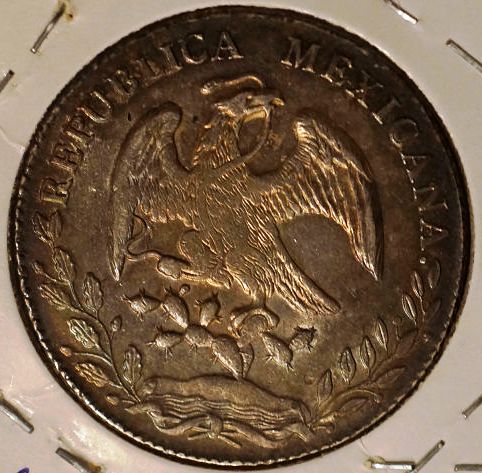
Numismat The way I review a Cap and Ray 8R may be different than most folks, but here is how I came to the conclusion that the coin was a counterfeit. I believe that it likely matches an example I already own which has a low Specific Gravity a bad edge and is extremely close to the genuine die design. It is a surprising coin. This is why I asked about SG. That is usually the basis of the actual proof.
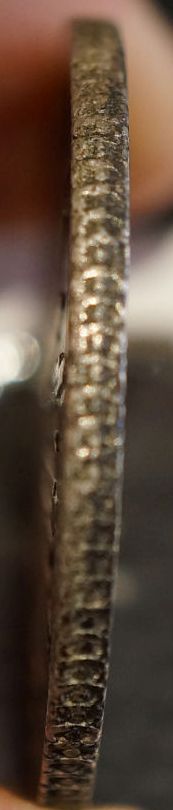
I always start with the edge. I look for a well executed edge like you see on a steam powered multiple edger. This coin has a badly chipped edge. The pattern is poorly defined and not very deep. There is little indication of multiple passes present. In this respect, the coin does not appear to be genuine and if it were mine I would do Specific Gravity to confirm the forgery.
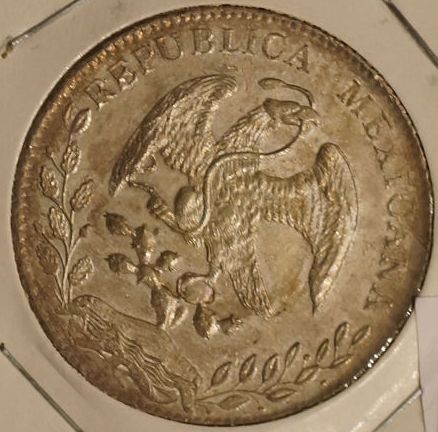
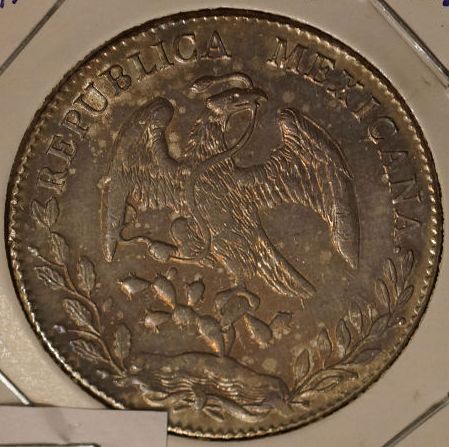
The second thing I look at is the eagle. I believe I have mentioned before that I look at the eagle as I would at a human face. I have spend over 54 years looking at these eagles. In many respects they are my oldest friends. I have no living school friends that I go back this far with. That may sound nuts but I form a quick impression and usually that is it. This initial impression of the appearance is all I usually do. It either looks correct or not. This one did not.
At this point you are asking - But why? To do this I needed to do a much closer review. When looking at the coin in detail I also follow a pattern. I start with the bird's head. I looked at several authenticated and graded examples from the Heritage site to establish the base line for the content of the hub and to estimate which specific traits still vary die to die (finishing touches like the cactus spines are even different on hubbed dies). So I started here with a three coin comparison of the eagle's head. Two known real and one now suspect based on the edge.

The two coins on the right are two examples of the standardized die hub used in 1884. These are exact matches of different dies - proving first of all the existence of a hub. They have different die spines among other minor differences. I noticed first that the head of the snake appears longer and not as round as on the suspect coin that it does on the two standard coins. I tried to mark these limits in white below. I can envision some difference in length based on focus or lighting but the impression remains.
Next I noticed the neck of the snake is shaped differently (one of the standard coins has a ding making it look more bent than it is). Both of the standard necks have a rapid curve and a nearly straight segment joining the snake's head. This is clearly a different shape than the questioned coin which has a longer gradual sweep. I did not mark over the necks.
Next I noticed where the snake's body meets the beak on both sides. The standardized dies use a projection of the snakes body through the beak that creates the appearance of an almost continuous line - there is a small offset based on how you project the segments but in no case is there a severe angle needed in the body of the snake to make the connection. The coin in question has a long offset that is not possible to join without at least one angle point. See the yellow lines below. This gives the bird the appearance of a much longer beak - which when measured is not actually longer but appears longer and gives the bird a different look. The elongated eagles head was something I saw as an anomaly initially.
As noted above eagle's beak is similar in shape and length on all three coins. One of the standard coins has a lump which points to a small die chip. The eye position matches. The effect of the chip makes the curve of the mouth look greater which it is not.
Then I looked at the feathering pattern right behind the crest. The standard coins have clear head feathers directly under the crest but the subject coin does not. See area circled in green below. This may be wear but it makes the bird look different. Also where the head joins the neck - under the chin - the subject coin has a thickening like a lump that gives the bird an entirely different appearance.
Finally the first main row of feathers on the neck of the bird is straight on both the standard coins but is a long curving sweep on the coin in question. See red lines below.
Collectively when viewing just the head area it looks like a different bird and snake.

Next I always look at the positions of the cactus pads which will not vary on a hubbed coin except for the spines which were often added as finishing touches. I do this quite often as a way of categorizing forgeries. Even when the dies varied one by one the relative size and positions of the cactus pads are very informative. Very similar to the leaf size and branching of the oak and laurel branches.
Enough digression into trivia. Here is a comparison of the Cactus plant. I picked only one of the two standard coins for speed. They both matched identically anyway.

To my eye these are simply two different plants even allowing for the spines which always vary. In this case the very tiny pad on the second pad from the left also appears to be a finishing touch added to each die individually. In the picture below I circled two areas of what I view as radical difference.

Next I looked at the area directly above the cactus because it also looked different.
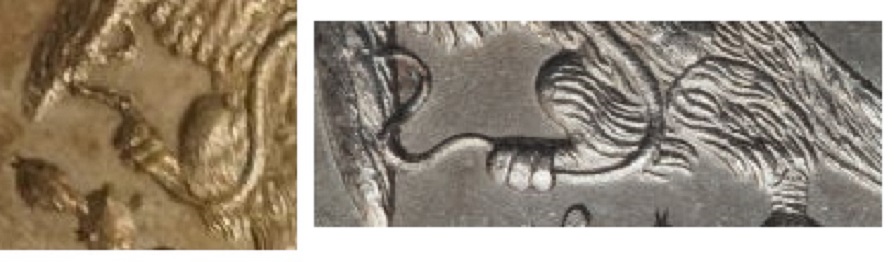
The differences I see are in the layout and shape of the snake and the feathering of the leg which is below and to the right of where the snake passes over the eagle's leg.
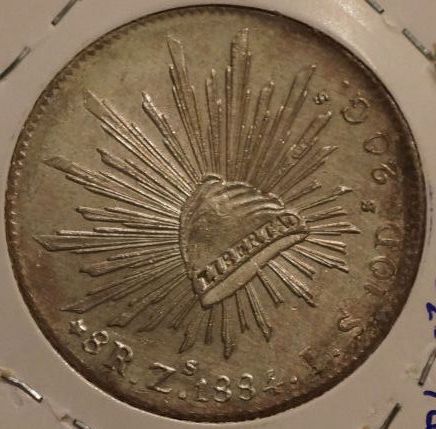
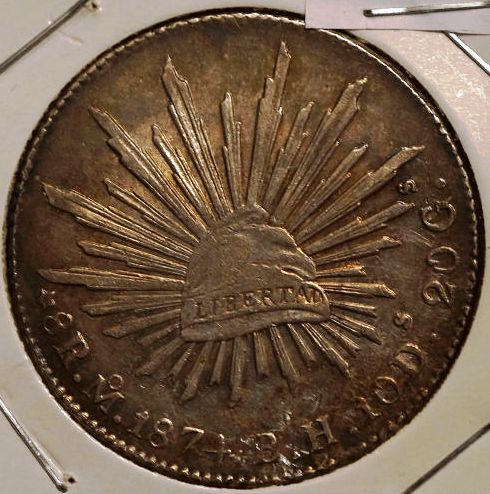
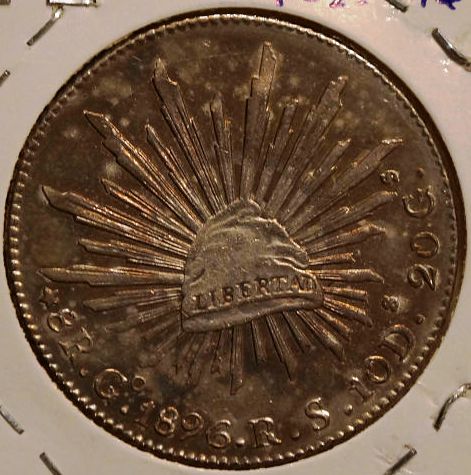
Finally I look at the cap to see if the opening and deep fold patterns match. I never liked the cap much but the rays do add a complexity that can be fun when they are not hubbed or made from a copy of a hub. I also checked the rays and some of the tips were slightly different but that could be setting depth or pressure.

I see the folds as being almost entirely missing on the left side of the cap on the subject coin while they are deep and pronounced on ALL the standard coins I saw. The coin being questioned was the only example I saw with a smooth right side.
As noted above, most of my initial observations were based on a rather quick look and the horrible edge might have been overly influential but on close second review,
I know why I believe the two varieties look significantly different.
I would have to go to the bank and try to find the one I already own but as I recall the deviations were similarly subtle and the diagnosis was made almost entirely from the edge and specific gravity alone.
I do stand to be corrected as in any examination based solely on pictures. I know I am not perfect at this but my error rate when buying fakes is wrong about 1 out of every 100 purchases.











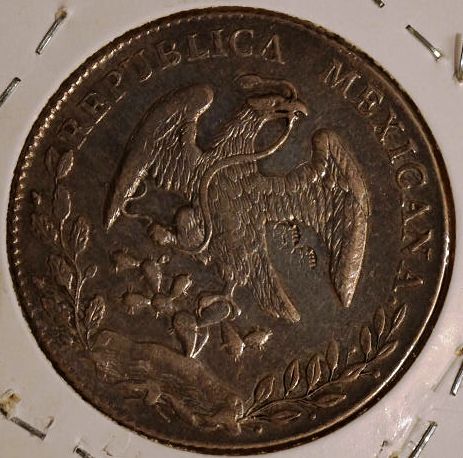
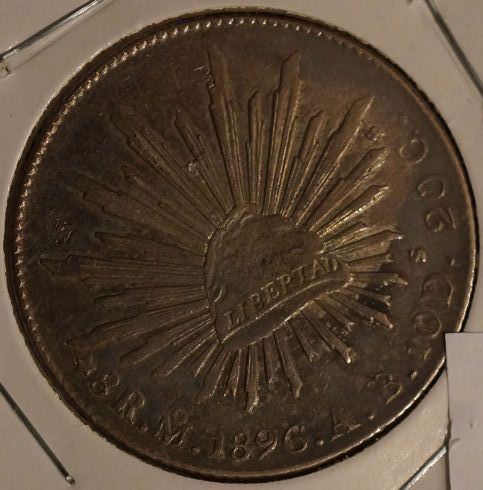



 Posted 04/12/2014 11:39 pm


