| Author |
 Replies: 26 / Views: 4,143 Replies: 26 / Views: 4,143 |
|
New Member
United States
19 Posts |
Hello to everyone, can anyone help me identify some detail that points to this Capped Bust being counterfeit. I'm sure it is because the diameter is 33.5mm to almost 34mm and it just feels weird in my hand. I don't have a good scale to weigh it on but it feels odd. Thanks for any help, Jim.. 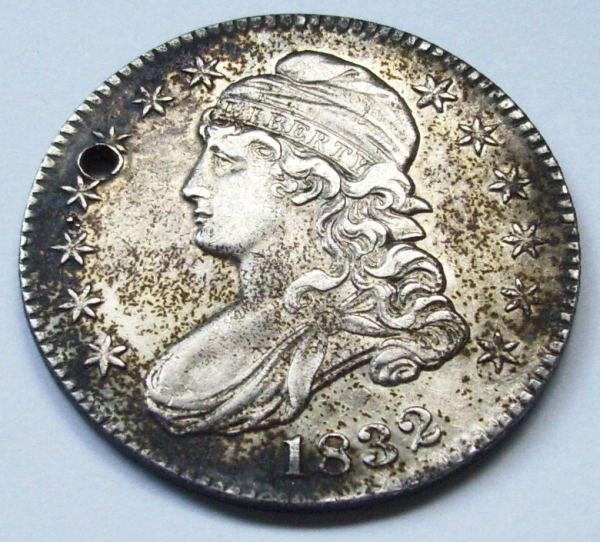 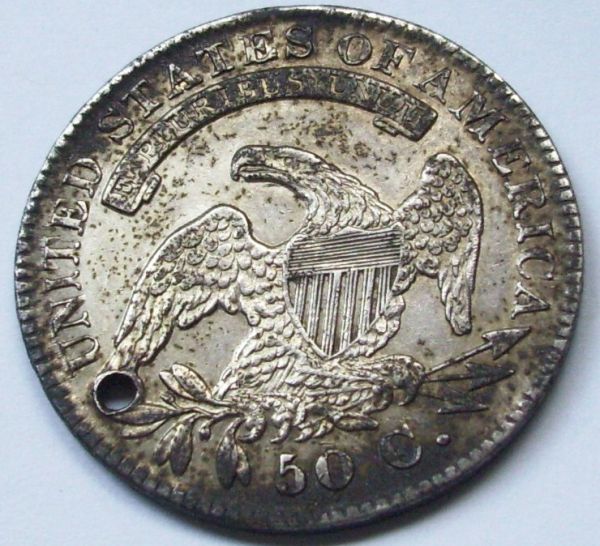 Edited by Jimmythegeek
04/25/2014 4:42 pm
|
|
|
|
Pillar of the Community
United States
2563 Posts |
|
|
Pillar of the Community
United States
1584 Posts |
|
|
Rest in Peace
United States
10625 Posts |
|
|
Pillar of the Community
United States
1054 Posts |
Hey Jim, I sold you that coin on the bay. At one point it was subjected to salt water, which explains the rusty grainy surface. If you have a problem with the coin, keep in mind I have an unconditional return policy.
|
|
Bedrock of the Community
United States
12437 Posts |
The diameter of CBHs is a bit variable since these coins were struck in an open collar press. Notice the fishtailing on the reverse peripheral devices- that is an indicator of significant radial expansion of the planchet during striking.
|
|
Pillar of the Community
United States
4883 Posts |
The drilled hole is a strong indicator, having been typically done in the past to signify "cancellation" of a counterfeit coin and prevent its further circulation. In between the two stars below that hole, there's a couple of raised bumps that are suggestive of a casting. I concur that a weight would really be helpful, but Riddell No. 460 would be a tentative identification. May I ask what (generally) the source of this piece was, and how it was represented to you?
Edit: Since posting this, I see someone is stating he was the seller, so my questions may be moot.
Colligo ergo sum
Edited by Lucky Cuss
04/25/2014 6:58 pm
|
|
New Member
 United States
19 Posts |
Thanks for the replies. The corrosion is odd not really rust, The color of this coin is just like another counterfeit I have. I bought this for $43 off ebay as a holed Capped bust Half with hole AU details. And to Kookoox10 I'm good with this coin for $43 no hard feelings at all and I am choosing to keep it knowing you would take it back. I collect counterfeits too so long as they are not expensive. I have around 200 of these Capped Bust halves and I have 3 counterfeits I know for sure. I am trying to get some input on this coin to see if anyone agrees with me. I'm 95% sure it's counterfeit because it's so big and feels different and looks odd. There are some very smart people on this sight and some of these people can spot the smallest detail or lack of it, truly amazing. Thanks, Jim. |
|
Pillar of the Community
United States
621 Posts |
"The drilled hole is a strong indicator, having been typically done in the past to signify "cancellation" of a counterfeit coin and prevent its further circulation"
I have never heard of this before, wouldn't it be easier to just destroy it outright?
You could be right, that is kind of an odd place to drill a hole if you were going to put it on a necklace or something, like I said I've just never heard of that before.
|
|
Pillar of the Community
United States
4883 Posts |
Quote:
I have never heard of this before, wouldn't it be easier to just destroy it outright? Destroying a coin (e.g. melting it down) is a lot of work. It's my understanding that the expedient of holing detected fakes was primarily a bank practice. Holes were also drilled to see if a suspected counterfeit had a copper or base metal core, so sometimes these aren't all the way through. Do note that I said "indicator" and not "proof" - there were certainly instances where coins were wrongly holed (I have a Mexican 8 reales that appears to be in this category, albeit it's easy to see why it might've been incorrectly judged to be fake), or holed for the purpose of wearing as a pendant (the orientation of the hole being significant in making this determination). But those folks who contend that genuine coins were routinely holed for ease of carrying on a piece of twine or a thong are, I think. "whistling past the graveyard," so to speak. A random hole ought to be viewed as presumptively identifying a forgery, and necessitating a very thorough examination of the coin, including weighing it and determining its specific gravity. Colligo ergo sum
|
|
Pillar of the Community
United States
8535 Posts |
Wayyy too many holed coins for your theory. I'm not sure why some are holed, lots for jewelry I guess. Indian Head cents, not sure on those but there sure are a bunch. Oregon coin geek.....*** GO BEAVS ! ! ! ***
|
|
Pillar of the Community
Korea, Republic Of
1881 Posts |
I am confused. The details all look quite accurate. I've never heard that people used to drill holes in coins for cancellation. Maybe this coin was hammered onto a door, as I've heard it was common practice in the old days to hammer a coin on the door for good luck or something. Maybe the hole was for some kind of jewelry. I don't think the strange position of the hole would be a direct evidence that this is fake, because there are LOT of coins out there that are completely genuine, but have a random hole for God knows why.
|
|
Pillar of the Community
United States
621 Posts |
Quote:
It's my understanding that the expedient of holing detected fakes was primarily a bank practice. [quote]wouldn't the bank then take them out of circulation anyway?
[quote]Holes were also drilled to see if a suspected counterfeit had a copper or base metal core, so sometimes these aren't all the way through.
Sounds plausible. |
|
Pillar of the Community
United States
2540 Posts |
Lucky
Drilling a hold was NOT an indicator of a fake.
It was very commonly done in the 19th century.
I believe the coin is real.
Not the look of a contemporary fake.
|
|
Pillar of the Community
Korea, Republic Of
1881 Posts |
 Precisely. I agree with Treashunt. |
|
Pillar of the Community
United States
4883 Posts |
Quote:
I've heard it was common practice in the old days to hammer a coin on the door for good luck or something. I've also read that someplace, and I'd guess that was done most often with cents. When I was young, that had taken the form of setting a penny into concrete. However, I'll stand by my remarks that the holing of this coin raises my suspicions as to its authenticity, and I do see some other things about it that reinforces that impression. We really need a weight here, it's a vital diagnostic for exposing a contemporary counterfeit. Colligo ergo sum
|
| |
Replies: 26 / Views: 4,143 |





 Posted 04/25/2014 5:42 pm





