| Author |
 Replies: 22 / Views: 7,600 Replies: 22 / Views: 7,600 |
|
Valued Member
Canada
405 Posts |
Sorry to ask what is probably a silly question but when the slab says things like
1) AU details ....does this mean the coin is AU or only some features are AU like ?
2) what would a qualifier on a slab like corroded mean ? i.e. if the coin is corroded how can it carry a grade of say EF ?
Any explanation that would clarify how to rate the relative condition of a coin with either of these (or other)qualifiers vis a vis similiar graded coins without would be greatly appreciated.
Thanks for all answers
*** Moved by Staff to a more appropriate forum. ***
|
|
|
|
Pillar of the Community
United States
5825 Posts |
Basically DETAILS means the coin has been altered in some way, generally by being cleaned. AU DETAILS means that IF the coin hadn't been altered it would have graded in the AU range. "Corroded" is used in place of DETAILS when the TPG can used a more descriptive term for the problem. Otherwise it means the same as above. IMO a grade for such coins should never be given. It gives newbie sellers to place an artificially high price on a coin. And newbie buyers end up paying more than a coin's worth. IMO only the problem should be noted on the slab and let the buyers and sellers determine its value. Edited by kanga
02/22/2016 08:47 am
|
|
Rest in Peace
United States
10625 Posts |
 a details (problem) coin label should read - Genuine followed by the description of the condition rendering it un-gradable. |
|
Pillar of the Community
 United States
2843 Posts |
I do not . If a coin is super rare, the only hope many people have of "filling" is with a problem one. There are some coins that definitely should be graded with details grades. Everything is out in the open. It says the problem so there is no trickery. If people are overpaying for them- that's their problem. Additionally, there are times that the details grade is given and the buyer feels that the coin is actually not cleaned. They now have a grade assigned to it, which they would otherwise not have. Yesterday, at a large coin show I was shown a coin that had an "Artificial toning" label from NGC which the seller was sure that was explainable in a natural way. (He is the seller, but was previously the buyer, and he felt that when he bought it as well, already in the slab.) The point I am trying to make is that the TPG should say what they think and allow for the consumer to determine on their own if they want the coin. They are not responsible for what people do with the grade. IMHO |
|
Pillar of the Community
United States
1812 Posts |
Isn't a Net Graded problem coin already reduced by one grade ?
I also agree Detail slabs should have a grade assigned to the coin..
|
|
Rest in Peace
United States
17900 Posts |
Go to NGC and PCGS websites. Your question is answered straight from the horse's mouth
|
|
Pillar of the Community
United States
4963 Posts |
Quote:
I also agree Detail slabs should have a grade assigned to the coin.. I also agree for the same reasons that Big Silver listed. You buy the coin, not the slab. |
|
Valued Member
 Canada
405 Posts |
Firstly. A sincere thanks for the replies, they really are enlightening. Mostly I've seen only ICCS graded coins and found the "details" qualifier quite confusing. I do beg to differ with some of the opinions expressed. TPG's are in effect holding themselves out as offering a somewhat objective standardized evaluation (and hence value) that eliminates/reduces subjective interpretations. As in any quality evaluation system (meat grading/diamonds/lumber) it should be universally clear and applicable by all parties in the same way. The idea that you ought to buy the coin not the slab is the antithesis of this. I may value coloured diamonds higher or lower than someone else but the grading should be consistent. Likewise meat grading relates to degree of marbling of fat, the cut may determine the taste or tenderness. And who would want a warped 2x4 even if it had a "tight grain" detail. This is of course only a personal opinion and subject to change depending on the arguments advanced |
|
Pillar of the Community
United States
7376 Posts |
Also keep in mind that you can have two of the exact same coin in slabs with the same grade, let's say XF Details for both, and one could be in much better shape that the other. Although both would be XF (and equal) if there were no damage....the details damage can be different on both coins. So to sum it up, each coin has to be evaluated carefully on it's own to determine the exact value. Older US Large Cents come to mind. You can have two 1794 VF details, and one can be worth $200, and the other could be worth $600. |
|
Pillar of the Community
United States
4963 Posts |
cdngmt- I am a bit hesitant to agree with you. Coin grading is and always has been extremely subjective. TPGs have, like you said, attempted to regulate it more and have been fairly successful. However, it still varies significantly. You can get a coin in a PCGS MS-63 slab, crack it and send it back, and get MS-65. By 'buying the coin, not the slab', you can consider if it is over- or undergraded (hence affecting value) and weigh other factors like eye appeal. This concept applies as much or more to details coins than problem-free ones.
|
|
Bedrock of the Community
United States
11951 Posts |
Interesting discussion. I look at getting a Details grade is saying the surface of the coin is not original. By assigning a grade the TPGis just stating what level of wear the coin is in. 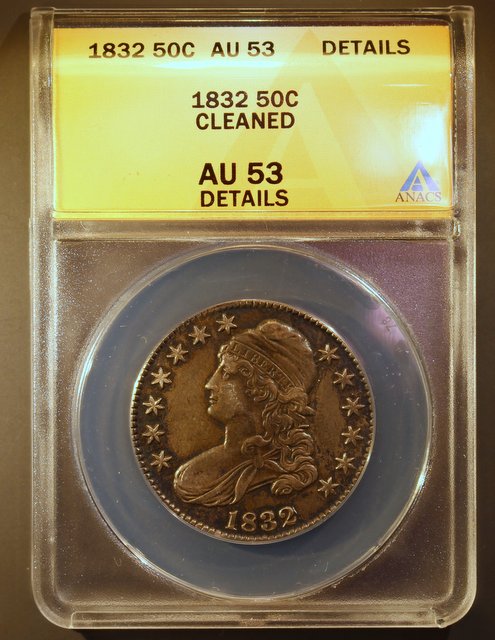 On this coin the TPG is saying the coin has been cleaned. but the coin has the same level of wear as a AU53 coin. |
|
Valued Member
Canada
405 Posts |
Hi
Again I do appreciate the opinions expressed. I can understand GR58 explanation ...as far as his example goes(ie with cleaned coins. BUT when I saw corroded I really can't see/accept it. To me its double talk akin to its perfect except where its not.
I think the other to commentators are both on the point I'm having such difficulty with. Unless grading is more standardized and will generate the same (or narrow range of )valuation wherever it is evaluated, there is no justification for pricing.
We are in effect buying tulip bulbs, prices and values have no floor, they are fad and whimsy (which is true of course to some degree). If the value is all puffery...why not just catalogue pictures? {we can't really handle the coins with "impairing their value and worth"}
|
|
Bedrock of the Community
United States
11951 Posts |
I am not exactly sure where your going with this idea. Here is another shot at hoping to be more clear. If you have two coins same date and grade, both TPG slabbed. But one has a "Details" on the label. The coin with out the "Details" on the label will sell for more. When "Details" is added to the label, the TPG's are saying there is a problem with the coin. Problems could be Corroded Cleaned Damaged Environmental damage Artificial toned and many other problems. The TPG's will still give a grade, based on the amount of wear on the coin. Because you could for example have two Lincoln Cent. One has full rims, but other main devices of the coin are gone. No wheat lines, Lincoln head is smooth. But the surfaces are corroded. Then you have a Lincoln that has all the wheat lines, Lincoln has hair lines, bow tie and defined coat lines. But is also corroded. Both coins are corroded but one still looks better than the other, the TPG's try to state that. |
|
Pillar of the Community
United States
4619 Posts |
Details BAD
It means that the coin was messed with. Altered. Cleaned. Something like that.
Not original.
Now, if your choice (for an exceptionally rare or pricy - given YOUR budget) is between a hole and a details coin, and you know you aren't going to turn around next week or next month or even next year and want to upgrade... a details coin can "fill the hole".
Sometimes that is ALL you are going to get - there simply aren't any original coins in existence. S'be'it.
Net Grading. OK, the coin has been messed with. If it HADN'T been, it would be an XF40.
One school says no net grading, just XF details.
The other school says, "we can approximate how messed with". XF Details, Net VF35 - means just a little. XF Details, Net AG3 - means a lot.
-----Burton 50+ year / Life / Emeritus ANA member (joined 12/1/1973) Life member: Numismatics International, CONECA Member: TNA, FtWCC, NETCC, EveryCountry (online) coin club Owned by three cats and a wife of 40+ years (joined 1983) Author: 3rd Edition of the Sample Slabs book, https://www.sampleslabs.info/ |
|
Bedrock of the Community
United States
94367 Posts |
IMO, "net grading" is essentially meaningless. I mean, as if the original grade wasn't subjective enough in the first place! The term might have validity in the structured EAC system, perhaps, but it is a useless distraction otherwise.
|
|
Pillar of the Community
United States
4085 Posts |
Also sometimes you look at a Details coin and you might think "I don't see it". Remember, the TPG's are still just some guys sitting in a room giving an opinion. They have lots of experience of course but they aren't necessarily perfect. |
| |
Replies: 22 / Views: 7,600 |







 Posted 02/22/2016 10:44 am





