To start off, sorry for not responding sooner! I'm on mobile so my response might be a little scattered and I'm still new to operating on this forum. Tried uploading via IMGUR, but that doesn't seem to be accepted here....
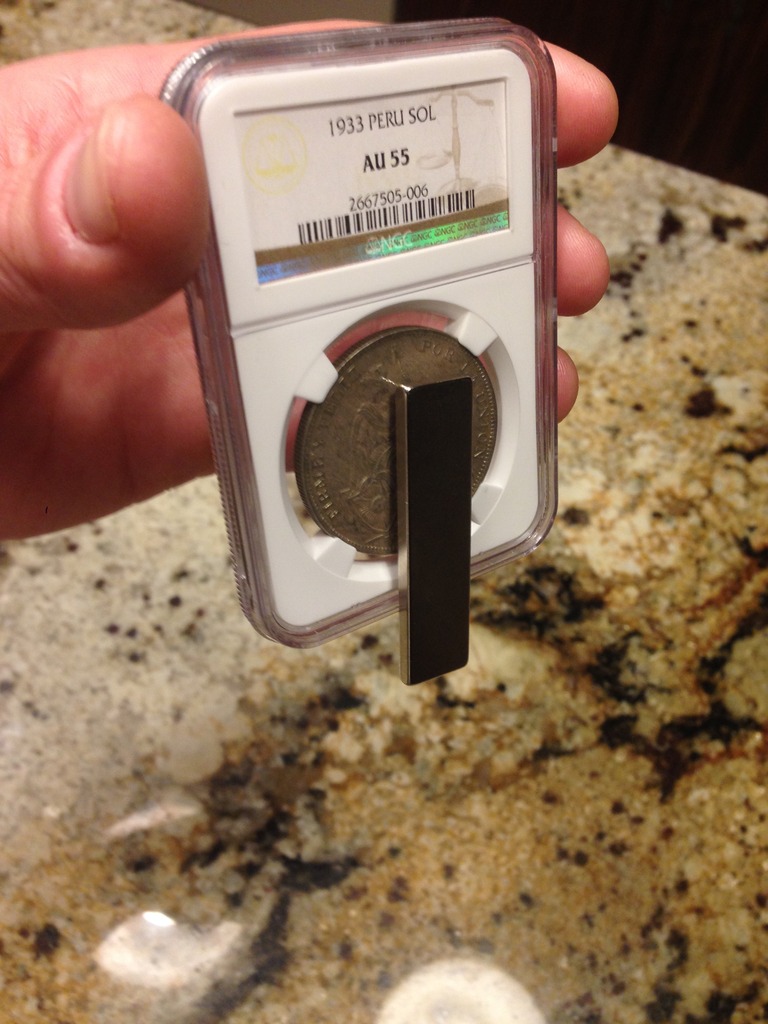
From what I see, the coin in the original post is 100% legit and would be willing to buy that from OP to submit it. I tried using the forum picture uploaded but the files are too big. Here is one of the coins I'm referring to that is quite magnetic.
I tested quite a few 1933 sols and this was the most magnetic one I had...using a neodymium magnet. The others ranged from slightly magnet to not magnetic at all. I also tested other .500 sols and again others were very magnetic, while others were not.
I have submitted many 1933 Sol's for certification at PCGS/NGC and have never had one come back counterfeit and have never heard of a counterfeit one in the years I have been collecting Peru Sol's.
As for whether the population is 5,000...I have not seen any other information to suggest otherwise and yes they are definitely not easy to find. The prices don't reflect that, but I think that may change soon :) I have not heard and do not believe that these sols were produced in the US, but now that there is a claim that they could have been, I'll do a little research.
Commems- What references are you referring to for Peru Sol's?
This 1933 date is definitely a rarity and in my opinion a very under priced coin in an underappreciated series. From what I have seen collecting 33 Sol's, there is only 1 die pair used with some minor deteriorating die states. The hallmark die "marker" I use and that I have seen on every 1933 sol is the broken wreath. The date is always the same too: the "3"'s are always curled in and the face on the shield is also always very faint compared to other dates within this series.
@ShadyDave: The data I referred to has been published by the US Department of the Treasury / US Mint. In addition to being part of various Annual Reports, the data have been compiled and published in book form under the title Domestic and Foreign Coins Manufactured by Mints of the United States.
Several editions of the volume have been published over the years; the most recent covers the years 1793 to 1980 (the US has struck a very limited number of foreign coins since). All of the editions cover the period under discussion regarding Peru's Sols, however, so any of them should serve as a solid reference.
You should be able to find a used copy rather easily from online booksellers.
Collecting history one coin or medal at a time! (c) commems. All rights reserved.
Quote: I find a bit strange that ebay has so many 1933 sols for sale.
Quote: At this moment there are only three Peru 1 Sol 1933 on ebay, and one is ending.
Since mid-September, there have been 15 listings of a 1933 Peru Sol. Add that to the current listings and you have 18 different coins available for sale in a period of less than three months. That seems like an unusually high level of availability for a coin with only 5,000 minted.
Collecting history one coin or medal at a time! (c) commems. All rights reserved.
Quote: Since mid-September, there have been 15 listings of a 1933 Peru Sol. Add that to the current listings and you have 18 different coins available for sale in a period of less than three months. That seems like an unusually high level of availability for a coin with only 5,000 minted.
I do not think so, since ebay has been the prefered way to sell "rare" coins. On one hand, I think many owners of Peru 1933 Sol are trying to sell their "rare" coins and to make a profit. On the other hand, Peru Sol collectors by date might be few. My krause catalog doesn't make much price difference for it, compared to other more common years.
Quote: 18 different coins available for sale in a period of less than three months. That seems like an unusually high level of availability for a coin with only 5,000 minted.
Quote: On one hand, I think many owners of Peru 1933 Sol are trying to sell their "rare" coins and to make a profit. On the other hand, Peru Sol collectors by date might be few.
These statements actually mesh quite nicely, I think...
I am extremely bothered by more than a dozen copies of any coin with a total original mintage of 5,000 copies being seen on ebay within a 3 month period. It has absolutely not been my experience over the past 16 years.
For many years, I kept track of the numbers of Mexican 8 Reales appearing on ebay by various types. There are far more common coins than the 1933 Peruvian Sol that simply do not appear this often on ebay.
I am also extremely bothered by the fact that some examples believed to be genuine are magnetic and others are not. In addition from what I read above the magnetic qualities are reported as variable. How would that happen?
It would seem to me that at a minimum it would have to involve a switch from copper to nickel as the silver alloy.
This increases the raw cost and creates an alloy that is more difficult make and use. Silver and copper alloys work very well.
A switch to nickel provides no advantage to the mint that I can see. In 1933 nickel cost 35 cents per pound. The average price of nickel between 1929 and 1941 was stable at 35 cents per pound.
Copper prices conversely fell from 18.35 cents per pound in 1929 to a low of 5.79 cents in 1932 and in 1933 it had rebounded to only 7.28 cents. Copper did not hit 35 cents a pound until about 1967.
Silver prices per pound in December of 1932 hit an all time low of 24 cents per ounce or $2.40 per pound.
So to create the magnetic alloy you need to accept that the mint intentionally used a more costly and more difficult to use alloy.
Combine this with the prevalence of nickel in Chinese numismatic forgeries and I get super suspicious.
So why do we give the benefit of the to the TPGs for being able to spot a fake 1933 Sol when they fail with other counterfeits precisely when the alloys are incorrect?
Quote: I tested quite a few 1933 sols and this was the most magnetic one I had...using a neodymium magnet. The others ranged from slightly magnet to not magnetic at all. I also tested other .500 sols and again others were very magnetic, while others were not.
Presumably, this means other dates BESIDE 1933?
If that's true... there's really no discussion here.
-----
Bob, did you look at the ebay listings? All different grades, all different sources...
They've really nailed the natural-looking toning on those rim dings, I guess...
One thing I'll say about these - they all do have a curious surface texture to them... like a pebbly look to them. Product of the hodge-podge alloy?
PS - Random thought... even on the high grade examples, there seems to be something of a mushy relief effect to them... That COULD speak to a high nickel content, harder metal, tougher to get good strikes.
If that's true... there's really no discussion here.
You were referring to the comment that other 500 fine sols were tested and they were at times magnetic and at other times not magnetic.
If that is true the discussion should begin in earnest - it is not over. There has to be a reason why if these coins are all genuine that the mint at Lima switched to a more costly harder to strike metal in a time of depression.
Was nickel more available in Peru than copper in 1933?
Do world copper and nickel prices not apply to Peru?
Were demonetized copper-nickel coins available for forgers to use to make planchets for counterfeit Sols? I stress copper-nickel because the alloy is difficult to separate into pure copper and pure nickel. Many refiners still reject copper-nickel as a good source for refining pure nickel. That is why Canada revised its alloy for their 5 cent coin and at the same time began removing the older pure nickel 5 cents coins from circulation for melting. The pure nickel was worth more than the face value.
I could as easily postulate that the depression caused more than just the 1933 coin to be counterfeited contemporaneously using copper-nickel alloy that is variable in magnetic properties (like the Italian coins of 1940 which are copper-nickel and come in magnetic and non-magnetic varieties. Both comments are speculation and neither would represent a definitive answer.
The first auction you indicated on ebay could be genuine or a contemporary counterfeit. The fact that the seller indicates it has a 50 year old provenance would not support one hypothesis over the other. It may be genuine or it may be a contemporary forgery. In 50 years natural toning would take place for either composition.
If his coin is magnetic - it might indicate that my comment about Chinese forgers using nickel may not apply to dates other than 1933. I still see the 1933 (which sells for say $50 on average) as a target for numismatic forgers. The margin needed is present.
The second auction is coincidently by the same seller. So he had two of these rarities. Once again it was in his possession for over 50 years so toning would be natural especially if it was stored in a paper 2x2 envelope. The coin does look good except that there is that "pebbly" surface apparent.
Just yesterday I reviewed a 1943 counterfeit US 50 cent coin with a similar pebbly surface. My report indicated that that coin was a contemporary counterfeit and the pebbles were due to tin crystals forming on the surface of the alloy when it cooled. That coin was low in density and non magnetic so I do not suspect the same alloy was used. I made this comment because counterfeiting during the depression era was very common everywhere not just in the US.
I do not accept the position that just because a coin is graded by a TPG that it has to be genuine. Low value coins in particular get a very cursory review that does not involve even checking the weight. Any world coin with a value under $100 graded by a TPG gets the same bums rush through the process.
Why do so many collectors rely on TPGs to get the authenticity correct when they spend only seconds to complete the process?
Yes, the coin is valuable enough to fake... but have you ever noticed any fakes of this type from the usual sources? I haven't...
That, combined with the varying conditions/sources in the ebay sample, would seem to rule out a mass modern forgery of these. So then... whatever the metal prices were, etc. etc...... were they really making this high a quality of contemporary counterfeit there?
Disclaimer: While a tremendous amount of effort goes into ensuring the accuracy of the information contained in this site, Coin Community assumes no liability for errors. Copyright 2005 - 2026 Coin Community Family- all rights reserved worldwide. Use of any images or content on this website without prior written permission of Coin Community or the original lender is strictly prohibited. Contact Us | Advertise Here | Privacy Policy / Terms of Use







 First Page


 Posted 11/29/2016 12:32 pm