| Author |
 Replies: 42 / Views: 7,113 Replies: 42 / Views: 7,113 |
|
Valued Member
269 Posts |
Recently here on CCF there has been discussion of fake Australian coins, some bronze, mostly silver - all George V. The common coin among those confidently pointed out as fake is the Australia 1911 shilling. Many claims have been made and some are well worth investigating, and some are spurious. I'm at odds with the counterfeit claims because what I have so far seen is insubstantive and does not constitute proof. That conversation has spread among several topics and it has become somewhat difficult to track input and opinions. I would like to systematize available info into one coherent unified body of information. Counterfeits produced by these illegal dies carry the same attributes, features, hallmarks and distinctions that the original genuine martyred coin had. Here is a 1911 Shilling that has been confidently called out as a transfer die counterfeit. 302301082448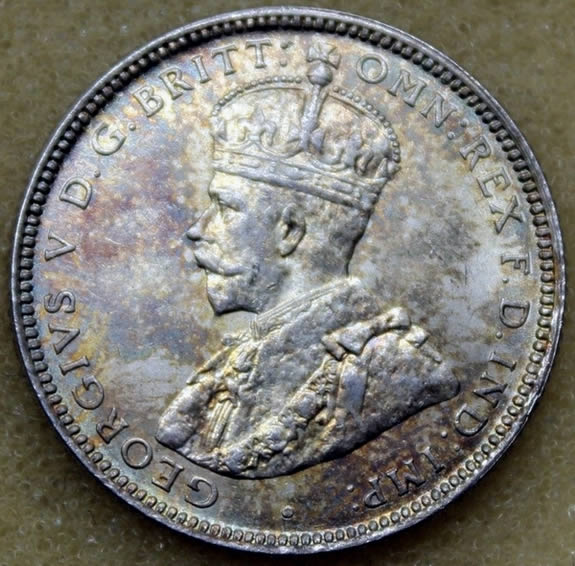 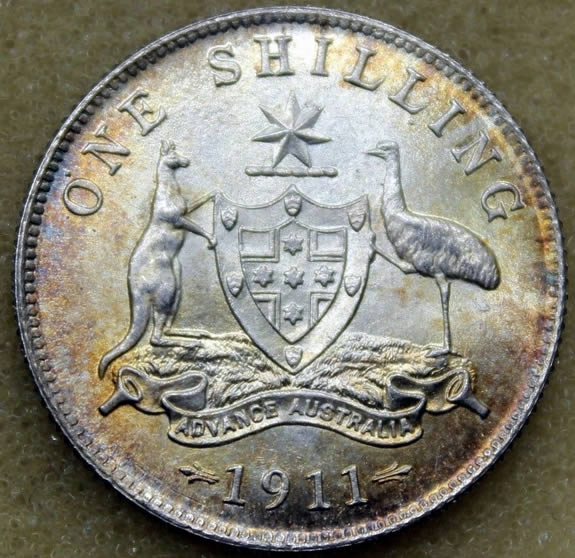 Notice [on reverse] the obvious die crack, and dots [above O, below L] and other very distinctive markings near Emu head that uniquely identify the die used. * * * Here is another 1911 shilling to be auctioned by Heritage auctions on April 20 - 24th 2018 at the CCE World Coins Signature Auction in Chicago. 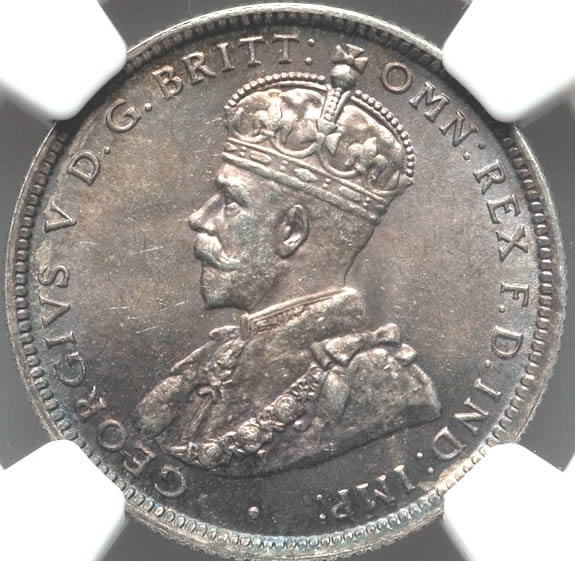 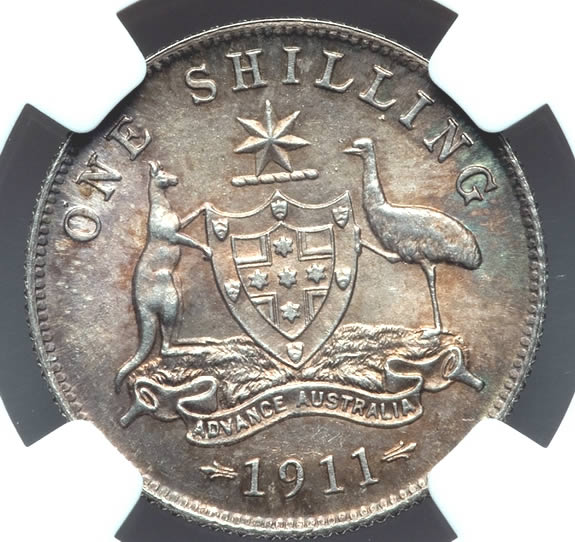 The die crack, dots, are all there -exactly- in the same place as the alleged counterfeit, it's the same die. There is no possibility that they are the same coin. The 2nd coin has been authenticated and graded by NGC as MS63. I am currently examining hundreds of hi-res images of this particular date, including all examples indexed by Google including all sold on ebay, to learn more about exactly what is going on here. Some have pointed out other details which are oddly consistent across several specimens but without good photographs, it's not easy to offer an informed opinion. Finning is very common on early Australian silver coins and is of no concern and may explain why some here suggest there an 'extra rim' which I don't see at all. More to follow, and any opinions welcome of course. |
|
|
|
New Member
Australia
36 Posts |
Why not send it in for grading. I'm sure you will find out then. Good luck. I hope it legit.
Cheers
|
|
Bedrock of the Community
Australia
21789 Posts |
A copy of a copy of a copy of a copy.........
With each successive generation, clarity of detail suffers.
Same for other objects besides coins.
You need an experienced specialist in this series who can reliably differentiate wear from lack of detail. That is one method of identifying a fake. Must examine closely in hand next to a known genuine example, looking for tiny differences.
The trouble with Third Party Grading is that the person who submits a coin in this series, has to know the guy who grades it, is also an experienced specialist in this series, as regards authenticity. Two different skill sets.
|
|
Valued Member
 269 Posts |
Quote:
Why not send it in for grading We don't have either coin. The top one is on ebay now and is in Spain. The bottom coin has been consigned to Heritage auctions and is in the USA waiting to be sold in Chicago next month. The Spain coin has [Aud] $771 on it. |
|
Valued Member
269 Posts |
Quote:
Must examine closely in hand next to a known genuine example, looking for tiny differences That's easier said than done. Quote:
The trouble with Third Party Grading is that the person who submits a coin in this series, has to know the guy who grades it, is also an experienced specialist in this series When does a submitter know the grader? Anyway .. The owner of the top coin is aware of this forum and basically thinks we're all idiots. The people here that have yelled 'fake' - I find very unconvincing. The arguments so far don't wash. I'm not going to question NGC's grade of the 2nd coin above. One of the controversial coins is on the way back from NGC and I'll publish the result the day it arrives. If I get a good grade, doubtless some will say NGC are wrong.. it's hard to win. Edited by CoinOS
03/06/2018 7:23 pm
|
|
Pillar of the Community
Australia
1045 Posts |
Quote:
Notice [on reverse] the obvious die crack, and dots [above O, below L] and other very distinctive markings near Emu head that uniquely identify the die used.
I don't have the skills to say its a definite fake but the dot above 'O' and below 'L' seem to only appear on these egs.,they are all of similar appearance and grade so far. I sorted through my 2011 Shillings(5) and those listed on ebay last night and none of the circulated egs had those markers. Only a small sample but we need more circulated egs of Coins with those Die markers,the 'O'& 'L' dots are easy to ID. Until then I wouldn't touch them,you can bet if they are fakes the next batch won't have those markers so the end result is a stuffed pre-dec.Coin industry. |
|
Valued Member
269 Posts |
Quote:
the dot above 'O' and below 'L' seem to only appear on these egs.,they are all of similar appearance and grade so far. I think I'm seeing those dots on the Canada 1911 too, but that seller's photo is no good. I asked the buyer to post a decent image here but maybe he's busy or doesn't want to. What makes it interesting is the matching example going to Heritages upcoming Chicago auction, which has been graded 63. I have a paid NGC membership, but they won't take a second look just because I ask. Most photos are useless, which I why I started with Heritages excellent photos, I'm still investing some time in that search and looking for an answer that make sense. Quote:
if they are fakes the next batch won't have those markers I have held off from the Spanish seller's auctions because of all the doubts raised. The dot-marked ones do all look eerily alike, that's a fact. Edited by CoinOS
03/07/2018 12:42 am
|
|
New Member
Australia
42 Posts |
Just my two bobs worth, oops I mean shillings worth. Die cracks and Cuds (dots) are often replicated on multiple strikes, I don't think they're a concern, unlike other dings from the minting process that appear to have been repeated. Such as those in and around the centre shield. |
|
Valued Member
269 Posts |
Quote:Die cracks and Cuds (dots) are often replicated on multiple strikes, I don't think they're a concern, unlike other dings from the minting process that appear to have been repeated Quite right. IMO The top coin is likely genuine. So are the others that have been questioned here on CCF. Transfer die counterfeits will retain & carry bag marks. I see no photographic evidence of that here or in the other threads whatsoever. Those spots are a bad die - not contact marks. Counterfeiters can work around that, but it's not evident here. The book "Numismatic Forgery' By Charles M. Larson [2004] discusses this - pp 156-158 is relevant and is viewable free online at Google books. I'm satisfied the coins are real. Edited by CoinOS
03/07/2018 4:14 pm
|
|
Pillar of the Community
Australia
852 Posts |
You DO have photographic evidence of 2 coins carrying bag marks. Both of those "shillings" have a scratch into the surface to the right of the star and another between the bottom of E and S. A scratch into a working die produces a raised line and a scratch into a hub would show in a number of dies (which didn't happen with the 1911 shilling). Case closed, they are 100% FAKE.
|
|
Valued Member
Australia
369 Posts |
Quote:
I'm satisfied the coins are real. In my opinion they are real. The existence of dots and scratches is not enough proof for me. They need to inspected in the hand and at least weighed to be positive. The strength of strike sways me towards the genuine side. I would not trust an overseas grading company to pass judgement. |
|
Pillar of the Community
United States
992 Posts |
When the weak strikes also include dual rims and raised die marks, together with a lack of detail, I'm not inclined to bestow the benefit of a doubt with my wallet.
|
|
Pillar of the Community
Australia
1045 Posts |
Quote:
When the weak strikes also include dual rims and raised die marks, together with a lack of detail, I'm not inclined to bestow the benefit of a doubt with my wallet. Exactly,the raised Die marks are a big worry but you need a good photo to ID,very easy to hide if the Photographer has skill. As I posted before I don't have the skill or knowledge to offer a definite opinion but several of the Oz. Coin Forum people that have posted here do,must be a big ? on these Coins. Enjoying the Threads. |
|
Bedrock of the Community
13014 Posts |
Quote:
What makes it interesting is the matching example going to Heritages upcoming Chicago auction, which has been graded 63. I have a paid NGC membership, but they won't take a second look just because I ask. If there's a legitimate question about authenticity Heritage would look into it and you would have a definitive answer for sure at the end. They've pulled things before if they found out they were fake or if they needed more time because they weren't completely sure |
|
Pillar of the Community
Australia
605 Posts |
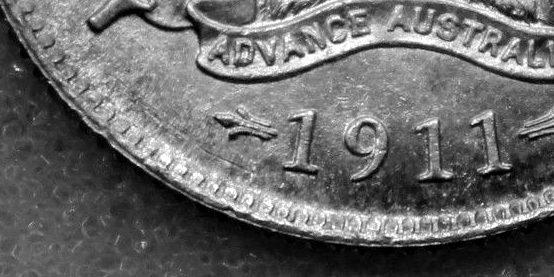 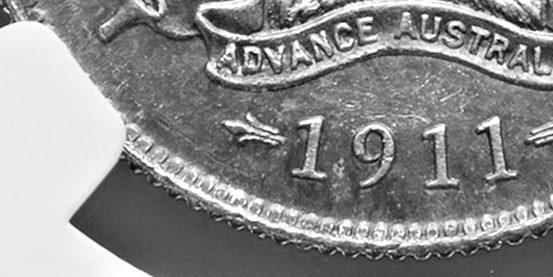 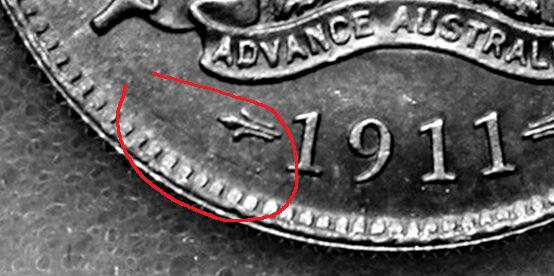 Three different 1911 shillings all with the exact same scratch. The evil sellers of these fakes are fully aware of this forum and these threads and will likely create new transfer dies. Watch your top knot
Edited by echidna
03/08/2018 09:55 am
|
|
Pillar of the Community
United States
4883 Posts |
Quote:
When the weak strikes also include dual rims and raised die marks, together with a lack of detail, I'm not inclined to bestow the benefit of a doubt with my wallet.  Quote:
Three different 1911 shillings all with the exact same scratch. Here in the U.S., some dollars have been indisputably exposed as phonies on account of their having precisely the same "bagmarks". Quote:
I'm not going to question NGC's grade of the 2nd coin above. Procedurally that's a investigative blunder. It's a fact that NGC, PCGS, et al have on occasion mistakenly certified particularly competent numismatic forgeries (I believe swamperbob has a collection of such within his area of interest and expertise). The focus here might better be placed on whether this is yet another case of that. Colligo ergo sum
|
| |
Replies: 42 / Views: 7,113 |










 Posted 03/06/2018 06:06 am


