| Author |
 Replies: 21 / Views: 2,972 Replies: 21 / Views: 2,972 |
|
New Member
Australia
26 Posts |
I recently acquired a 1692 token but am having difficulty in identifying its origin or use. It was described as a possible mining/colliery token. The token is made of bronze (or possibly copper), has a diameter of 27.9mm with a ///// edge. The obverse has a stag's head erased (family crest?) with bead ornamentation close to the rim. The reverse includes the 1692 date preceded by a dot and has what appear to be four acorns, the upper two with an indistinct shape between and the lower two with a star between. The reverse also has bead ornamentation. As the token is quite worn I have included a drawing (please excuse the poor quality). Does anyone have any ideas/clues as to the origin or use of this token?  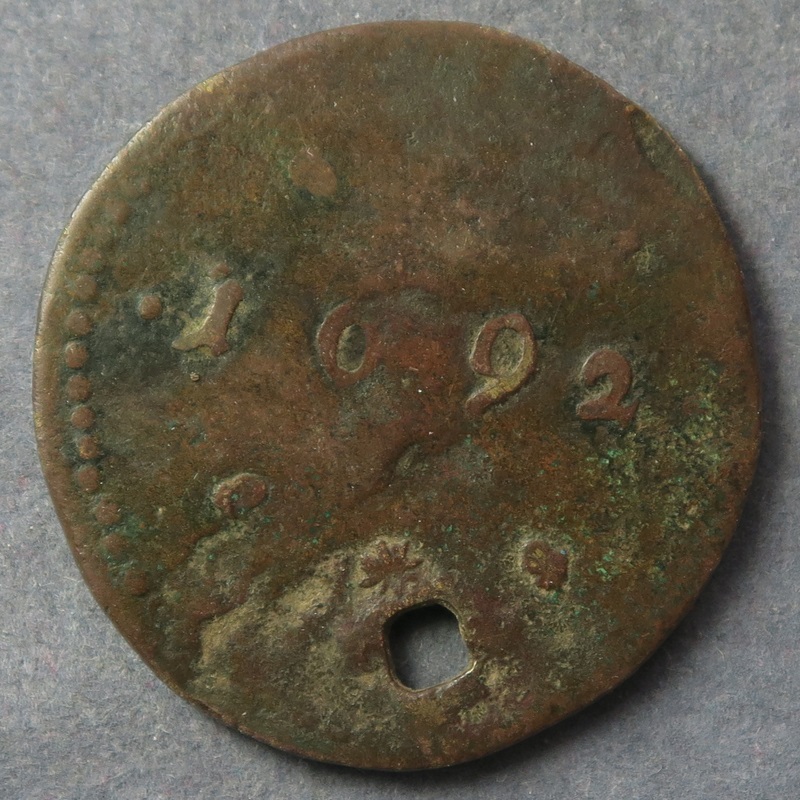 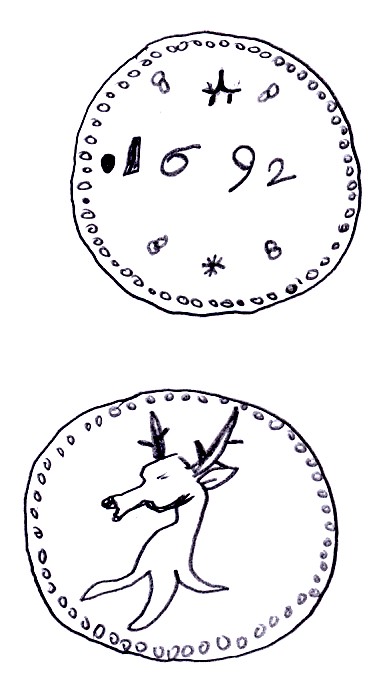 |
|
|
|
Pillar of the Community
United Kingdom
945 Posts |
 Interesting token, but sadly I can't immediately help you. I had a similar problem with a later token that had a Bear on it. Eventually tracked it down as a "Manorial token" issued by a posh household in Sussex. I think your best approach is to research the Stag's Head motif amongst family crests around 1692 - may well be Scottish or Northern England. |
|
Bedrock of the Community
United States
10284 Posts |
Your drawing of your token is a great likeness. I'll look around for a bit and see if I can be of any help. Neat token. Excellent presentation for inquiry and to CCF |
|
Bedrock of the Community
United States
10284 Posts |
Seems the same images once appeared on simmonsgallery.co.uk
No longer found there.
|
|
Moderator
 United States
197712 Posts |
to the Community! |
|
Pillar of the Community
 United States
6514 Posts |
Nice drawings.  Better than anything I could have come up with. Welcome to the Forum. You've come to a phenomenal place to share and learn. Explore and Enjoy. |
|
New Member
 Australia
26 Posts |
Thank you all for the responses - I have looked through Fairbairns Book of Crests but have not found this particular crest. The reference book lists "stag's head erased" as being used by a number of families but none seem to correspond with the correct time period (so far).
I am curious as to why it is dated - perhaps it was meant as a token limited for use during the stated year - for deer hunting / stalking? If that were true I wouldn't expect it to show so much wear. It was not listed as a detector find but it does show some corrosion. However, that doesn't explain the wear.
TNG - my token is the one from Simmons.
|
|
Moderator
United States
34570 Posts |
@landy, first welcome to CCF. Second, at least according to simmons gallery, this seems to be a coal miner's tag. With that said, most of the other examples of this seem to have counterstamped numbers and a more cleanly punched hole. I recommend reaching out to Simmons as this specific piece was in their possession at one point. If nothing else, it helps to establish some provenance for you.
"If you climb a good tree, you get a push."
-----Ghanaian proverb
"The danger we all now face is distinguishing between what is authentic and what is performed."
-----King Adz
|
|
Pillar of the Community
Australia
1624 Posts |
Hard to say without the token in front of me but I'm having trouble making a 6 from the image. Looks like 1092. Good luck...
|
|
New Member
Australia
26 Posts |
I decided to do a bit more research based on the assumption that a number of Scottish clans use the 'stag head erased' as an emblem and that the numbers (1692, or possibly 1092 given the "6" is indistinct) represent a year. Two options with a Scottish/date link were found. The option I believe offers the best fit is that the token was issued to commemorate the Glencoe Massacre which took place on 13 February 1692. The other (in my view less likely) option is that the token commemorates the William II led invasion of Strathclyde which took place in 1092.
|
|
Pillar of the Community
United Kingdom
945 Posts |
Well done for getting further with this!
The style and strike is all wrong for a 1092 date, unless it was struck a lot later.
I am not convinced of the Glencoe link. If this were the case I would expect to see some reference to the MacDonald clan crest, and I don't believe the stags head links to that at all.
The number still looks more like 1092 than 1692 to me, and so I would suspect this is a tally number of some sort - whether for mining or some other form of trade.
Another thought - the deer could be a Hind, taking you to the town of Hindhead?
Also the "8"s on your drawing look to be acorns - I wonder if that takes you to forestry?
|
|
Moderator
United States
197712 Posts |
Very interesting. Thank you for the follow-up posts.  |
|
New Member
Australia
26 Posts |
PaddyB - thanks for your reply and suggestions. I agree that a date of 1092 is unlikely and that the "8"s are acorns (as per my original post). I'll add forestry to my list of clues but acorns have appeared on a number of coins and tokens unrelated to that industry (the Parys Mines token series, George V threepence and sixpence etc. immediately spring to mind). Their use may symbolise fertility, growth and fresh starts.
Although the styling of the "1" is curious I am still leaning towards the number being a date as it is part of the die strike rather than being added later. This would rule out a sequence number as a new die would have to be created for each number. I have trade tokens that were used as a receipt for a specified amount of goods transferred but 1692 would be an odd amount to specify. The number could represent the year for which the token is valid (a hunting/access licence or toll or receipt for rent paid perhaps?) Interestingly, Land Tax was first introduced in 1692!
I still favour a Scottish link even though the MacDonald clan crest does not include a stag head. The stag head is a common feature in Scottish symbolism and in this form is used by a number of other clans and may signify clan solidarity, allegiance or support following the 1692 massacre. The antlers would rule out the head being a hind.
The star below the date may offer another clue. It has eight points and on closer inspection is similar to the eight-pointed Maltese cross form (and cross of Saint John) - a possible Scottish Knights Templar or Freemasonry link?
The obvious question with any of the options is why haven't more examples survived? I have other tokens for which the source has yet to be identified but for each I have been able to find other documented examples.
The research continues.......
|
|
Bedrock of the Community
United States
27514 Posts |
Landyman, you have a fascinating piece and the mystery is absorbing! Please keep us updated on your quest.
Inordinately fascinated by bits of metal with strange markings and figures
|
|
Pillar of the Community
Russian Federation
5186 Posts |
 on the number being almost surely 1692 rather than 1092; probably a date and not-implausibly a date of issue. Is that a cloud under the stag head? |
|
Bedrock of the Community
United States
12057 Posts |
Bushel or colliery token or barrel stave marker, perhaps
There was a Stags Head Colliery in Durham, and another in Flintshire; and the famous Stags Fall Quarries in the Dales, Yorks.
And, of course, a great many Stags Head restaurants, pubs, guesthouses, and inns (with or without the greengrocer's apostrophe!)
Member ANA - EAC - TNA - SSDC - CCT #890 "Most of the things worth doing in the world had been declared impossible before they were done." -- Louis D. Brandeis |
| |
Replies: 21 / Views: 2,972 |




 Posted 10/18/2021 10:57 am





