| Author |
 Replies: 65 / Views: 5,017 Replies: 65 / Views: 5,017 |
|
|
|
Pillar of the Community
United States
2752 Posts |
Pre-strike planchet damage would explain why the pinched edge persists. The two depressions would have been associated with lower effective striking pressure, hence less forceful planchet expansion in this area. Does the coin's weight fall within the normal range of variation? And where did you find it?
Error coin writer and researcher.
|
|
Pillar of the Community
United States
2376 Posts |
Mr Diamond, isn't there a bit of metal flow at the top of the N in Question. Also , if this were pre strike damage to the planchet, wouldn't the then created preasure ridge supply the extra metal to prevent the majority of metal flow design loss at the edges of the anomaly?
|
|
Pillar of the Community
United States
2752 Posts |
I don't see any metal flow in the N. But you're correct that the pressure ridge on a planchet with pre-strike damage would limit or eliminate metal flow in the design elements struck upon that ridge.
Error coin writer and researcher.
|
|
Pillar of the Community
United States
592 Posts |
I can see remnants of the devices inside of the affected areas. Specifically, the T in Liberty and the left side of Jefferson's face (his left) on the obverse and the steps of Monticello on the reverse.
If the planchet were damaged pre strike how would the device elements get into the damaged area?
|
|
Pillar of the Community
United States
3207 Posts |
if those indentations were on the planchet, given how thin the planchet was at that location I would think the force of striking to have a decent chance of splitting the planchet in half
also, the tip of Tom's nose is visible down within the anomalous strip, something I would not expect given that's one of the deepest parts of the obverse die
|
|
Pillar of the Community
United States
2752 Posts |
I don't see any trace of the design in the recesses.
Error coin writer and researcher.
|
|
Pillar of the Community
United States
3207 Posts |
I've attached magnified images with arrows that point perpendicularly to what look to be parts of Tom's nose, eye, and cheek within the obverse recess. 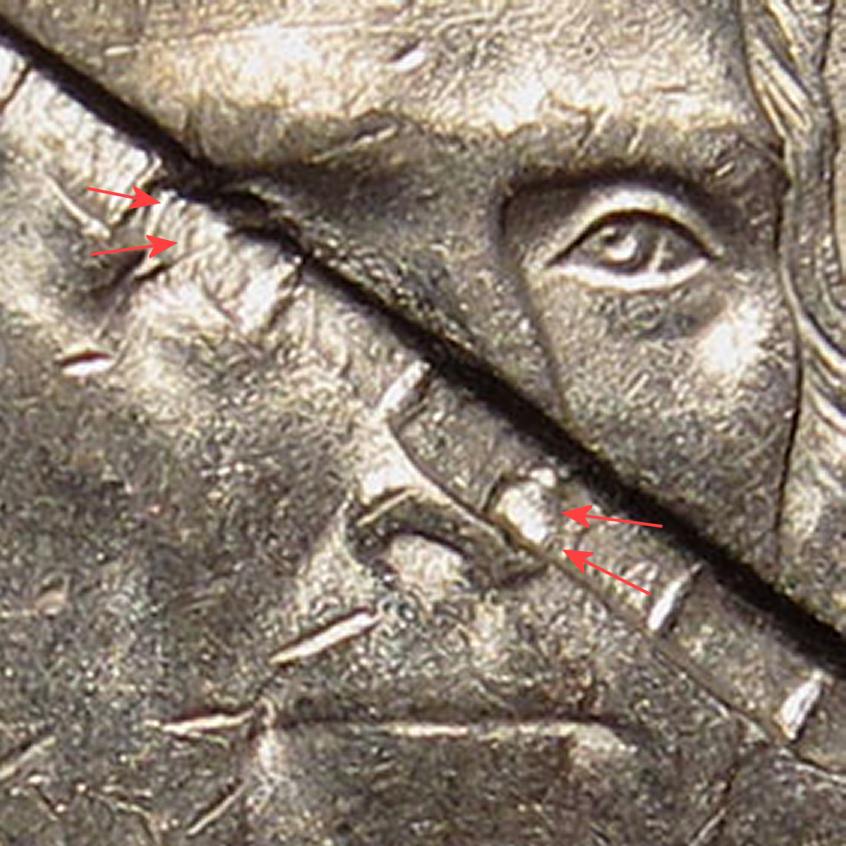 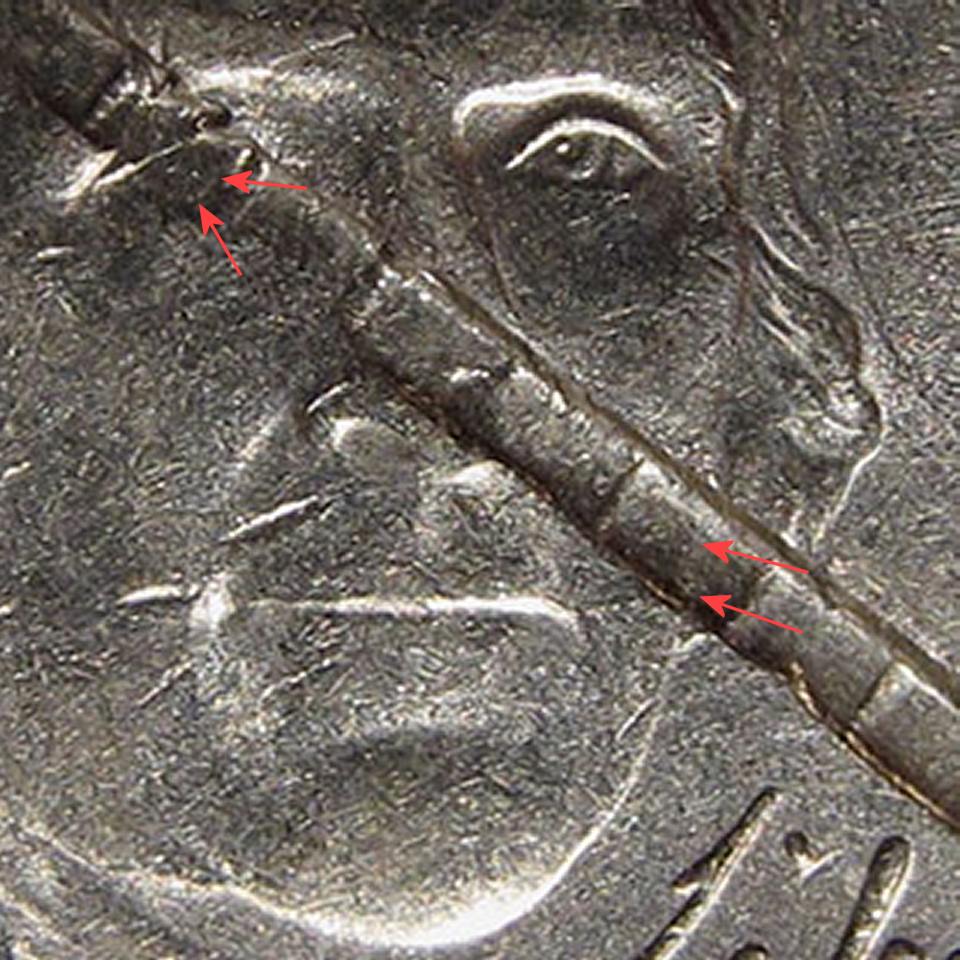 |
|
Pillar of the Community
United States
2752 Posts |
I still don't see any convincing traces of the design in the depths of the two recesses. You may simply be grasping onto any irregularity suggestive of a design continuation.
Error coin writer and researcher.
|
|
Pillar of the Community
United States
2818 Posts |
I'm sure TropicalBats will be happy to send this to you Mike for a definitive answer. It is interesting and I look forward to the verdict.
|
|
Pillar of the Community
Canada
6244 Posts |
I didn't want to come back, but I have to show something to you. Some part of the forensic of a coin, which maybe can help someone, somehow. I do not want to harm no one, please, understand this. What I will wrote is base of what it is a production of a coin? "=" APPLIED SCIENCE 1. Quote:
I would think the force of striking to have a decent chance of splitting the planchet in half I start with this because the planchet will never split if is well annealed and is no free moving space to bend. 2. 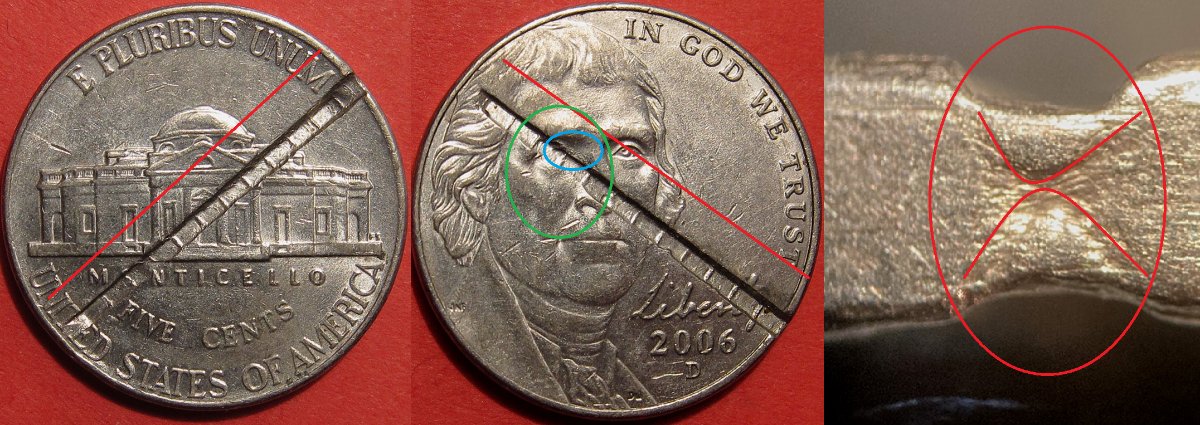 A. STRAIT RED LINES A. STRAIT RED LINES: The lines show how the forces was applied in angle to this planchet. On the both sides the N side of the mark is more profound which mean the planchet was in angle. B. RED CIRCLE ON SIDE: Show that heat was applied after mark was done and dispatch at end of the mark the moving material direction. There the material due to the mild high heat start to melt and make this small like hole with concentric melting metal lines. This is happening only in the melting metal. In this case the volume was smaller and the melting start there. C. RED ARCS SIDE COIN : Show that the moved coin material was flattered by the milling processes. D. GREEN CIRCLE : Show where the main forces of the strike was applied and then dissipate laterally, creating the high surface of the mark to change the shape a little bit. E. BLUE CIRCLE : Show that the material there have heat reflection and combinate with the heat apply start to form bulbs. In melting this is the first step of the metal to melt in the most thick parts. F. THE LETTERS T & E : Someone wrote that we see those letters printed. Yes normal because there is the most less affected part of the marks, and during the 80 tones applied; the metal will flow. G. INSIDE MARKS : Inside the marks I see some heating marks (strides) and also the rolls abrasive black material what was in time deterioration. THAT IS. I was sad when I see first that MIKE wrote, and very happy to see that him comeback with a supper conclusion wrote in numismatic terms. Guy's appreciate this because only big characters have the power to reflect of theirs's first view or reflection and then to come back to accept his, her mistake and put in place the correct and real. "CHAPEAU POUR TOI MIKE". Edited by silviosi
03/31/2022 02:48 am
|
|
Pillar of the Community
United States
2775 Posts |
More food for thought. Could a hefty pair of pinch pliers make a similar impression? Thanks, Doug.
|
|
Pillar of the Community
Canada
6244 Posts |
|
|
Pillar of the Community
 United States
5902 Posts |
Thanks again Mike and I'm sure it will be on the way once TB revisits. The N extending into the "trench" by a significant amount and the edge image showing no PSD (still mint luster even?) was what convinced me this can't be PSD. Words of encouragement are one of the major food groups.
We need to consume them regularly to thrive and grow.
|
|
Pillar of the Community
United States
2376 Posts |
The only process between blanking and striking that I can think of when a foreign object could have been pressed into a coins edge to remain for the strike would be the upsetting mill.
|
|
Valued Member
United States
426 Posts |
Figured it was PMD/PSD right away interesting to read this ongoing thread
|
| |
Replies: 65 / Views: 5,017 |








 First Page
 Previous Page


 Posted 03/30/2022 4:58 pm


