| Author |
 Replies: 54 / Views: 2,518 Replies: 54 / Views: 2,518 |
|
|
|
Pillar of the Community
 United States
6928 Posts |
|
|
Pillar of the Community
United States
6928 Posts |
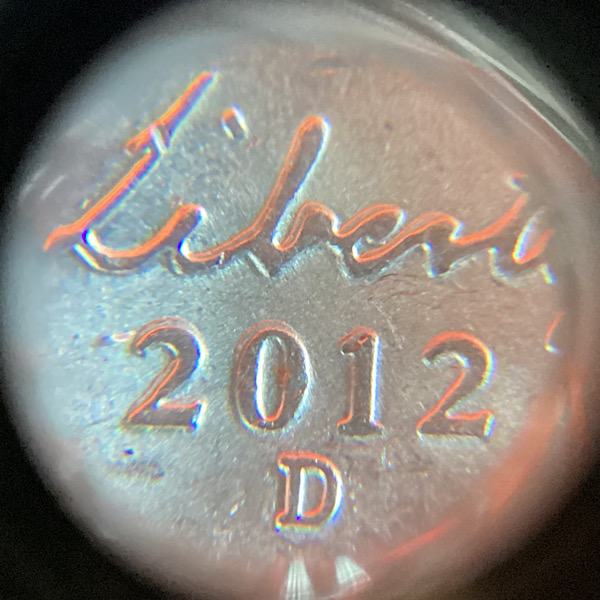
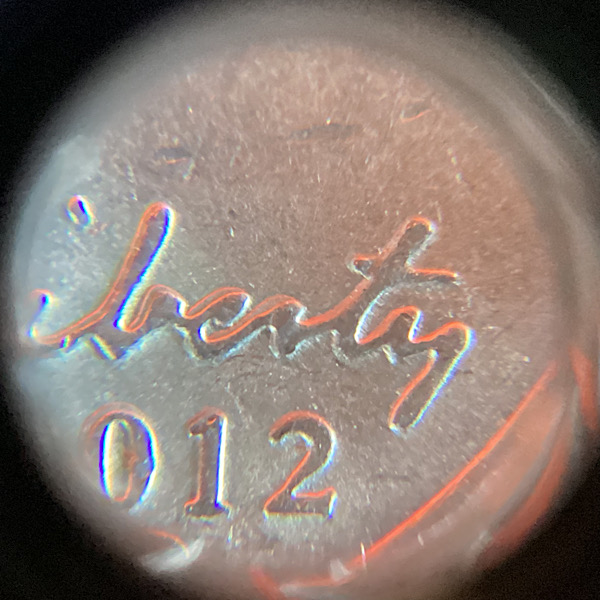
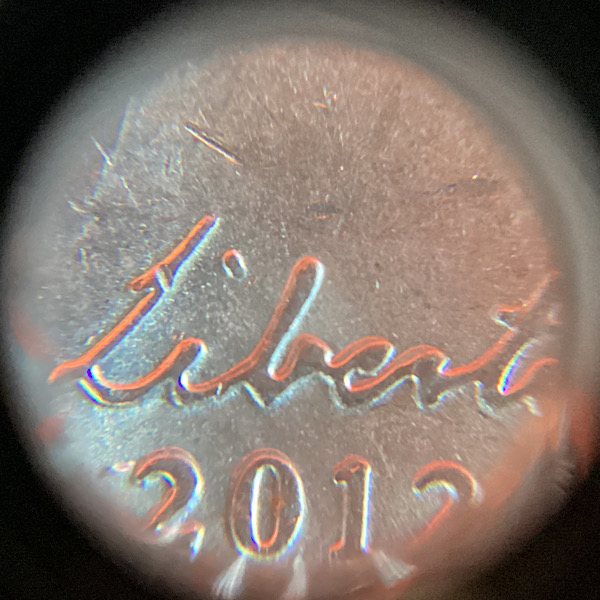
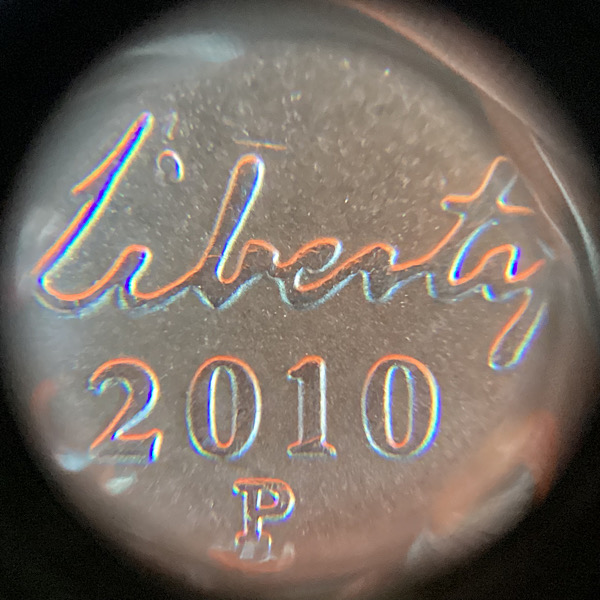
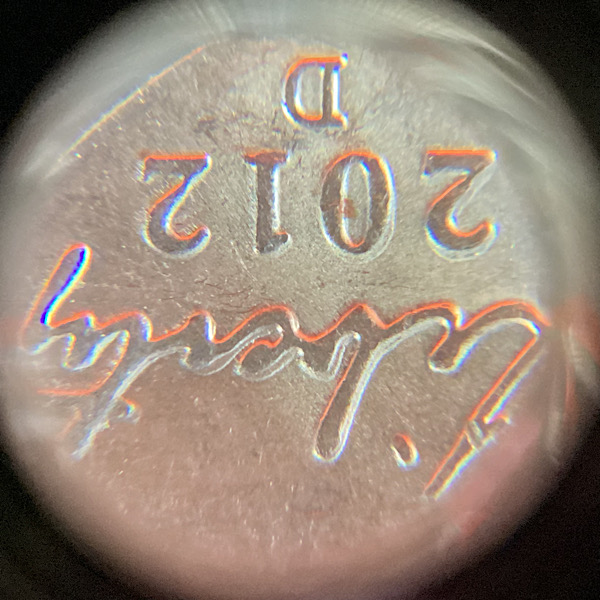
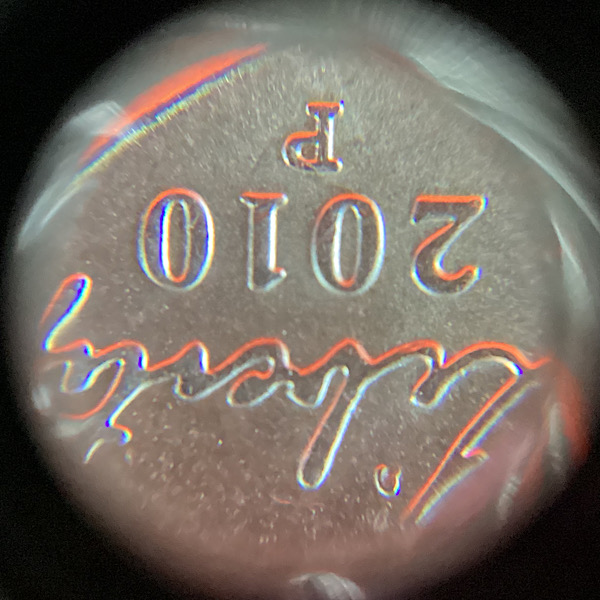
In all honesty, when I'm looking at these images, the 0 and 2 do not seem withered compared to the perfect 2010-P. If you drew the outer edge all the way around the double, I think you would have a fat and misshapen 0 that does not match the good copy.
The narrow neck of the 2 seems a little chewed down, but the top and base seem to match the 2010 exactly.
|
|
Pillar of the Community
Canada
6244 Posts |
Funny post this. @ Brandmeister: If you want to understand well MD (is generic name in numismatics), you have to study: 1. Strike Doubling (die) 2. Machine Doubling (striking) 3. Mechanical Doubling (ejecting) Those are the three forms included in generic name MD. |
|
Pillar of the Community
United States
6928 Posts |
@silvio: This subject needs a better quick reference. Error-ref.com lists errors by cause, which assumes you already know the cause. Coop's encyclopedia of 200+ annotated images is very complete, but also somewhat unstructured.
Surely there exists a short article that can quickly diagnose a particular doubling effect back to a specific root cause. A diagram, a few sentences, and some visual examples would make a much better beginner's guide.
|
|
Pillar of the Community
Canada
6244 Posts |
@ Brandmeister: I can tell you, Ken Potter, Favas, Stanton (RIP), Herbs (RIP), Wexler, Mike Diamond and here COOP wrote about this subject. If you want to go deep an understand and achieve more structured way I suggest you ANA Academy. I do not come here to teach but to give opinions and to show the path someone to take. It is no short way to learn this hobby, and if you expect someone will give on the plate everything's you can forgot this hobby. Those peoples I mention before they studies this hobby for decades and even all theirs life. Many books was wrote and many publications, so just studying and practice will made you achieve your goals. |
|
Pillar of the Community
United States
6928 Posts |
I dispute your theory. In just two days, I have already learned a great deal on this subject from nick, Dearborn, and numidan. I have discovered new terms to learn, new articles to read, and better questions to be answered.
The experts you listed have decades of experience and a very deep knowledge of this subject. I doubt I will ever approach their level of expertise, nor does that seem necesssary to answer my beginner questions. I don't need to be Tiger Woods to enjoy a round of golf.
Correctly identifying doubling seems to be a popular question for newbies here. Perhaps when I have compiled a sufficient knowledge, I will write the clear, concise diagnosis guide that I have suggested (assuming I haven't found a good one by then, because it almost certainly exists). Something akin to the error-ref.com section on how to distinguish a weak strike from a grease strike.
|
|
Valued Member
Canada
219 Posts |
@Brandmeister, thank you for the extra pictures much appreciated. Quote:
Surely there exists a short article that can quickly diagnose a particular doubling effect back to a specific root cause. A diagram, a few sentences, and some visual examples would make a much better beginner's guide. Read the topic (link given on page 1 of this post) and you will see that I have tried this. The best way to figure out if it is MD or not is by comparing a normal coin with one that has a doubling to determine if the device is larger or reduced. Quote:
Perhaps when I have compiled a sufficient knowledge, I will write the clear, concise diagnosis guide that I have suggested Not too long ago, on the CC's Canadian Discussion forum, O'connor asked the same questions as you about doubled die. Compiled sufficient knowledge and just released his first book on Canadian Doubled dies. https://www.mcddv.ca/So yes, with perseverance you can "enjoy a good round of golf" ;) Edited by numidan
06/11/2023 09:43 am
|
|
Pillar of the Community
United States
6928 Posts |
Apologies, I must have missed that particular link in your post. Your diagrams are excellent! Also a really thorough discussion. I am adding that to my favorites so I can read it again tonight and try to absorb everything. I will read the Canadian doubled die site as well.
To paraphrase a brilliant man: If you want to get good at anything worthwhile, you are going to have to accept being terrible at it when you start.
Also, like golf, I have discovered that the sting of coin collecting inadequacy is easily smoothed over with a couple pints. Cheers!
|
|
Pillar of the Community
United States
3207 Posts |
Many of the finer details that distinguish one coin anomaly from another become apparent only by angling that coin and observing light reflecting off the critical areas. Such details are difficult to express in words. Even a video can't fully show them because video is a projection onto a flat screen, whereas a coin is, of course, three dimensional. When drilling down to the level of detail you want, Brandmeiter, there is no substitute for practice with actual coins. The questions you've been asking demonstrate you've been making progress, good job!
|
|
Pillar of the Community
Canada
6244 Posts |
For me it is Interesting how the back and forth is developing. You dispute my theory? Your opinion and I respect. the last two posts give you a really good way to follow. But for this and is my example. I had to invest 3800 $ in a new photo system. I sill have the forensic software so I can see better. I gave you the three major classes of your subject, but in each class you know has other subclasses. Numi is one of the masters in three dimensional. Nick is perfect right. Me I develop a way to rotate the three dimensional to see. Damage I can not show here due to the ways photos work.
I will look forward for yours analyzes. To complete NUMI: O'connor has many years of studying coins, him ask and then know about relative knowledge of different communities in this hobby in order to be explicit in his book..
Edited by silviosi
06/11/2023 5:53 pm
|
|
Pillar of the Community
United States
6928 Posts |
I have been doing a lot of reading on Machine Doubling. My summary, some conclusions, and then questions. I think we all agree that this is not a real doubled die example. (Actually, I don't think anyone ever proposed that, but I am being 100% clear). The question here is: what specific kind of Machine Doubling happened to this coin? We have correctly proportioned devices accompanied by a thin duplicate shelf in a single uniform direction. This does not appear to be Die Deterioration Doubling. DDD examples on Error-ref.com look soft, rounded, and mushy. Our specimen is sharp, flat, shelf-like. The overall obverse coin strike looks pretty clear. Error-ref.com lists three sub-types of Machine Doubling during striking. Rim-restricted doubling is not relevant here. Slide doubling, which smears the design as the die drags across the newly struck coin, also doesn't seem to be a candidate. The ER description of Push Doubling matches a lot of Coop's examples in the #1-30 range. But that's the complete Machine Doubling entry at Error-ref.com. ER also lists flat field doubling for twice struck proofs (not relevant here), and ejection doubling, which produces effects like Sacagawea's extra eyes (also not relevant here). I note that visually the effect here is very similar to flat field doubling on proof coins, but that's obviously excluded from the possibilities. The problem I have with a push doubling conclusion is that the devices here do not seem to be cut into a shelf by a subtractive process. Everything is basically the correct size and outline, with a thin duplicate shelf underneath. Numidian has showed that quite well with his overlays. Approaching #100 in the Coop slide deck, we encounter "die movement doubling". It's a term I had not heard before on any site like ERef. The device appears correctly struck, but a shelf edge has been "pushed". That looks pretty darn close to my nickel. However, the term "die movement doubling" produces no results on Google. Obviously it's a phenomenon separate from the subtractive Push Doubling process. Is there a formal term for DMD? What is the cause? It doesn't seem like DMD can have the same cause as PD because PD relies on cutting some of the device metal into a shelf, which thins the devices. Nor does DMD seem that it can be caused by Slide Doubling because that process smears the metal. So what is Die Movement Doubling, what specifically causes that, and is that what happened on this nickel? 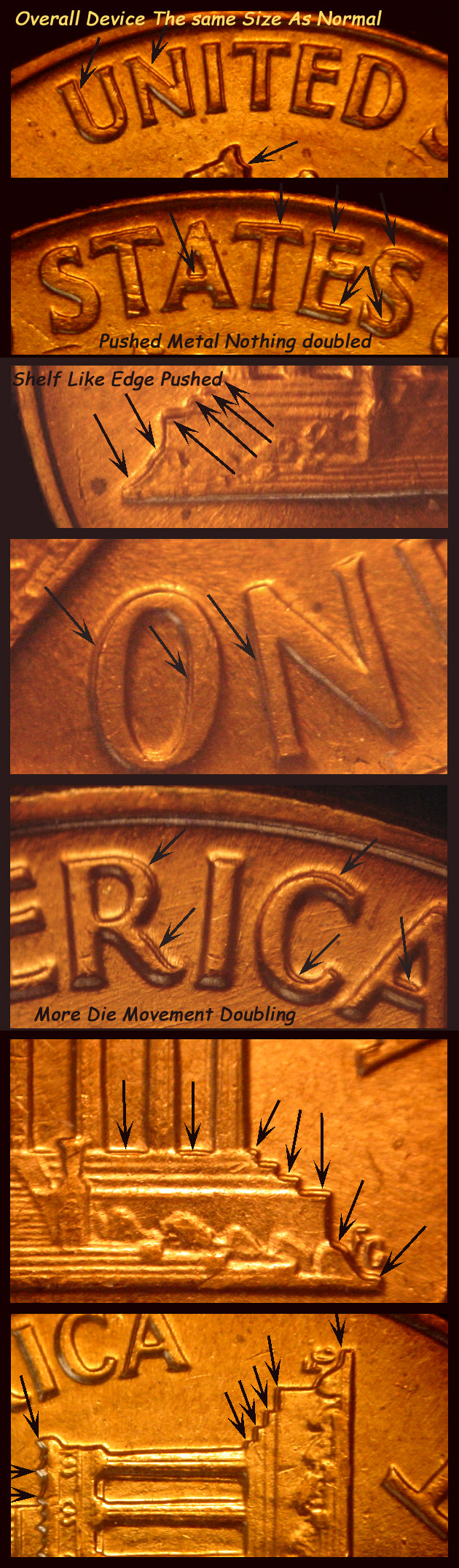 |
|
Pillar of the Community
United States
6928 Posts |
There is also something called "abrasion doubling" on Wexler's site. Heavy polishing of a die after a clash produces an effect similar to Die Deterioration, but in specific areas and apparently without the overall deterioration markers of DDD. Edit, forgot link: http://doubleddie.com/144864.htmlEdited by Brandmeister
06/12/2023 5:02 pm
|
|
Pillar of the Community
United States
6928 Posts |
In re-examining the nickel vs. the reference coin, I am now noticing that the strike seems shallower and less distinct than the second coin. I had initially assumed that was circulation wear, but maybe that is a sign of some Die Deterioration or polishing? |
|
Pillar of the Community
Canada
6244 Posts |
@ Brandmeister: Very nice work to understand, but what I do not understand why so much energy for uncollectable coins? The last link from Wex show an subcategory of DDD. Why you do not focus more on DD's? Seem to me you are able to come with something is the interest in collecting. Any form of MD is just a normal (me I say junk coins) face value. I agrees that if is MD coin at MS 66 or MS 67 is collectable till you find one clear. |
|
Pillar of the Community
United States
6928 Posts |
Quote:
Very nice work to understand, but what I do not understand why so much energy for uncollectable coins? It's a fair question. I am an engineer. The science of things matters to me. When I do a root-cause analysis, I get to a satisfactory explanation or I keep digging. I have very much enjoyed this discussion so far, even if the coin is worthless. I think people here give an answer of Machine Doubling (really meaning push doubling) far too easily. If the cause does not correctly explain the effect, then the scientific method requires further investigation. The term Machine Doubling itself seems to encompass a large number of common and uncommon scenarios that are not identical in formation or result. If we cannot point to a specific type of error from a specific cause, then that is guessing, not knowing with confidence. Also, the doubling question seems to arrive often from newcomers to this site. True die doubling is probably 1% of those cases. The various forms of MD/DDD and other manufacturing flaws are 99% of those cases. So all we have to do is guess Machine Doubling every single time, and we are likely to be correct with a 99% record. If we are looking for a valuable and rare 1%, then that is not a very useful strategy. I could throw out every tiny transparent mineral in my prospecting pan, but that guarantees I will never find a diamond. I would, however, be correct 99.99% of the time. Does that represent a mastery of diamond prospecting, or merely describe a basic grasp of probability? It seems quite possible to be 99.99% correct and achieve a result of $0. It is also worth asking the question in reverse. If I am sure that a coin has true die doubling, then I must first rule out worthless forms of doubling. Some of the legitimate forms of doubling like distended hub doubling seem to look very much like MD/DDD. How can I be trusted to identify a diamond if I cannot immediately dismiss quartz, glass, and other lookalike minerals? This seems especially important for doubled die coins, because the odds of finding one are tiny. A collector seems much more likely to purchase such a coin. You don't buy a Rolex if you can't identify a Rolex. I guess you can buy a Rolex from a certified dealer, but then you're just "buying the slab, not the coin". If I had found a different type of interesting error in a roll of nickels, I would be doing a deep dive on that subject instead of this one. =) |
| |
Replies: 54 / Views: 2,518 |





 First Page
 Previous Page



 Posted 06/10/2023 1:00 pm


