| Author |
 Replies: 30 / Views: 2,533 Replies: 30 / Views: 2,533 |
|
New Member
United States
4 Posts |
*** Edited by Staff to Add Year / Mintmark / Denomination to Title. It's very important to have in the title. ***I found this coin in my first coin rolling and was like hmm could someone help out thanks &  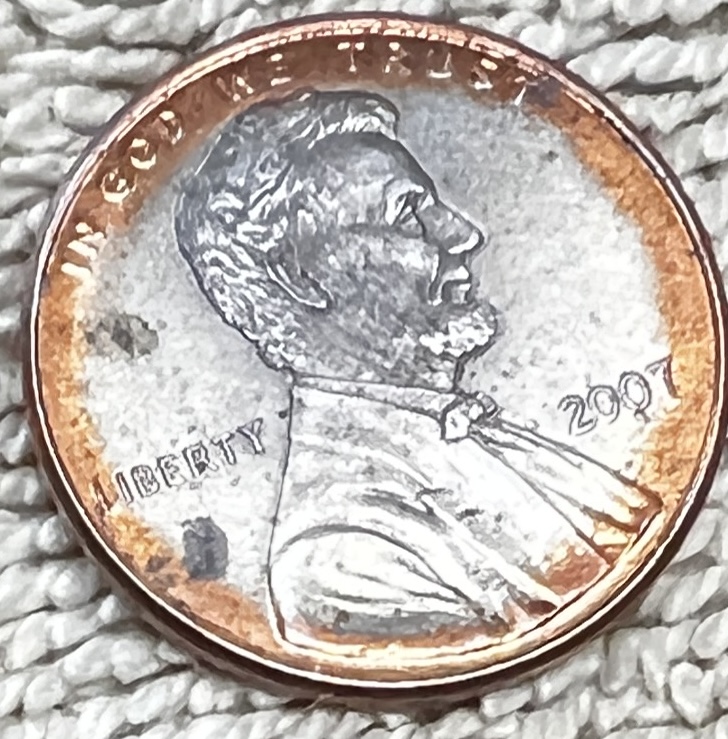 also first time in here :)
|
|
|
|
Bedrock of the Community
United States
19649 Posts |
What does the reverse look like?
|
|
Pillar of the Community
 United States
7174 Posts |
 to the CCF Looks like a bad plating job. |
|
Bedrock of the Community
United States
79802 Posts |
To CCF! What does the reverse look like? Errers and Varietys.
|
|
New Member
 United States
4 Posts |
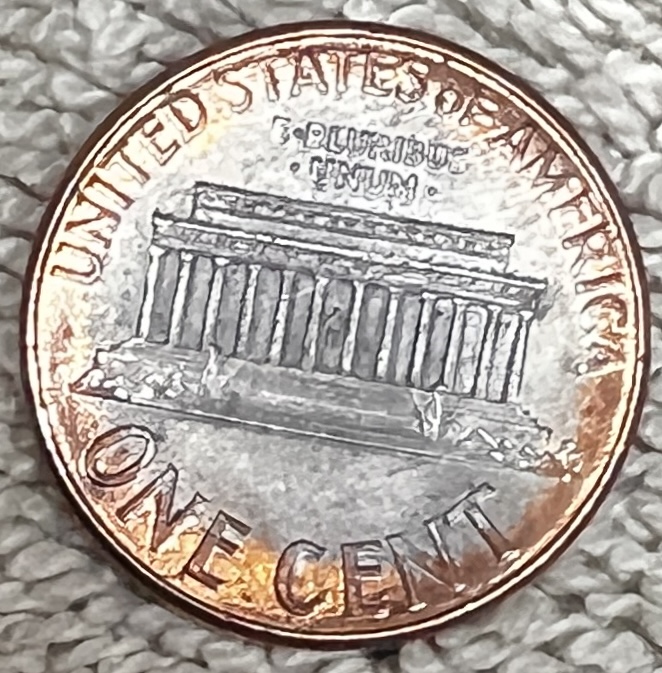 The reverse is the same |
|
Bedrock of the Community
United States
94367 Posts |
to the CCF! |
|
Moderator
United States
108581 Posts |
 we have seen this before - an improper copper plating on the zinc core. |
|
New Member
United States
4 Posts |
Thanks so much for the warm welcome already really enjoying the site!
|
|
Bedrock of the Community
United States
10601 Posts |
Sure does look like the real deal (improper plating) - Great find for roll hunting.
|
|
New Member
United States
4 Posts |
Does this affect the coins value at all? Or is it still worth .01? I think anyway cool add to a collection . Would it be worth having it graded? What do you all think ? & |
|
Pillar of the Community
United States
2752 Posts |
I don't believe this is a genuine example of a cent struck on a partially plated zinc planchet. I've seen far too many fakes with this pattern of bifacial, centralized zinc exposure.
Error coin writer and researcher.
|
|
Pillar of the Community
United States
7174 Posts |
Mike, I opened up some string rolls of 95P. These coins were new and never been circ. They ranged from a little spot to almost completely un plated. Out of about 20 rolls, I ended up with over 2 rolls of them. I'm sure there was a problem with the plating tubs they used to plate them. Here are a few of the coins I found.  |
|
Pillar of the Community
United States
2752 Posts |
New or not, I don't think your cents were struck on partially plated planchets. The pattern of zinc exposure (or copper discoloration) is all wrong and the dull luster is contrary to expectations. Perhaps some chemical reaction occurred inside the Mint or between the Mint and the coin-wrapping facility. I invite you to send me a representative sample for further study and analysis. In the meantime, I will try to reach out to metallurgists to see what insights they might offer.
Error coin writer and researcher.
Edited by mikediamond
02/22/2024 6:44 pm
|
|
Pillar of the Community
United States
2752 Posts |
Bing's AI tool provided one answer: Solid-State Diffusion:
Diffusion in solid-state materials occurs when different materials mix together at the atomic level within a solid host material.
For diffusion to happen, there must be a concentration gradient, and the rate of diffusion is significantly influenced by temperature.
Metallic solids have atomic vacancies and other small-scale defects that allow atoms to exchange places.
High temperatures are often necessary for atoms to have sufficient energy for exchange.
Copper-Plated Zinc Pennies:
Post-1982 pennies consist of a zinc core with a copper-plated shell.
When these pennies are subjected to elevated temperatures, an interesting phenomenon occurs.
The copper layer on the penny appears to disappear, leaving behind a zinc-colored surface.
This disappearance is due to the diffusion of copper into zinc.
Why Does This Happen?:
The copper and zinc atoms at the interface of the penny experience a concentration gradient.
As the penny is heated, copper atoms from the plated layer migrate into the zinc core.
Eventually, the copper layer becomes thin enough that it seems to vanish, revealing the underlying zinc.
Practical Implications:
In engineering applications, metals are often chosen for processes carried out at high temperatures.
Undesired diffusion processes can occur, affecting material properties.
For example, if copper plating is too thin, zinc can diffuse through it and interact with the underlying material (e.g., steel).
In summary, while zinc plating on copper is technically feasible, diffusion of zinc into copper does occur. The resultant material at the interface may even become brass due to this diffusion process
Error coin writer and researcher.
|
|
Valued Member
United States
116 Posts |
Here are some cents I heated on the stove and "painted" with a butane torch. 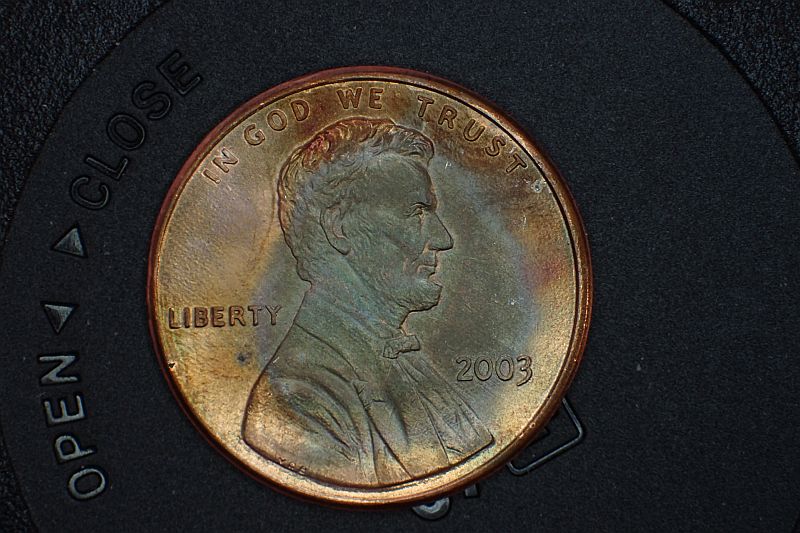 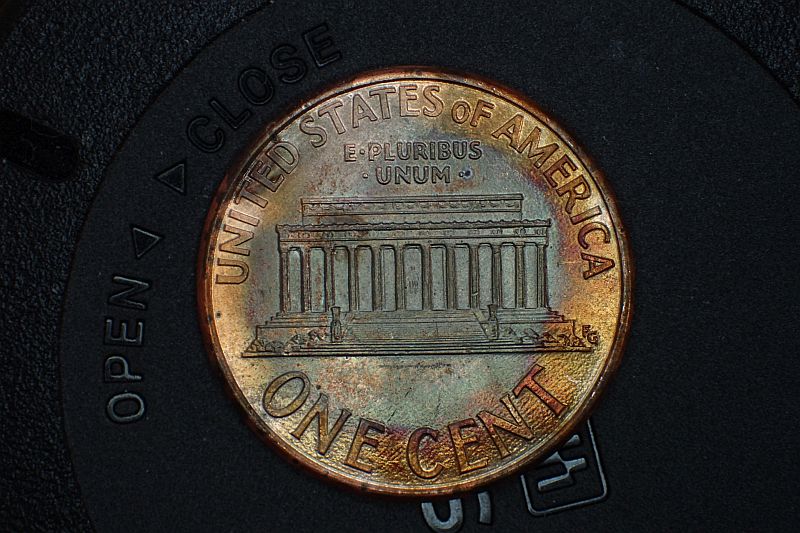 Heat can mix the zinc into the copper and change the coins color. Here are some other "Stove Top Specials" I made. The upper left cent is natural.  Edited by J-Tal
02/23/2024 06:36 am
|
|
Pillar of the Community
United States
2752 Posts |
Thank you for posting the results of your experiments, J-tal. I notice that with the first cent, the color of the copper in the outer ring has also been changed a bit. This is not the case with the cents posted by Cujohn. However, I expect there are ways to produce a solid-state diffusion effect without altering the color and luster in the outer ring. Solid-state diffusion may occur spontaneously for all I know, although I'm no metallurgist and cannot speculate on the necessary conditions. All I'm confident of is that Cujohn's coins and the innumerable other examples I've seen over the years do not represent incomplete plating errors. They may not all be fakes (i.e., intentionally created), but I'm confident that the zinc bulls-eye forms after the coin has been struck. Creating even more confusion is the fact that some incomplete plating errors do assume a bulls-eye pattern, although they look very different from these presumed solid-state diffusion cents.
Error coin writer and researcher.
|
| |
Replies: 30 / Views: 2,533 |




 Posted 02/21/2024 6:25 pm





