| Author |
 Replies: 28 / Views: 6,665 Replies: 28 / Views: 6,665 |
|
Valued Member
United States
126 Posts |
Ok first off I understand alot of these topics are useless without pics, but I am having trouble getting a clear pic. I came across a 1974 D with sharp doubling in the date (all numbers), nose and forehead of old abe. I have browsed the site and saw alot of mech doubling, but most were very weak doubling. The one I found has crisp doubling. Are there any pics of strong, sharp mech doubling or is it possible that I may have a real DDO? I will try to put a pic on soon, but having problems with lighting. |
|
|
|
Moderator
 United States
56855 Posts |
|
|
Bedrock of the Community
United States
62064 Posts |
Here are few examples of Machine Doubling. 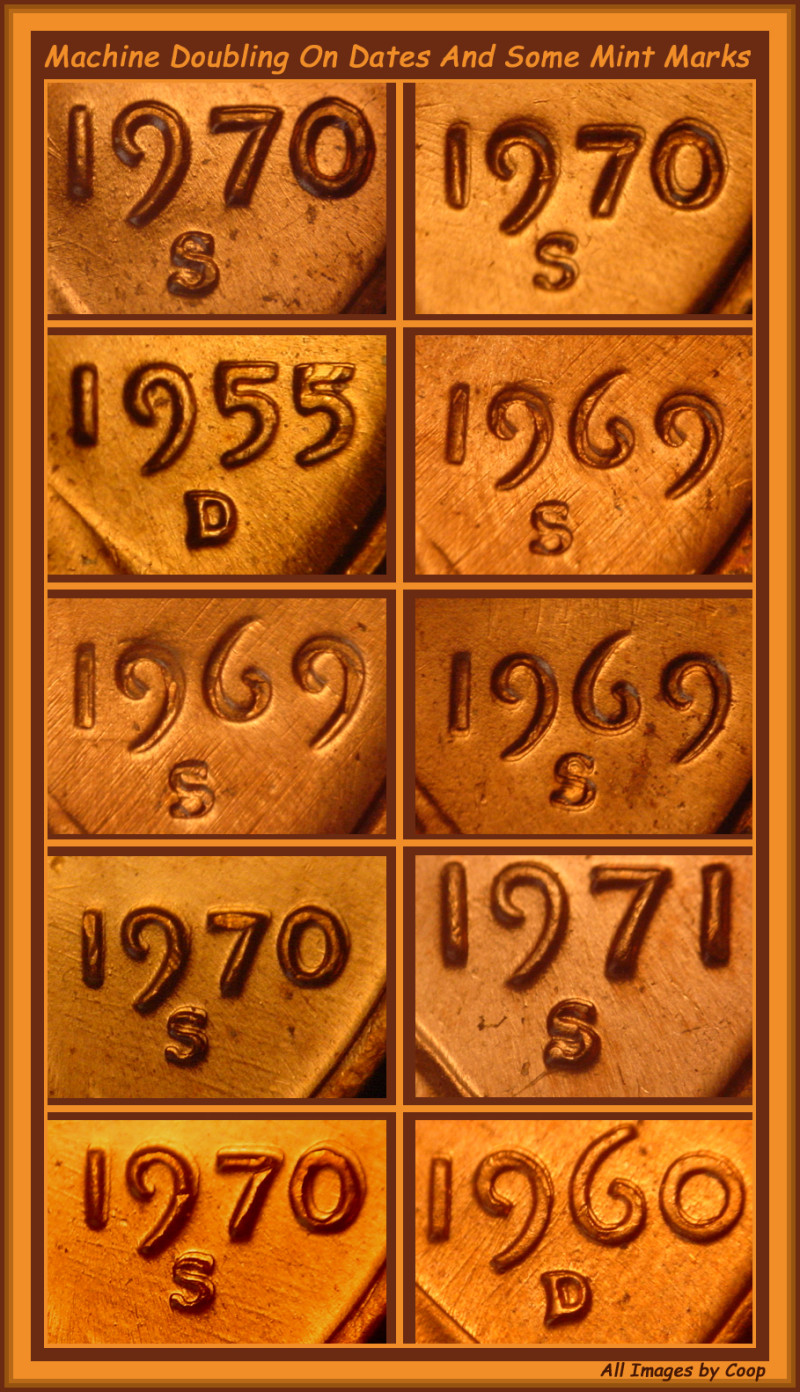 Mechanical is the wrong term. Machine is the correct one that most collectors use. |
|
Pillar of the Community
United States
1882 Posts |
Quote:
Machine is the correct one that most collectors use. Or Strike Doubling? |
|
Pillar of the Community
United States
1807 Posts |
Here's a comment I made about ' Strike Doubling' on another forum and got a royal 'A' chewing for it. "It is not part of the strike, the damage occurs after the completion of the strike, so obviously it cannot be Strike Doubling. The cause is the bouncing of the die or die holder assembly on the struck coin. The strike ends with the final impact of the die pair. That's why I feel the term ' Strike Doubling' would be an improper term because MMD happens after the strike". If I'm way wrong be gentle this time. Thanks |
|
Pillar of the Community
United States
7629 Posts |
Okay...a lesson in proper terminology... ALL doubling that occurs with normal dies at the press is ' Machine Doubling' - NOT Mechanical Doubling - that's not even a numismatic term. There are essentially three different kinds of Machine Doubling - Strike Doubling, eject doubling, and abraded die doubling. The term Machine Doubling is a broad term used for doubling that occurs because of and during the strike. They differ greatly from doubled dies in that the die is often completely normal in Machine Doubling, Machine Doubling is far more common, and Machine Doubling is not organizable by die because every coin has different doubling characteristics. Conversely, doubled dies have the same attributes from coin to coin because the doubling is actually on the die itself. The basic types of Machine Doubling: Strike Doubling is the effect of a second slightly shifted strike on a coin. Also called flat field doubling, and most often mistaken for the more general tern ' Machine Doubling'. Eject doubling is the effect of the die 'scooping up' the edges of devices as the coin is ejected. Its appearance is very similar to Strike Doubling, but has many slight differences that show to the somewhat experienced eye. Abraded die doubling can happen in two ways. First, a die wears out and starts to chip away close to the rim. Also called Die Deterioration Doubling, this is yet another form of Machine Doubling. |
|
Pillar of the Community
United States
2752 Posts |
I have to disagree with coppercoins on a few points. " Machine Doubling" is the same thing as " Mechanical Doubling", "machine damage doubling", " Machine Doubling damage", "strike doubling, "ejection doubling", "shift doubling" and probably a few more synonyms I'm forgetting. While some "ejection doubling" might be caused by the ejection process, it is visually indistinguishable from other forms of Machine Doubling and therefore must be lumped in together with all other forms. Most forms of Machine Doubling are caused by a loose die, loose die assembly, press vibration, or some other source of die/press instability such as a loose cam. There are two subtypes of Machine Doubling. "Push doubling" occurs when a die bounces after completion of the downstroke, shifts to one side, and then lands lightly on the freshly struck design. This produces a flat shelf along the margin of the design and rounded doubling in the interior of the design. "Slide doubling" occurs when the die shifts laterally when it reaches the lowest point of its downstroke. It drags itself through the newly-minted design, smearing it and piling up metal in a series of ridges. Of course you can have intermediate conditions involving both bounce and slide. It's basically Alan Herbert who decided that Machine Doubling is "damage". Some have fallen in line with his opinion. I happen not to share it. I consider Machine Doubling to be a legitimate striking error, even though it occurs after completion of the downstroke of the hammer die. Declaring the minting process over as soon as the downstrike has reached its lowest point is an arbitrary decision. Abrasion doubling (both "outside abraded die doubling" and "inside abraded die doubling") is largely a myth. It is NOT Die Deterioration Doubling. Aside from a few possible cases among cents in the 1970s, I've never seen a convincing example. Most of those trotted out as examples are simply cases of Die Deterioration Doubling. Die Deterioration Doubling is NOT Machine Doubling. "Flat field doubling" is not Machine Doubling, if we accept Alan Herbert's definition. It's doubling seen on proof coins and is a side effect of the multiple strikes that proofs receive. In essence, it is an indicator of multiple strikes. Error coin writer and researcher.
Edited by mikediamond
05/01/2009 11:03 pm
|
|
Pillar of the Community
United States
1807 Posts |
I guess what I need to know now is, when can "ejection doubling" not be " Machine Doubling"? |
|
Valued Member
 United States
126 Posts |
I appreciate the input. I think one side of my mind was thinking Machine Doubling, but the other side typed mechanical. I had come across a couple pics of 1974 D DDO that my coin has characteristics of. As soon as I can get a descent pic I will put it up. -Brave Rifles |
|
Pillar of the Community
United States
2600 Posts |
|
|
Bedrock of the Community
United States
62064 Posts |
Mike here is an example of abraded die damage.  Here are a couple Ejection damaged coins.   If they are incorrect, let me know and I can correct them. |
|
Pillar of the Community
United States
2752 Posts |
Why would you attribute the distortion seen on the 1913-S cent to excessive abrasion? To me it looks like Die Deterioration. The other two coins show Machine Doubling. It is impossible to distinguish ejection doubling from any of the other causes that are behind Machine Doubling. So it's best to drop the "ejection doubling" label altogether, since it is impossible to verify. Error coin writer and researcher.
|
|
Pillar of the Community
United States
5700 Posts |
Mike, I really appreciate the post you have addressed, you show the difference between, what I call a difference of opinion, while other's state that some things you say are not so and to dis-agree is to just be confrontational and opinionated,when I state what you have,I am reminded the "facts remain to be the facts". I do agree that Machine Doubling is an Error, and to say so will just bring "other experts" to bear down and again point out that what I just said is not fact, but opinion, also just my opinion.I do agree that the terminology used by some, including me, is and can be taken out of context at times and give the impression of being misinformed and fighting the system.I am still getting an education in this hobby and am trying to learn the differences between things like an error, whether man caused, or machine caused, It would seem that the terminology needs to be more distinct, and used for the "general collector" and the entire numismatic world.I do not wish to fight the system, however the "facts presented I do not agree with like you". The difference, mainly, you are an expert while I am just a collector, learning for the last 45+ years, I again would like to thank-you for your input and very informative insight on this subject, be well, Mike....PS: Stay tuned.... |
|
Bedrock of the Community
United States
62064 Posts |
Thanks Mike. I can fix that and have.
|
|
Pillar of the Community
United States
3507 Posts |
Hi, I am interested in a little debate as to whether or not Machine Doubling is damage or an error. I'm gonna split hairs and see what happens. I'm gonna hop on both sides of the fence here, in total awareness that I could get hurt that way:-) Some might say that Machine Doubling is an error because the end result on a coin happens as a result of a die being loose. That would seem to fall within our concept of an error coin being caused by a mechanical mishap in the minting process. As Tevye, of "Fiddler on the Roof" fame would say, But on the other hand....doesn't an error coin have to fall outside what is acceptable by the Mint as an acceptable product? Since what we call Machine Doubling is considered normal at the Mint, can something normal and acceptable be considered an error? I will still separate the concepts of die variety and error. A die variety is not an error based upon proper terminology unless a coin happens to be something like a 1955 Lincoln Doubled Die Obverse cent that was struck on an incomplete planchet, or was struck off-center, for example. Die varieties are not errors. OK, I'll duck now and see where this goes. Thanks, Bill |
|
Pillar of the Community
United States
5700 Posts |
Bill, I have been doing some touch -up research, that said, I see where Alan Herbert discusses the Planchet-Die-Striking error identification system, where he states that Any error or variety on dies that shows up on the coins, including engraving touch-ups, hub breaks and cracks, die breaks and cracks, doubled dies, dual hub dies, mispositioned dates and Mintmarks, Doubled Dates, Doubled Mintmarks, Overdates, dual Mintmarks, Clashed Dies, Die Gouges and scratches, and Over Polished Dies. Striking errors, any error occurring during the striking process of the coin, includes misaligned dies, rotated dies, partial collar, Broadstrikes, off center strikes, multiple strikes, struck through strikes, also Strike Doubling.including Machine Doubling.This would indicate to me that some things we as a group call errors are indeed errors, if we take the decisions of this author and numismatist to heart.Now I will also be ducking.....  |
| |
Replies: 28 / Views: 6,665 |










 Posted 05/01/2009 5:40 pm


