Archraz Not bad at all.
Hafner lists a series of primary variable items he uses to characterize all of the MTT varieties.
His list begins with the mint mark (see below) and then the coat of arms. There are many varieties of the coat of arms including one with a bird in the lower right quadrant. But Hafner focuses on the shape of the central shield only - which comes in three version.
Third are the three variations of the Brooch
a. Oval no diamonds
b. Round with 9 diamonds
c. Oval with 9 diamonds - seen on all restrikes
Fourth the number of pearls in the diadem (crown)
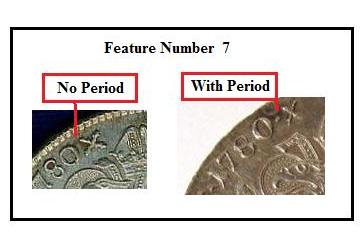
Fifth the type of punctuation of the Cross (saltaire ? spelling) the "X".
The other variables which fall into subcategories are the number and arrangement of tail feathers, position and number of minor feathers and punctuation variance. The letter U is one of those sub-category variables because in large measure nearly all MTT's use the V. There are too many variables to list but you get the picture.
Not all of these variables occur on all coins (specifically the mint marks) and not all of these are variable between any two individual specimens you might be comparing. But if you get to know the bigger ones you can cherry pick inventory and even junk boxes. Imagine finding a Karlsburg original in a junk box for $12!
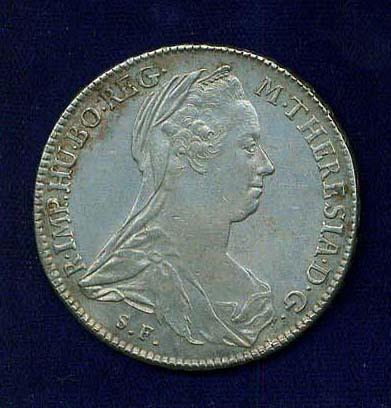
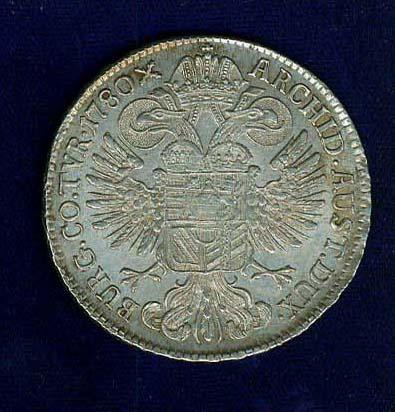
When you compare the Hafner # 27 to a typical Modern restrike the 7 features that stand out most to me are - after the U.
1. The brooch shape. In this case it is the plain oval. This is a feature of all of the Original types. There are no plain oval brooches made after 1805. Here is a photographic comparison:

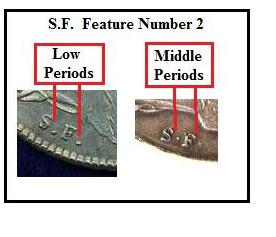
2. The second variation is one of those pesky subvarieties - the position of the punctuation between the S and F beneath the bust.
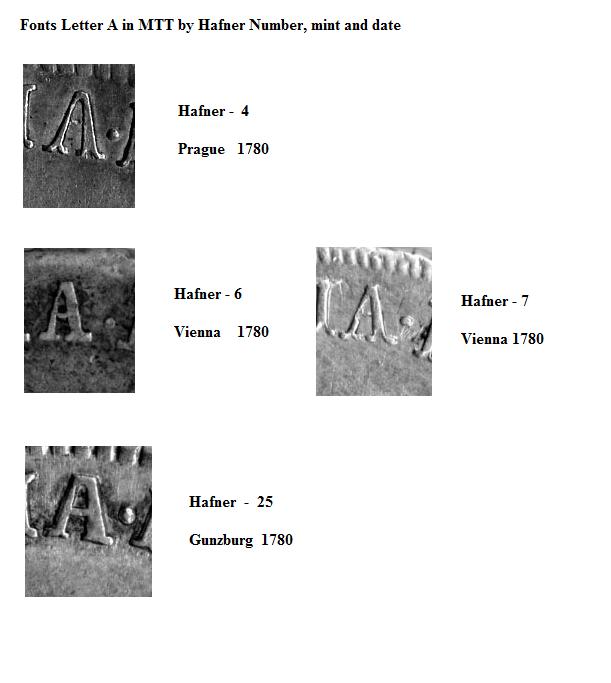
But first I will tackle the subject of mint marks. You indicated as point 6 the "signature under the bust". The SF is a mint mark and it appears on Original Gunzburg coins in 1780. By contrast the other mint marks on 1780 issues are all found on the reverse under the eagle in the form of 4 or 5 letters - 2 or 3 on each side positioned under the claws. The SF mint mark (Gunzburg) was adopted as standard for all restrikes made after 1790 and it was used regardless of where the coin was made.
There are five reverse mint marks:
A.H. G.S. for Karlsburg
EvS I.K. and P.S. I.K. for Prague
S.K. B.D./B for Kremnitz
T.S. I.F. for Gunzburg 1792-1796
Under the bust are:
F.S. for Venice 1815 only
SF, S.F., S:F: etc for Gunzburg and other locations after 1790
A blank space under the bust and No reverse mint mark - identifies unauthorized North African copies (private mint) that some people like myself classify as Bullion Counterfeits like the Boston 8 Reales. These North African restrikes are usually found with Hejaz or Nejed countermarks - they date from about 1920.
One other warning - counterfeits exist - just today I saw one with the mint mark S. It appeared to be an alteration.
But in this case the #27 differs from the average restrike because the periods between the S and F are placed LOW.
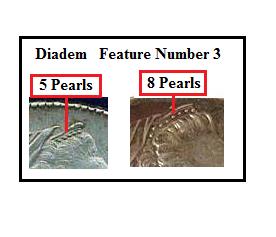
The next variable is one of the Hafner "big 5". I am referring to the number of pearls in the diadem. The number of pearls in the diadem or crown varies - types exist with 0, 4, 5, 6, 7, 8 and 9 pearls. In this case, we have coins with 5 and 8 - see below: (note: the modern copies usually have 8. Some coins which are struck from worn dies can make the counting difficult.)
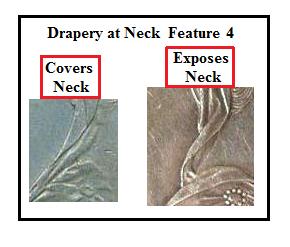
Next is a major design feature which is not even mentioned by Hafner - the position of the head veil in relation to Maria's neck. The earliest types have a straight drapery that hides her neck - the curved drapery exposing her neck comes in several variations (most are rare). The variants were first introduced as early as 1781 and can be subtile. The curved drapery as shown on the right is the modern standard - it originated in Vienna before 1800 and was adopted on essentially all coins made after 1815.
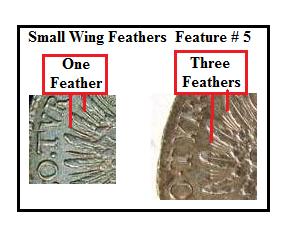
Next are the small feathers between the large wing feathers. Modern restrikes have 3 in each case - three single lines. The most common modern copies have three lines of EQUAL length between the two feathers nearest the T in TYR. Some "early modern" strikes have three small feathers with the central line longest and on scarcer varieties there are other arrangements. The coin on the right shows the EQUAL length configuration. One interresting die variety caused by erosion produced coins with what look like arrows between the feathers. I own a few but do not have a picture available. They date to WWII.
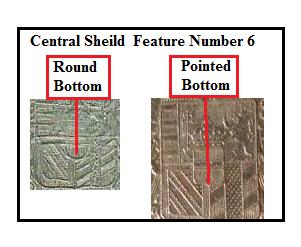
The next feature is the central shield. As noted above, there are innumerable variations in the entire shield but Hafner focuses on the shape of the central shield. There are three shapes - Rounded Bottom - V shaped bottom and Pointed bottom like a horizontal bracket shape {. The modern copies all have the pointed bottom (bracket shaped) shield. Round and Pointed are both scarce.
Finally we have the Cross, X or saltaire (need to check spelling there). There are many different shapes but Hafner chooses to ignore the shape and he uses 7 variations of the punctuation. The modern restrikes all have a period before the X but NOT AFTER. The earliest copies have many other configurations but one was the period X. The Gunzburg types have no period on the early strikes.
That was a long post - sorry, but the subject of the MTT's is a favorite of mine. No one has ever attempted a completely definitive list - that would likely be impossible. I got my first MTT in 1960. I have owned about 60 varieties at different times.







 Posted 09/10/2009 9:35 pm