Coin Community Family of Web Sites Join Thousands of Coin, Bullion, & Money Collectors
Join Thousands of Coin, Bullion, & Money Collectors Royal Canadian Mint products, Canadian, Polish, American, and world coins and banknotes. 300,000 items to help build your collection! Specializing in Modern Numismatics Vancouvers #1 Coin and Paper Money Dealer Royal Estate Auctions - $1 Coin AuctionsCoin, Banknote and Medal Collectors's Online Mall


Username:
Password:
Save Password
Forgot your Password?


This page may contain links that result in small commissions to keep this free site up and running.

Welcome Guest! Registering and/or logging in will remove the anchor (bottom) ads. It's Free!

Attribution For Jefferson Nickel, 1943-P, 3 Over 2?

To participate in the forum you must log in or register.
Author Previous TopicReplies: 10 / Views: 11,255Next Topic  
Pillar of the Community
Darth Anarchus's Avatar
United States
1388 Posts
 Posted 03/04/2011  6:37 pm Show Profile   Bookmark this topic Add Darth Anarchus to your friends list Get a Link to this Message Number of Subscribers
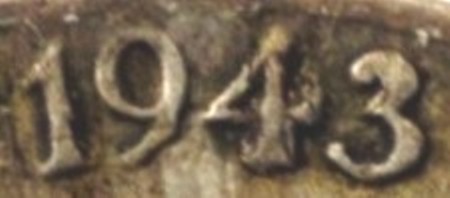
I can't find much information on this variety, and I have no clue if there are any other determining factors to confirm this variety. I know there is another variety for this year, but I'm just lost as to how to diagnose either of them. I'm just starting to scratch the surface dabbling with varieties and Jeffersons are not my strongest suit. Any help would be much appreciated, thank you in advance.
Bedrock of the Community
coop's Avatar
United States
62064 Posts
 Posted 03/04/2011  6:47 pm  Show Profile   Bookmark this reply Add coop to your friends list Get a Link to this Reply
Attribution-For-Jefferson-Nickel,-1943-P,-3-Over-2?
The straight line on the inner part of the three is probably the biggest thing to look for.
Pillar of the Community
Darth Anarchus's Avatar
United States
1388 Posts
 Posted 03/05/2011  08:33 am  Show Profile   Bookmark this reply Add Darth Anarchus to your friends list Get a Link to this Reply
Thanks Coop, I must have a die chip or somethin...
Bedrock of the Community
biokemist6's Avatar
United States
12437 Posts
 Posted 03/05/2011  12:36 pm  Show Profile   Bookmark this reply Add biokemist6 to your friends list Get a Link to this Reply
This variety, along with the other modern "overdates", is a Class 3 DDO- Design Hub Doubling. A die was hubbed on a 1942 hub, set aside, and then later had a second hubbing on a 1943 hub. The CPG also mentions the secondary doubling on LIBERTY and IGWT shown in coop's pictures. The 1943P Doubled Eye DDO also have secondary doubling on the date, LIBERTY, and IGWT.
Pillar of the Community
Darth Anarchus's Avatar
United States
1388 Posts
 Posted 03/05/2011  2:25 pm  Show Profile   Bookmark this reply Add Darth Anarchus to your friends list Get a Link to this Reply
I have a problem, the one I have that I am trying to attribute has doubling of all the above. But the 3(of the date) is hard for me to determine, as mine looks not as prevalent as it is probably grades at F or VF, and there it is a little dirty, especially by the eye. I can try to get pics, but I don't have the capacity to get close shots like above with Coops' pics. But is this the kind of coin I should use acetone on to better determine the situation? I don't want to contaminate(clean) a coin of this potential value.
Bedrock of the Community
coop's Avatar
United States
62064 Posts
 Posted 03/05/2011  5:38 pm  Show Profile   Bookmark this reply Add coop to your friends list Get a Link to this Reply
Darth: See the first image I posted. See the arrow behind the 3? Check your coin for this. Also check for the other arrows of doubling to see if they match your coin.
Pillar of the Community
Darth Anarchus's Avatar
United States
1388 Posts
 Posted 03/06/2011  11:52 am  Show Profile   Bookmark this reply Add Darth Anarchus to your friends list Get a Link to this Reply
ok, thanks, must just be the DDO then... I appreciate the help everyone
New Member
Birchpointmich's Avatar
United States
1 Posts
 Posted 03/22/2011  11:32 am  Show Profile   Bookmark this reply Add Birchpointmich to your friends list Get a Link to this Reply
Darth and coop, great info.
I'm not sure if my example is truly a 1943/2 P overdate variety or not. And my specimen is no where as nice as the example coop used to illustrate which characteristics to look for. Unfortunately, even using a scanner resolution of 2400, it is difficult to get a clear image. So this is the best I can provide:


Attribution-For-Jefferson-Nickel,-1943-P,-3-Over-2?
Pillar of the Community
Darth Anarchus's Avatar
United States
1388 Posts
 Posted 03/22/2011  2:27 pm  Show Profile   Bookmark this reply Add Darth Anarchus to your friends list Get a Link to this Reply
That one looks to have the "2" coming through the bottom opening of the 3...
Pillar of the Community
fortcollins's Avatar
United States
3659 Posts
 Posted 07/30/2016  4:57 pm  Show Profile   Bookmark this reply Add fortcollins to your friends list Get a Link to this Reply
I'm a new member to the coincommunity.com forum, but a longtime collector (40+ years) and pocket dealer (25 years).

The 1943-P 3/2 is one of the most accessible overdates* for collectors. PCGS estimates a survival pool of 17,000 in MS-60 and above, though that seems high. Given the high mintage for the 1943-P and the excessive die use for the date and mint, a large number of the 3/2 should be expected to exist in all grades. I certainly would not quibble with a survival rate of 20,000 to 25,000 in all grades. Over the years, I have accumulated just over two hundred junk silver rolls of the silver War Nickels, mainly from roll lots and dealer junk boxes. Not surprisingly, the 1943-P dominates the bulk of those coins. In that time, I have located six of the overdates, with grades ranging from AG-3 to VF-35. Based on that experience, here are a few observations:

+ The 1943-P 3/2 is not rare. It isn't common, but it does exist in the wild and can be found by diligent searchers. It's s fun search.

+ Over the years, the most common question I have been asked about this particular overdate is "Is this one of them?" Only once has the proffered coin been an overdate. The key reason I think this coin generates the question is that people expect the overdate to be subtle, and hidden in the shadows. It isn't. The overdate is bold, and readily identifiable, even in my AG-3 example. Similar to the 1942 and 1942-D 2/1 Mercury dimes, the Philadelphia mint in this case simply made no effort to obliterate the "2" before rehubbing the die. This is understandable: it was wartime, speed mattered, quantity mattered, and the focus was on production.

+ Most of the confusion comes from the two die break varieties that show spikes protruding upward from the end of the lower curl of the "3." One variety has the crack proceeding vertically, pointed toward the top curl of the "3," while the other has a smaller crack pointing toward the middle bar of the "3." On a genuine 3/2, the spike protruding from the end of the bottom curl of the "3" points to approximately a 2:00 position within the bottom curl, a much more acute angle than the two die cracks.

+ Other confusion stems from the coin's composition. The copper-silver-manganese composition is prone to pitting, discoloration, metal flow lines, entrained bubbles, and laminations. These can mislead and obscure attribution, especially for people who haven't handled a lot of the coins. The soft composition also allowed for much more rapid wear, widening the gap between the oft-seen MS-65+ diagnostic pictures and the real world of grimy, worn G-to-VG coins.

+ Heavy die wear also contributes to the problem, with hairline die cracks, die scratches, clash marks and metal flow obscuring the key area.

All of that said, the overdate is quite bold. Once a collector has actually found an overdate, the search takes on a different dimension: the hairline cracks and scratches are quickly ignored, because the eye has been trained to look for the specific identifiers.

For me, the key diagnostic is the presence of the horizontal "check mark" or "fishhook." On coins of any grade, this remains bold. The horizontal line, in particular, lies in a well-protected area, surrounded by the lower curl of the "3." Even on my AG-3 specimen, this line is plainly visible, although the top of the "hook" or "check" starts to blend into the wear from the rim.


*I recognize the distinction between a older repunched overdates and a hubbed overdate. Thought the product of hubbing rather than repunching, the rehubbing here was done specifically to change the date. I think it is still fair to call this an overdate.

Bedrock of the Community
coop's Avatar
United States
62064 Posts
 Posted 07/31/2016  01:52 am  Show Profile   Bookmark this reply Add coop to your friends list Get a Link to this Reply
I just noticed that there was a wrong term on my image. So I edited the image and removed the errant one. Here is what it should say on this die information:
Attribution-For-Jefferson-Nickel,-1943-P,-3-Over-2?
It is a doubled die, not an over date. It was hubbed from two different years hubs. So it is a doubled die.
  Previous TopicReplies: 10 / Views: 11,255Next Topic  

To participate in the forum you must log in or register.


Disclaimer: While a tremendous amount of effort goes into ensuring the accuracy of the information contained in this site, Coin Community assumes no liability for errors. Copyright 2005 - 2026 Coin Community Family- all rights reserved worldwide. Use of any images or content on this website without prior written permission of Coin Community or the original lender is strictly prohibited.
Contact Us  |  Advertise Here  |  Privacy Policy / Terms of Use

Coin Community Forum © 2005 - 2026 Coin Community Forums
It took 0.52 seconds to rattle this change. Forums