First Page
 Previous Page


 Posted 12/19/2022 2:07 pm


Quote:
I had an old coin book printed in London in 1653, that mentions a "curious silver disk, with an NE monogram on one side, and XII on the other..." and the author supposed it was a Norwich(e) issue, but didn't know for sure
@Oldgrouchyguy, do you have the book/author to reference? 1653 seems far too early to me. http://numismatics.org/digitallibra...95/nnan42410 is an interesting read geared towards the "Good Samaritan" shilling but lots of info about the other early coins. It says I had an old coin book printed in London in 1653, that mentions a "curious silver disk, with an NE monogram on one side, and XII on the other..." and the author supposed it was a Norwich(e) issue, but didn't know for sure
Quote:
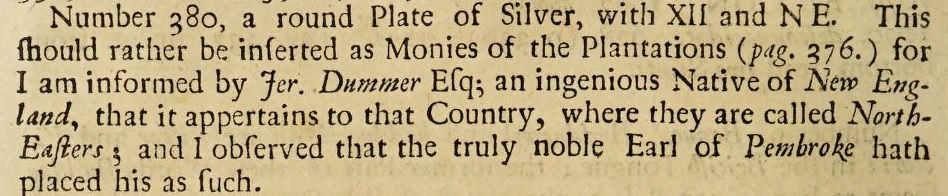
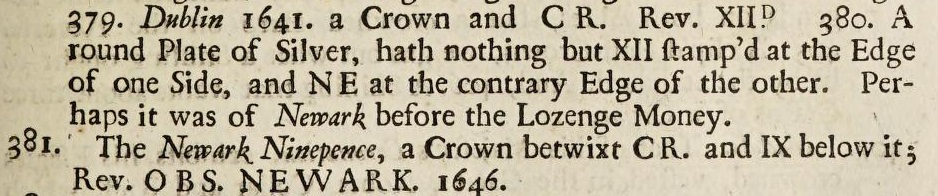
The earliest numismatic publications mentioning Massachusetts coinage are Ralph Thorsby's Ducatus Leodiensis, published in London in 1715, followed by Stephen Martin-Leake's An Historical Account of English Money published in 1726. Although the former suggested that the NE on the New England coinage might be an abbreviation for Newark under seige, the latter states that the Earl of Pembroke has classified them in his collection as New England coins. Pine Tree pieces are included in each book, but the Good Samaritan shilling is not mentioned by either writer.
...
The next publication to include the Good Samaritan shilling was prepared by Martin Folkes. Folkes, whose reputation as an antiquary was acknowledged by his presidency of the Royal Society from 1741 to 1752, published in 1745 under the auspices of the Society of Antiquaries, A Table of English Silver Coins.
I was familiar with the Folkes book from our infamous 1652 threepence thread, as generating the first interest in collecting these early Colonials in the UK. The Folkes book says:The earliest numismatic publications mentioning Massachusetts coinage are Ralph Thorsby's Ducatus Leodiensis, published in London in 1715, followed by Stephen Martin-Leake's An Historical Account of English Money published in 1726. Although the former suggested that the NE on the New England coinage might be an abbreviation for Newark under seige, the latter states that the Earl of Pembroke has classified them in his collection as New England coins. Pine Tree pieces are included in each book, but the Good Samaritan shilling is not mentioned by either writer.
...
The next publication to include the Good Samaritan shilling was prepared by Martin Folkes. Folkes, whose reputation as an antiquary was acknowledged by his presidency of the Royal Society from 1741 to 1752, published in 1745 under the auspices of the Society of Antiquaries, A Table of English Silver Coins.
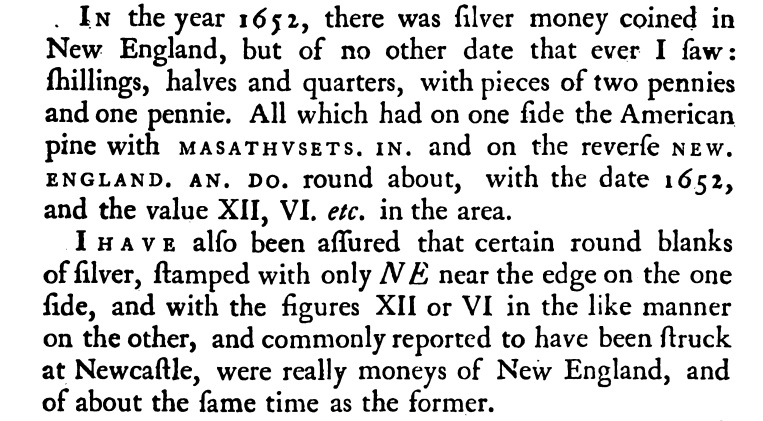
which mentions them thought to have been struck at Newcastle, not Norwiche. It sounds very similar to what you quoted, but not the same, and not from 1653. (Note that Folkes references non-existent twopence and penny coins; more on that in the linked article)