We reached a major milestone this week.
ANS rejected our book project for publication. That is of course a 180 degree turn around when compared to earlier contacts we had made.

Rejection is never pleasant of course but in this case it may greatly improve the end product.

The reasons for rejection are simple. It comes down to two things. First ANS feels the book will not sell (I have heard O.T.R. that they are concerned it would never sell 100 copies because "how many people are interested in counterfeit 8 Reales anyway?") and second the Class 2 silver counterfeits are controversial and the individual who did the review does not believe they really exist.
I completely agree on part of the last issue. It is liable to be controversial. It will pit opinion against science and facts against supposition based on nothing more than the "expertise" of dealers.
The first point is totally understandable from ANS' perspective and it is completely acceptable to me even though it is based on what I believe is a deflated estimate of interest in the topic. The apparent failure of the recent book
New Jersey State Coppers by Roger S. Siboni, John L. Howes, and A. Buell Ish which was released about six months ago may color their opinion. That book has fared poorly with fewer than 200 volumes sold from an initial production run of 250 copies. The book is comparable in size to ours at nearly 600 pages. The issue price was $ 235 with a reduction to $165 for ANS members. The price alone is a killer (40 cents a page). It appears that this book has placed a financial strain on ANS which I can understand. It is also quite logical from their perspective to be concerned that a book on Counterfeit 8 Reales from essentially the same period of time will sell no better than the New Jersey Coppers book has.
They of course believe that there are more collectors of New Jersey coppers than counterfeit 8 Reales. On that point they may be right for now, but I see the field as wide open in the future for the entry of many more collectors of counterfeits. I see the New Jersey coppers as a fully developed and mature market segment with little growth potential. Interest is there but at stratospheric costs as evidenced by the Neuman sale of Colonials where roughly 200 lots sold for over 10 Million Dollars. Not all of us are rich collectors or investors with a few hundred thousand dollars available to buy one coin. But there is GREAT potential in a market where almost unique rarities still sell for under $100 and fantastic bargains can still be had in junk boxes for $5.
In hindsight the sudden departure of Robert Hoge from ANS should have been a warning to us, but we missed the import of that action. Mr. Hoge was the individual who initially championed both books. His departure was the writing on the wall we all missed.
The second point, which I recognize as a legitimate concern, is at the same time harder to accept as a valid reason not to proceed with the book project. Personally, I do not fear controversy. In fact I embrace controversy provided it occurs in an honest search for truth, even if it happens in a sea of self-serving opinion. This part of the rejection reads more like an authoritative parent or teacher coming down hard on a child that repeatedly asks "Why?" It is a rejection which I view as being based in large part on supposition, incorrect readings of parts of the book and some obvious unexpressed bias. It is not what I anticipated as a final result. More like the sputtering and fuming of a parent or teacher who has been caught in a logical bind by a child's question and who is forced to retort. "Because I said so that's why!"
In fact the tone of the report on the merits of the book sounds a lot like the response seen on this forum by some professional coin dealers who simply refuse to believe they cannot spot fakes sitting under their noses. "The coin is genuine because I know better than you do."
In this case, the individual doing the final review picked a bad example of an error!

In that case, the referee (the author of the vetting report, who wrote anonymously) cited as a basis for rejection a specific coin which in his opinion was
almost certainly genuine. He made a terrible error which becomes a self-indictment. Here is exactly what was said:
Quote:
Page 1: Portrait coin on cover and on back cover is a coin that the authors believe to be a contemporary silver counterfeit. They're probably wrong â€" the coin is almost certainly genuine. The authors' claims that there were extraordinarily well-made silver counterfeits ("the story of the old counterfeiter") are a bit dubious.
The coin is the one pictured on the front and back of the book - the "dust jacket". It is a coin I own. With no basis at all, the referee concludes we are wrong because the coin is "almost certainly genuine". That would not be too bad, just a difference of opinion if we provided no data about the coin and just made a bare faced assumption it was a great looking counterfeit. But this coin is shown with an assigned GNL number. It is described in detail in the book and it is discussed a second time in relation to the use of a silver edge ribbon to cover the core. It is pure and simply a Sheffield plate counterfeit. We have two examples under our control made from the same die pair. My copy has a nearly intact plate and has a Specific Gravity of 9.10. That is about 28-30% silver. The second coin which is a far more worn coin is a strike in debased silver without significant plate remaining. The core XRF tested at 28.1% silver. It is a classic Class 1 Contemporary Circulating Counterfeit. I found it in an on line auction and it had previously come from a European Auction gallery where it was described as genuine near MS. It actually has a tiny spot of coppery alloy showing through the silver plate (tiny but present).
Here is the coin itself, you may recall it.
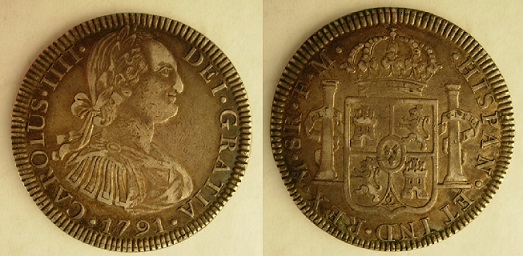
So I ask, is that coin "almost certainly genuine" or does the referee simply not understand what he is looking at while at the same time telling us we are wrong? I actually question whether this unknown referee actually knows the difference between a genuine 8 Reales and a Counterfeit.
The fact that this same referee was going to be the final editor for the project would have been unacceptable to the writers. His bias shows clearly in his comments.
The second conclusion the referee makes in the quote above is his personal belief that the premise of about half the book is "a bit dubious". That belief rests (like the opinion that the coin above is genuine)on nothing but overly stimulated air molecules.

The Sheffield plate coin in this case was made with dies that mimic but do not even match actual Mexico City die punches for 1791. It is not a Class 2 silver restrike as he seems to infer but rather it is a straight forward Sheffield Plate counterfeit probably made in England in the mid to late 1790s based on the silver ribbon edge technology used. His choice of examples proves the referee did not read all of the book completely and actually has a limited understanding of what is and is not genuine.
The attacks on the book with one exception are predominantly baseless and without merit. I have to admit I was very ashamed that a 14 page technical section turned out to be copied from Wikipedia without correct citation. The section was simply an explanation of the scientific methodology of testing (XRF) which was INCORRECTLY submitted and attributed as original authorship IN ERROR. The party responsible indicates he was unaware of citation requirements for this type of data and really didn't think it was germane to the book. I agree that a simplified explanation of XRF to try to explain what the test is to a non-professional is hardly a central theme in a book about counterfeit coins. XRF is a well documented and well proven technology for authentication of museum articles. However, this of course is a case of plagiarism. I see that clearly and I am at fault for not myself vetting that 14 page technical submission. But the book is over 500 pages in length. The necessary changes can and will be completed with very minimal effort. The referee lists the six different instances (different sources) that came from that section and he turned one error into six. Then every instance was repeated TWO or THREE times in the report as if blatant plagiarism of the entire work had been committed by a bunch idiots.
The fact the error was from a single source, was off central topic, is easily remedied and represented background data on a scientific process was not considered. Instead it became a rallying call for a withering and at times very personal diatribe that over reaches the facts presented. Of all the comments made I agree with ONLY TWO.
But that is all neither here nor there.
I plan to rebut the factual errors point for point just for the record even though it will not change any minds.
Nor do I now feel that I would want the participation as publisher of a group bent on killing research or the referee as final editor. I also became concerned that ANS would never agree to allow us to use the data in the book for ongoing updates if they controlled the rights. The best way to kill the topic is to allow nothing further to build on this book.
I suspect that behind the scenes there are simply too many ties to the numismatic establishment which would rather see the subject buried. It makes we wonder if the part of the numismatic community which stands to be impacted the most financially has been at work behind the scenes.
So we are now taking the rejection as a positive confirmation that we have hit some raw nerves.
So we are exploring alternatives including self-publication.
That is the huge silver lining I see here. An opportunity to step back briefly and move in a BETTER direction.
In the 17 months that ANS effectively delayed the project with editing and then vetting some things have changed. If we self-publish, all we lose is name recognition of a well-known publisher, however in return
we will retain and control all of the rights to the book itself and more importantly the ability to amend or add to the contents without needing written approval from anyone.We now wonder if an issue as a e-book might not make more sense.
During the long run up to publication, I have been more and more concerned that the control of the rights to the contents of the book outweighed the savings in work and the gains in prestige and finance that the first route provided.
From the start of this project, I have viewed this as just the beginning of a more or less living document. The ultimate value of the book will not be achieved unless the topic outlives myself and the other authors.
I have made preliminary contacts with a printer who can do a 600 page bound book for a rather reasonable cost. Not leather bound or glossy paper with color pictures or with gold - leaf -
just a utilitarian book. That is large enough for the entire text with plenty of spare space and would include all the photos used to illustrate the text. The pictures of the counterfeit coins themselves could also be done as a second volume (possibly a loose leaf binder) so that purchasers of the book could receive periodic updates as new coins are added for a small charge. There could also be a digital version so that the coins and descriptions could appear on a tablet or laptop computer for use at shows. That is the real value of the book. The book needs to be useful to meet the needs of the buyers. I also envision that ongoing discussions of issues that arise (as on the forum) could be included with the updates as additional information.
I am also wondering if we have a loose leaf option if a one coin per page approach might not be the best. The pictures could be far bigger (about 2.5 to 3X actual size). The text with the description for each coin would be on the same page and any space left on the page could be filled with lines for notes. The back of each page would be lined for added notes. The cost per page in loose-leaf format is minimal. These entries could be modified in the future as needed and replaced as better grade examples are located or as alternative alloys are discovered.
This would allow for continuous updates and new submittals could be made to the authors (or their replacements) by any collector as long as there is someone alive to do the work. The book then becomes a collective project for all those interested. It would be a LIVING growing document. A central group would always have to retain overall control of the requirements needed for submission etc. This group would also have to have the overall expertise to classify the various counterfeits and to issue new numbers. Only then can we all be on the same page.
I know that for many "old school" collectors the idea of showing all your cards is unpopular. I know many collectors who closely guard the information they have on rarity and population statistics because they get better deals that way. I have never liked that attitude. I am reaching the point in life where I more than ever see the fallacy of that attitude if we want coin collectors to be part of a vibrant and growing community. It brings to mind something I heard an old time dealer say to an older customer. The customer had asked why Walter spent so much time helping kids (like me) with minimal purchases from 10 cent junk boxes? Walter's simple answer was something I have never forgotten. He looked at the older gent and said "These kids are my future customers. If I lose them now they will be gone forever".
That approach was not what the ANS wanted. They apparently wanted a book 100% complete in all details (ready for dead storage) that was somehow both shorter (done by removing all
unique counterfeits and casts) while at the same time containing examples from more collections.

To me the value of the book is to show all counterfeits whether there is only 1 or 100 known. He would of course have eliminated over half of our examples!
The final point the referee objected to was the last statement which I placed under the photo on the back cover of the book (dust jacket). I said "Solamente el comienzo!" This translates as "This is only the beginning!" His precise comment on this statement was:
Quote:
leave out the cute bits.
Perhaps a living and useful book that collectors might welcome is not what some publishers want. Perhaps a fancy space filler on a shelf that is totally devoid of interest or controversy is what they do want. Perhaps it is their approach that is out of date and why they are in financial difficulty.
I do marvel at the entire process however.

So I am asking forum members who might be interested in this book a few simple questions.
1. What format do you see as most valuable to you?
2. Would you want both a hard copy and an e-book version?
3. Does loose leaf for the coin pictures make sense?
4. Would you want a loose leaf version in addition to the original listing?
5. Would you actually buy one?
6. What would it be worth to you? (Upper limit of cost).









 Posted 05/18/2014 5:14 pm


