Apologies in advance, but I'm going to wander a little bit here.
The
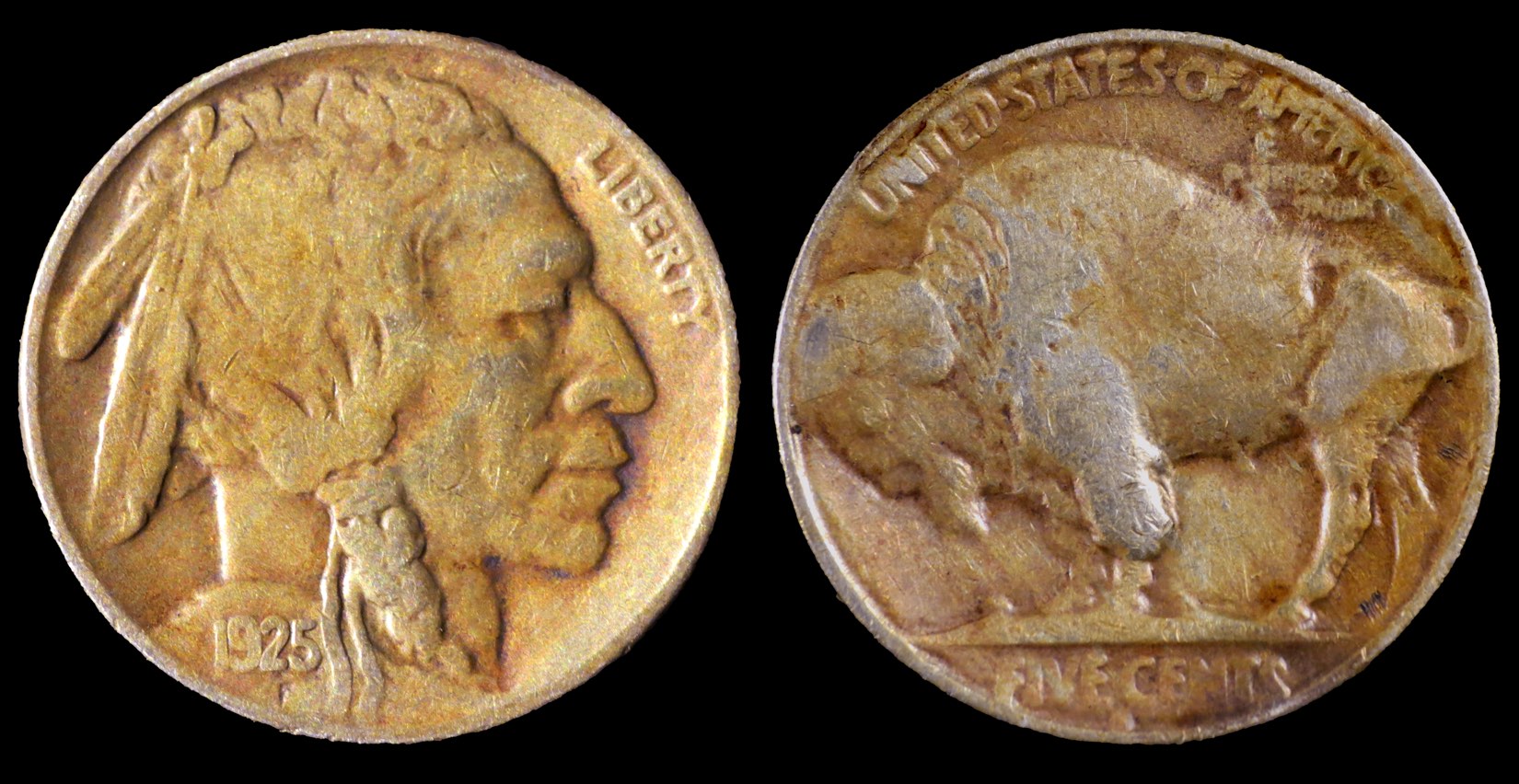
Buffalo nickel series is one of the most complex series of coins, but also one of the shortest. Churchill described Russia as "a riddle wrapped in a mystery inside an enigma." That describes the Buff series, too.
Think about this:

It is one of the most cluttered coin designs attempted (excluding some of the classic commemoratives).
The two branch mints had exactly one year experience striking nickel coinage before tackling the Buff. San Francisco only had four years of experience with minor coins (1909
Lincoln Cent) and Denver had only two years with minor coins (1911
Lincoln Cent).
Denver and San Francisco hated producing minor coins anyway, believing they had been created to strike gold and silver coins only.
All three mints had different equipment with different striking pressure and different levels of production floor experience.
The mints absolutely hated the design because of the production difficulties.
The
Liberty nickel was easy to strike, with relatively low striking pressure. Dies had long lives. Not so with the Buff.
The public immediately complained about the new coins: they didn't stack correctly, the denomination wore off too quickly, the date wore off too quickly. This led to repeated design changes.
In just 25 years, there were nine different obverse designs and two major reverse designs.
Alloy issues, especially during WW I, led to surface pitting, discoloration, and laminations.
Strike quality varied widely by mint and by year.
The cluttered design transferred far too easily when dies clashed. There was no easy manual for fixing the clashing. Aggressive die polishing led to a ridiculously large array of abraded die varieties: missing feathers, missing designer's initial, missing legs, missing horns, orange peeled backs, and more.
Philadelphia made all of the dies. Philadelphia also had the most modern coin presses. That meant Philadelphia could replace its worn dies easily, and didn't fret about extending die life beyond functional use.
The branch mints had to make do with what Philadelphia sent them. Extending die life could only be done two ways: reduce striking pressure and producing pancakes or running the dies past terminal stage. They did both.
The branch mints, in particular, swapped out one die at a time. The ridiculous mismatched dies (like the OPs coin) are the result.
It is believed, but not confirmed, that the branch mints put back in to production reverse dies (the anvil dies) across multiple years. If so, this may explain some of the pitting seen on dies. It may also explain why some reverse die markers and varieties seem to appear in multiple years. A full die study is needed.
There are a few coins that are seen from time to time with unusually sharp individual design elements. Did the branch mints re-engrave design elements to extend die life? (Re-engraved Lincoln Cents exist, but mostly in the 1930s to 1950s. One of the CCF contributors discovered a new re-engraved Lincoln business strike from the early 1950s just a year or so ago.)
For a short series, the number of DDOs and DDRs and RPMs are staggering. Two of the DDOs are major coins needed for any complete collection, the 1918/1917-D and 1916. The 1916 is almost a set stopper for most collectors.
The short series also has its mysteries. For example, is the 1914 with spikes in and around the date the result of hub defects, master die damage, doubled hubbing, or doubled working dies? Is it another
DDO overdate, or not? (Ron Pope believes that it is. Dr. Wiles is still examining the coins and hasn't definitively taken a position.) For what it's worth, I don't think it is.
The series has one rare coin (1916
DDO), several scarce coins, and some staggering condition rarities.
For nearly every date, coins meeting four specific criteria are exceptionally difficult to find: (a) well struck examples (b) with matching EDS dies (c) minimal die clashing and little or no die polishing (d) in higher grades (AU-55 and up). As Ron Pope notes, a truly fully struck business strike coin likely is nonexistent.
Collectors have barely scratched the surface of the extent of a possible
complete Buff collection. With all that, there are not that many Buff collectors around, and far fewer who collect the varieties. And even with
that, there is a very small supply of coins to meet the demand.
And with that, I'll retreat to my curmudgeon's corner and watch baseball.






 Posted 07/08/2022 09:20 am





