| Author |
 Replies: 14 / Views: 5,542 Replies: 14 / Views: 5,542 |
|
|
New Member
United States
4 Posts |
Hey, I found an odd dime in my pocket change. It was darkly tarnished, so it caught my eye thinking it was silver. After I cleaned it a little, I realised that it is a clad dime, just a little weird looking. I tossed it in my coin box and forgot about it for a while. But, somewhere in the back of my head, lurked the mystery of this one. After doing some research, this is my theory: A centavos planchet was punched too small, and didn't get a rim. Maybe quality control caught it or something. Then, somehow, it got mixed up with the dime blanks, and got struck with the usual Roosevelt dimes. Because it is so similar, it easily passed into circulation, and escaped detection for years until I spied it. After showing it to a couple of local coin dealers, they agreed with me, and told me I should send it off to be authenticated. One suggested I take pictures and send them to a more experienced coin guy. He looked at the pictures, and said it is simply a "damaged/altered" coin. However it looks a little different in pictures. The details of the reeding and edges aren't crisp enough to really do it justice. But, here it is, anyway. I would really like some opinions on this one. Should I go through the hassle and expense of sending it to a professional grading service? Or is this really just a dud? The specifications: 1967 Roosevelt dime, weighing 1.5 grams. It is a little smaller across and perhaps a tad bit thinner than a normal dime. I think this is because it is missing the rim. It is perfectly round. The reeding is on the inner material, and there is none on the slight over-hang of clading on the outside. This makes creating contrast for good pictures difficult, but the reeding itself, though a little damaged in places, is very straight and regular. The black spots and lines on the coin are not holes, just tarnish and gunk that I hadn't cleaned off when the photos were taken. Okay, guys! Let me have it! Faked, damaged, or real error? 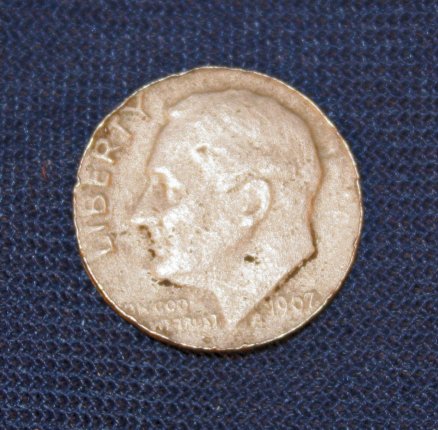 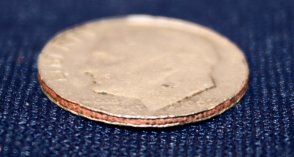 |
|
|
|
Bedrock of the Community
United States
10284 Posts |
I think it just has the rim cut off. I can see the copper center just like a normal clad dime has so I would think it is an altered dime.
|
|
Pillar of the Community
United States
2189 Posts |
 With Wheezydog |
|
Pillar of the Community
United States
2529 Posts |
post mint damage |
|
Rest in Peace
United States
1943 Posts |
Looks like an acid coin. The acid eats away the copper faster than the cladding.
|
|
New Member
 United States
4 Posts |
If this dime had simply had the rim cut off, then wouldn't the reeding be missing? The reeding is still very distinct, straight and regular. It just doesn't show up in photos very well.
Edited by johnjones
08/26/2009 7:44 pm
|
|
Valued Member
United States
322 Posts |
Hi. It looks like damage to me. I have seen many clad coins with this look. Acid of some kind was eating away the coin, the reason it's slightly thinner and lighter than a normal one.
As for the rim, look at a normal clad dime.... There is almost no clad layer on the rim. Whatever corroded the dime, ate away the copper "core" faster making it appear to be smaller.
I would guess all that stuff you cleaned off the dime was corrosion.
Mike
|
|
New Member
United States
4 Posts |
Thanks for the input guys. I really appreciate it. One question, though. If acid errosion can account for the "damage" to the coin, can it also account for the dime missing 1/3 of it's weight? Wouldn't eating away enough of the surface to remove a whole .8 gram remove the design as well? Or, at the very least, cause the dime to have a pitted surface? The surface doesn't have any holes.
|
|
Moderator
 United States
6563 Posts |
Quote:
can it also account for the dime missing 1/3 of it's weight?
It sure can. Check out This Thread about a cent to see how much of the coin is gone yet still quite distinguishable |
|
Bedrock of the Community
United States
12437 Posts |
Yes, a soak in an acidic solution would remove metal which would lighten the coin. However, the design will still be visible even on an extremely thin coin. The surface of the dime is pitted, just not in the form of large craters like you are envisioning. https://goccf.com/t/41991&SearchTerms=acid, |
|
Pillar of the Community
United States
3507 Posts |
Hi,
There is no doubt that the coin was acid dipped. It accounts for the surface condition, the loss of weight and the way that the edge looks.
Thanks,
Bill
|
|
New Member
United States
4 Posts |
Hey, I really appreciate all the feed-back I have been getting about this dime. I still haven't gotten my mind wrapped around the idea that it is an acid-dipped one, though. Does anyone have any links to pictures of a clad coin that was dipped that still has the clad layer on? All I can find of clad coins are the ones that no longer have the outer coating. And the clading seems to be the normal thickness on this darn dime.
Any help you guys can give is great.
|
|
Bedrock of the Community
United States
62064 Posts |
Acid dipping removes the devices evenly and removes the rim on the coin. Yours is one of them. 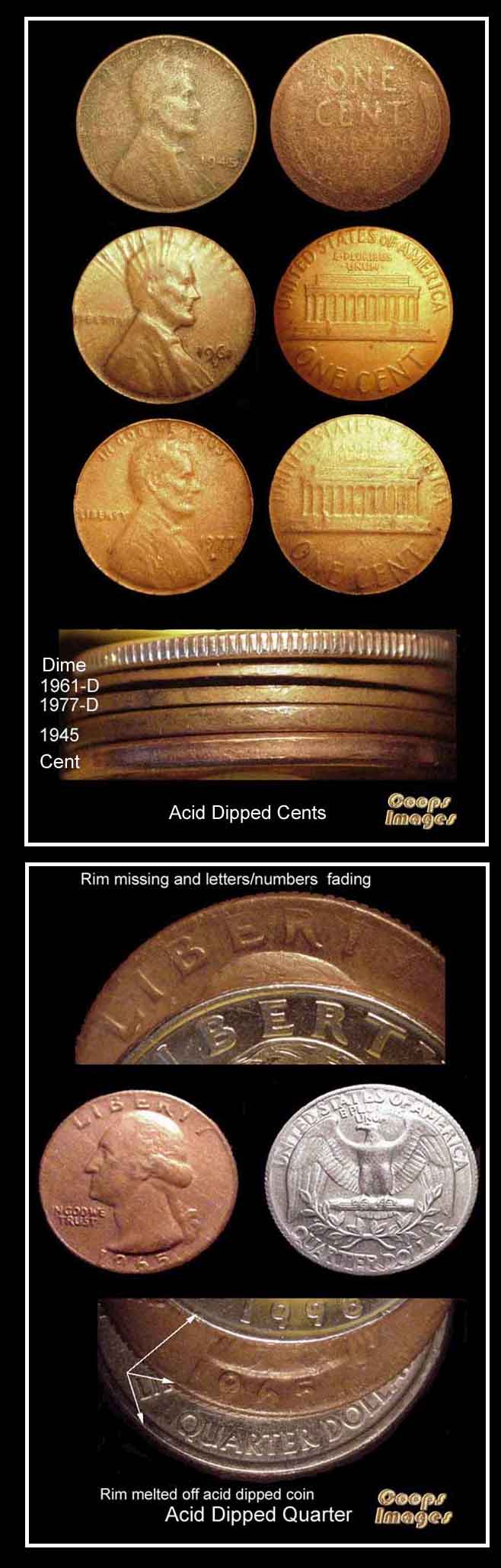 |
|
Bedrock of the Community
United States
17884 Posts |
A very important comment from the original post. Quote:
After showing it to a couple of local coin dealers, they agreed with me, and told me I should send it off to be authenticated. It once again shows the danger of listening to local dealers who are not experienced in understanding errors. A great many dealers do not know how to recognize errors or tell errors from damage. If the original poster had just followed their advice instead of seeking more information here he could easily have spent $30 or more to find out that his dime was worth a dime. |
|
Pillar of the Community
United States
3507 Posts |
Conder101,
Thanks for pointing that out. Many dealers are completely and unfortunately lacking in knowledge when it comes to the look of an unusual coin.
Have Fun,
Bill
|
| |
Replies: 14 / Views: 5,542 |
|







 Posted 08/26/2009 6:30 pm





