| Author |
 Replies: 20 / Views: 2,928 Replies: 20 / Views: 2,928 |
|
Pillar of the Community
United States
4433 Posts |
Given my longtime interest in odd and unusual coins, I could scarcely believe my eyes when the below picture coin appeared in a local, coin club auction. I was the only bidder, winning it for the starting bid. As it was consigned by a dealer friend who is a certified ANACS grader, I had no doubt it was authentic. In my more than six decades of collecting coins, I don't recall ever seeing such a well-worn dollar of this type, 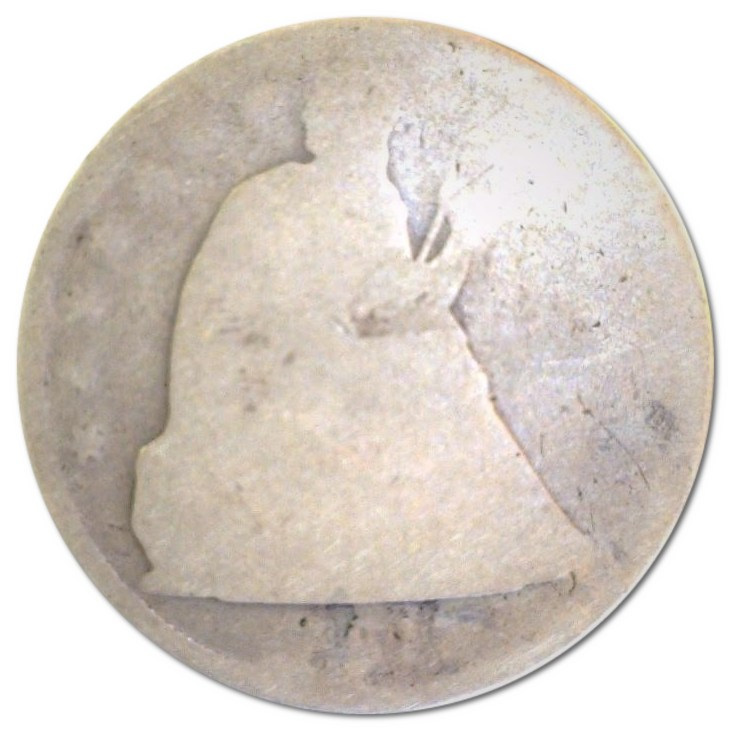 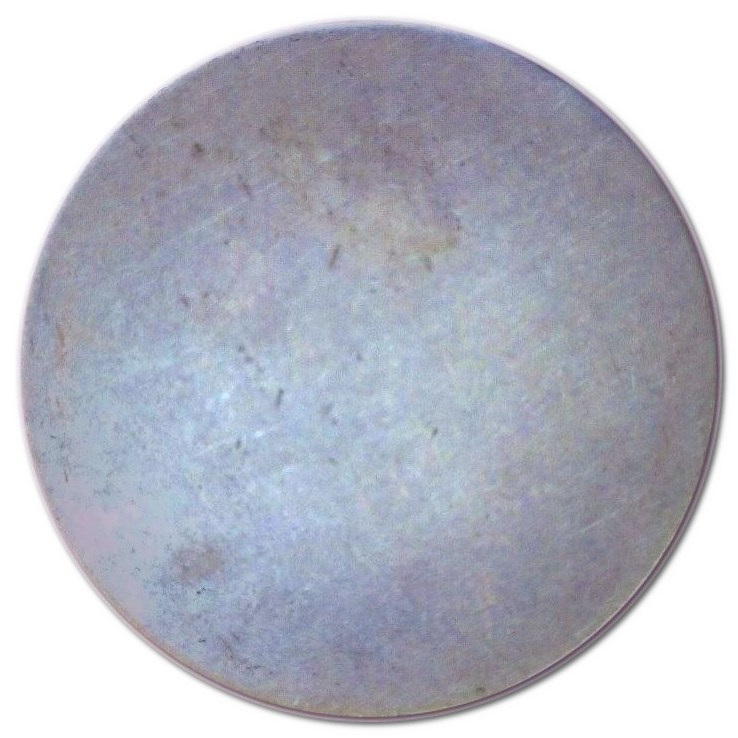 The reverse appears completely blank. I tried darkening that pic, hoping to perhaps see some detail; this, to no avail The rim evidencess absolutely no reeding. .This coin's weight is 23.9 grams (original weight was 26.73 grams). Curious as to how my newly acquired dollar compared to a PCGS PO-1 specimen, I visited their website and spotted the one pictured below .... 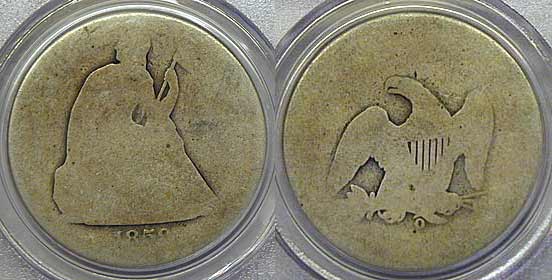 PCGS site: [url https://www.PCGS.com/setregistry/my.../97863/32379][/url] Now, comparing these two specimens, I can't help but ask, "Do we now need a a lower grade added to the scale, say, ABOUT POOR?" Whaddaya think?   |
|
|
|
Bedrock of the Community
United States
94367 Posts |
That's a honker for sure!
|
|
Pillar of the Community
 United States
4433 Posts |
Quote:
That's a honker for sure! Gotta say, I've not before seen or heard "honker" used in reference to numismatics. My ear, nose & throat doctor uses it though ....  |
|
Moderator
 United States
34564 Posts |
Not much remaining detail. I know your question is tongue in cheek, but the term "slick" is the only one I recall for a state that doesn't even reach the level of poor. I kinda like "honker" though.
"If you climb a good tree, you get a push."
-----Ghanaian proverb
"The danger we all now face is distinguishing between what is authentic and what is performed."
-----King Adz
|
|
Pillar of the Community
United States
3363 Posts |
My 1844 is close but doesn't have the slick reverse, nor the beautiful natural toning.
Edited by thq
10/27/2022 09:41 am
|
|
Valued Member
United States
428 Posts |
I've always thought that just as you can't go above 70, you shouldn't be able to go below 1, so yes the whole scale leaves too much room at the bottom. This would be about a -7 |
|
Pillar of the Community
 United States
737 Posts |
Wow thats pretty neat
I've been collecting for a couple years... Favorite Coin's are Standing Liberty quarters, Working on my type set | Coffee, Corvettes, Coins & the CCF what could be better? |
|
Moderator
United States
196676 Posts |
This one is smooth, that is for certain!  |
|
Pillar of the Community
United States
1316 Posts |
For us less familiar with the series, could you help us ID how they figured 1841?
|
|
Pillar of the Community
Russian Federation
5186 Posts |
Quote:
I've always thought that just as you can't go above 70, you shouldn't be able to go below 1, so yes the whole scale leaves too much room at the bottom. Indeed! Some types, especially single-year types*, can actually go far below the OP coin and still be identifiable, and sometimes even worth a nontrivial amount of money; in particular, there's a bunch of known 1793 chain cents worn so much that the chain is the only design element visible, and that barely. On the other side, for some other types it's extremely hard to get as far as standard Poor-1 and still have the date and/or mintmark visible. (And of course if it's a P mint in years that have others, even a Fair-2 is hard to confirm.) I recall seeing a thread a few years ago about a coin - I forgot what it was - that was claimed to be the first PO-1 coin known of its entire type; at the time there were none in the census reports and there was some dispute over whether it would actually be graded 1 when there's nothing to compare it with for that. EDIT: Quote:
For us less familiar with the series, could you help us ID how they figured 1841? As someone probably even less familiar with the series than you, 184x is clear enough and there's not a lot of plausible options for the last digit either. I'd read 1847 on the pic but I imagine it's clearer in hand, and/or with magnified contrast. Either way the date should be legible enough in hand. *) offhand I am not aware of any exceptions for US coins, not counting some single-year subtypes [such as the 1916 SLQ] where a date is uniquely determinable by non-date features, but there are some world coin examples; in particular, the recessed dates of 1860s British pennies, and the incuse dates of 1870s Russian 5 kopeks, combined with the high circulation of both, provide plentiful examples where almost nothing but the date is visible, though in those particular cases they're not worth anything unless it's a very rare date Edited by january1may
10/27/2022 12:15 pm
|
|
Pillar of the Community
United States
4233 Posts |
I'm also curious how you get 1841. Perhaps it's more obvious in hand? I can see the 8, and enough of the third digit to decide that it can't be 5, 6 or 7, but the last digit? I can see it as 0 or 7 instead of 1.
|
|
Valued Member
United States
357 Posts |
Looks like the last digit is a "7" and not a "1."
|
|
Pillar of the Community
United States
2255 Posts |
Back when silver dollars were real workhorses!  |
|
Pillar of the Community
United States
4680 Posts |
Wow, that is extreme! Slick is an understatement.
I can't make out a date, but I suppose if the date were without-a-doubt legible in hand it would be a shoo in for P-01. Now if it were a date that was struck at multiple mints, then no, as the potential MM wouldn't be discernible.
Very cool piece, nice pickup!
|
|
Pillar of the Community
United States
4433 Posts |
Thanks for all the astute replies! Quote:
For us less familiar with the series, could you help us ID how they figured 1841? It seems that many of the comments question the 1841 date. Let me be clear .... My dealer friend and I, examining the coin in-hand, THINK it's an 1841. We have over a hundred years of experience, studying coins, between us. That said, we may be wrong. Meanwhile, I'll see if I can't get some more telling camera angles. If I can, I'll post the close-up pics. The main reason for this post was to call attention to and hopefully discuss the grading of lowball coins. IMHO, PCGS undergraded the 1859-O $1. I view that coin as a Fair-2. Here's my rationale .... The purpose of the grading scale is an effort to quantify or rate the condition of any given coin. From my understanding, whether a coin is good or uncirculated, its basic design should be fully visible (excluding errors, damage and other anomolies, etc). With coins grading below GOOD, design elements are worn to the point of being obliterated. Personally, I've long graded coins below GOOD, based on the degree of design obliteration; this, which is quantifiable. Looking at the obverse and reverse surface area on my presumably "1841" dollar, approximately 35-40% is barely visible. Looking at the 1859-O $1, over 50% of the surface area is easily discernible. Whenever I see a coin that reveals between 50-80% of the design elements, I call it a FAIR coin. An AG coin would have up to say 20% of the design worn slick. All things considered, I think the grading companies would do well to uniformly grade POOR, FAIR and AG coins along this line, using agreed-upon, similar percentages. Then too, note that the visible design elements on the 1859-O are relatively strong, whereas the visible elements on the "1841" are mushy and week, So,I'd ultimately rate the 1859-O as a FAIR-2+ (the + indicating strength of remaining design). The "1841" is, IMHO, a true PO-1  . |
|
Pillar of the Community
United States
4233 Posts |
https://www.PCGS.com/photograde#/SeatedDol/GradesIf you look at Photograde, there's a huge difference in remaining detail from P01 to AG3. Seems like there needs to be more numbers between 0 and 3. Their P01 I dare say is even "honkier" than yours. I have no idea how they got a date out of that one, given the images. I'm leery of the "race to the bottom" craze because it's too easy to make one yourself. The scratches on the PCGS example look suspiciously fresh to me. But that's a whole other discussion.
|
| |
Replies: 20 / Views: 2,928 |







 Posted 10/27/2022 08:01 am





