| Author |
 Replies: 25 / Views: 3,891 Replies: 25 / Views: 3,891 |
|
Pillar of the Community
Australia
1006 Posts |
Hi lately I have been cataloguing my collection and was wondering what is a variety and what is not for example is a 1944s florin classified as a variety of the 1944 florin? or for it to be classified as a variety does it have to have a different design or a error of some sort?
Thanks for your help in advance Edited by oh my florin
01/02/2013 03:48 am
|
|
|
|
Pillar of the Community
Australia
908 Posts |
The S on a florin is a mintmark for the San Francisco Mint
|
|
Pillar of the Community
 Australia
1006 Posts |
I know that. Sorry I didnt phrase the question properly which made it kind of misleading.
Edited by oh my florin
01/02/2013 03:49 am
|
|
Pillar of the Community
Australia
4411 Posts |
|
|
Pillar of the Community
Australia
1006 Posts |
Okay I had a read through it. So acording to those definitions does that make 1944s florins 1954 royal visit florins and 1915h florins a variety because it does fit that definition because the design was modified by the mint prior to striking and was intentional? Quoting trout1105 It is my opinion that if there is a deliberate design change by the mint to the coin it is a variety. If there is an unintended change to the coin ( eg cracks Cuds etc) then it is an error Edited by oh my florin
01/02/2013 04:35 am
|
|
Pillar of the Community
Australia
2180 Posts |
I guess you could say that the presence or absence of a mintmark is a variety but in my opinion a variety is more of a sub-type of the main types of a coin which would include mintmarks and significantly different obverse/reverses.
For example, I would have said that 1915 and 1915H florins are different types while the different positions of the second 1 on 1915 London florins are varieties.
|
|
Valued Member
Australia
363 Posts |
I had a look at my 1944S Florins & I have examples of the 'S' being in different heights from the date. Is this a variety or an error?
|
|
Pillar of the Community
Australia
1006 Posts |
Yes if they are different heights then it would be a variety
|
|
Pillar of the Community
Australia
4411 Posts |
I would agree with Mr T and wouldnt classify different mintmarks and dates as varieties.
|
|
Moderator
 Australia
17037 Posts |
The subject is confused here in Australia because a certain writer in the Australasian Coin & Banknote Magazine decided, in defiance of a century of numismatic literature on the subject, to unilaterally re-define all the words he used. Under the new paradigm, everything weird or unusual that might appear on a coin has became a "variety".
But historically, "variety" and "error" were two different things. A "variety" was basically a "problem" with the die - a crack, a chip, doubling, a date-figure or mintmark put in a slightly different place. Varieties were mass-produced, in the sense that every coin made using that die (once it acquired the problem in question) featured that variety.
An "error" was a one-off "problem" with some other part of the production - misaligned or rotated dies, off-centre strikes, brockages, capped dies, edge clips and so on. Such pieces are typically "one-off" - the error happened to that coin and that coin alone; the coins struck before and after it would show no evidence of the error having occurred.
Don't say "infinitely" when you mean "very"; otherwise, you'll have no word left when you want to talk about something really infinite. - C. S. Lewis
|
|
Bedrock of the Community
United States
12437 Posts |
Quote:
I have examples of the 'S' being in different heights from the date. Is this a variety or an error?
Neither, it is perfectly normal. Until 1990, all mintmarks on US-struck coins were applied to the dies by hand so there will be some slight natural positional differences. Interestingly enough, those positional differences are sometimes used to determine whether a coin is genuine or not with the prime examples being the key dates of the 1909-S VDB Lincoln Cent and the 1916-D Mercury dime. Both examples have exactly four mintmark locations from four unique dies. |
|
Valued Member
Australia
216 Posts |
Hey Sap. I thought a variety was any change made to the die prior to it being placed in the press. An error was any change that occurred after the die had been hung. So die cracks/cuds/rotations etc are errors. Design differences, scroll dots in the 19/20 penny's etc are varieties. Is this correct, or am I completely bonkers?  |
|
Pillar of the Community
Australia
1006 Posts |
biokemist 6 I am sorry but it is actually classified as a variety in Australia and it has been backed up by featuring in renniks predecimal varieties book (which I am about to order) and fred levers reference book for varieties otherwise there are five varieties of the Mintmark which are high, medium, just touching, normal(most common) and low here is a link where it shows pictures of it just scroll down a bit and you will see it http://www.triton.vg/F42.html |
|
Pillar of the Community
Australia
852 Posts |
OMF
There are NOT five varieties of the "S" florin. Those 5 positions are just a handy method of of lumping similar position mintmarks together. Fred and Ian are dedicated enthusiasts but they don't have the skills and equipment to systematically identify every mintmark position and nor does the average collector. Correctly speaking as each working die was individually "S" stamped then either every die made its own variety or none of them did. Bio6 is correct about how those minor positional differences are a handy diagnostic tool.
SAPs definition of varieties and errors is reasonable; varieties need not be a "problem" though (eg the English or Indian dies of '20, '21, '24, '27 and '31 were either economically using up old dies or the result of experimentation).
|
|
Pillar of the Community
Australia
674 Posts |
 Well explained.!! |
|
Pillar of the Community
Australia
7096 Posts |
I call this my misaligned "S" Not really an error or a variety, more of an oddity/novelty coin  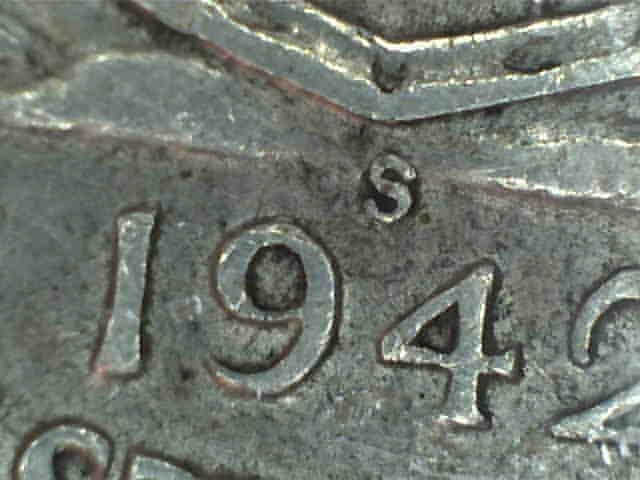 |
| |
Replies: 25 / Views: 3,891 |




 Posted 01/02/2013 03:44 am





