| Author |
 Replies: 13 / Views: 1,164 Replies: 13 / Views: 1,164 |
|
|
Pillar of the Community
Netherlands
847 Posts |
In my collection I have this strange looking American 2 cents. It bears two stamps which I don't know. Could be colonial use? Besides, when looking closer to the head side. There apears to be some incuse or other strike beneeth? Who can tell me more about this curious piece? 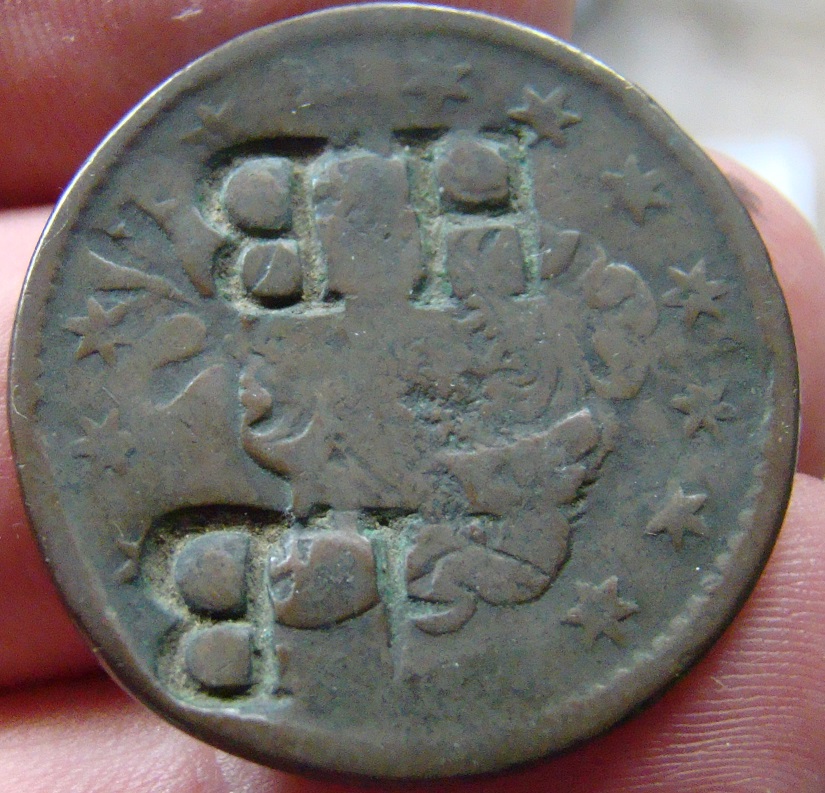 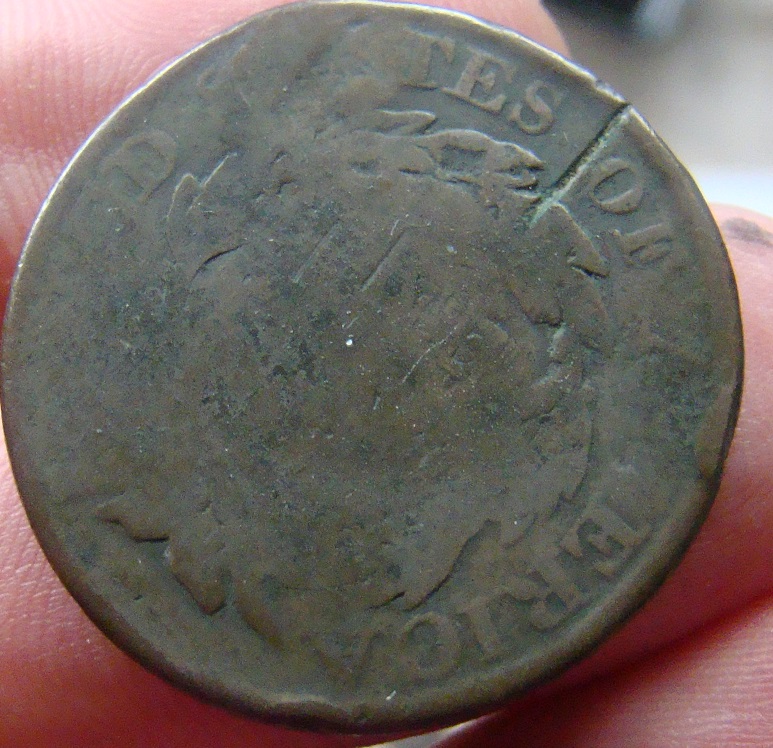 |
|
|
|
Moderator
 United States
34569 Posts |
@vince, that is a curious piece. Can you please add the weight and diameter? I'm not convinced (yet) that the base coin is a Two Cent Piece. With regard to the HB counterstamps, that are considered mavericks and it is unlikely that we will ever know why this coin was punched with them. I also see that branch-shaped incuse area in your first picture at nine o'clock. Perhaps this is an earlier counterstamp? I'm not sure. "If you climb a good tree, you get a push."
-----Ghanaian proverb
"The danger we all now face is distinguishing between what is authentic and what is performed."
-----King Adz
|
|
Bedrock of the Community
United States
94367 Posts |
I know I've see that HB stamp before.  |
|
Pillar of the Community
United States
1367 Posts |
It appears to be a large cent or 1/2 cent, with a counterstamp.
|
|
Bedrock of the Community
United States
12005 Posts |
It looks like a coronet cent with 13 stars. Trying to make out the date and I think I see 1817 but the 18 and 17 seem to be too far apart and the 8 is slanted weirdly. If it is 1817, there were no Half Cents minted in 1817 nor 1827 and the Half Cent series did not issue the coronet type but the classic head design that went immediately to braided hair so we can rule those out. Not a colonial coin since the reverse clearly says UNITED STATES OF AMERICA. IN NECESSARIIS UNITAS - IN DUBIIS LIBERTAS - IN OMNIBUS CARITAS THE MAN IN THE ARENA, Theodore Roosevelt at the Sorbonne Paris on April 23, 1910: " It is not the critic who counts; not the man who points out how the strong man stumbles or where the doer of deeds could have done better. The credit belongs to the man who is actually in the arena, whose face is marred by dust and sweat and blood, who strives valiantly, who errs and comes up short again and again, because there is no effort without error or shortcoming, but who knows the great enthusiasms, the great devotions, who spends himself in a worthy cause; who, at the best, knows, in the end, the triumph of high achievement, and who, at the worst, if he fails, at least he fails while daring greatly, so that his place shall never be with those cold and timid souls who knew neither victory nor defeat." My coin website: https://fairfaxcoins.com |
|
Pillar of the Community
 Netherlands
847 Posts |
Many thanks for your help in this matter! The weight of the coin is 10,51 grams. And diameter of this piece is 29-30mm.
There are I can see 13 stars yes. What would you think is the incuse or part left of the portret?
|
|
Bedrock of the Community
United States
12005 Posts |
At that weight it is a large cent. The incuse branch/leaves appear to be a merchant countermark added by someone after the coin was minted for some unknown purpose. Some collectors collect these punched coins and do research on what the purpose of the identifying mark was. Sometimes it was advertising, access to a business or product or to indicate ownership of something. If you add countermark to your title an expert in this area is more apt to look in and perhaps add information.
IN NECESSARIIS UNITAS - IN DUBIIS LIBERTAS - IN OMNIBUS CARITAS THE MAN IN THE ARENA, Theodore Roosevelt at the Sorbonne Paris on April 23, 1910: " It is not the critic who counts; not the man who points out how the strong man stumbles or where the doer of deeds could have done better. The credit belongs to the man who is actually in the arena, whose face is marred by dust and sweat and blood, who strives valiantly, who errs and comes up short again and again, because there is no effort without error or shortcoming, but who knows the great enthusiasms, the great devotions, who spends himself in a worthy cause; who, at the best, knows, in the end, the triumph of high achievement, and who, at the worst, if he fails, at least he fails while daring greatly, so that his place shall never be with those cold and timid souls who knew neither victory nor defeat." My coin website: https://fairfaxcoins.com |
|
Pillar of the Community
United States
9811 Posts |
Looks more like a 1/2 cent to me. The reverse is most definitely not a Two Cent Piece. I will have to check my counterstamps, but I believe I too have a Two Cent Piece with the HB counterstamp on it. "Buy the Book Before You Buy the Coin" - Aaron R. Feldman - "And read it" - Me 2013! ANA Life Member #3288 in good standing since 1981, ANS, Early American Coppers Member (EAC), Colonial Coin Collectors Club member (C4), Conder Token Collector Club member (CTCC), Civil War Token Society (CWTS) member, Liberty Seated Collectors Club (LSCC) & Numismatic Bibliomania Society member (NBS), USMex, Member in good standing, 2¢ variety collector. See my want page: http://goccf.com/t/140440 |
|
Bedrock of the Community
United States
17884 Posts |
Definitely a large cent from the 1816 to 1835 era. I suspect the other incuse features (other than the HB) are the result of a "vise job" where some other coin has been pressed into it.
|
|
Pillar of the Community
Netherlands
847 Posts |
Could it not be a part of the branch on the reverse that somehow ended up there?
|
|
Pillar of the Community
United States
4233 Posts |
It's incuse so it's either another counterstamp or stamped against another coin (aka vise job). Nothing on the reverse of a coronet head cent matches, and I can't think of another US coin with something like that. Your first image needs to be viewed upside-down to correctly see the HB, and looking at it that way it could be some sort of ribbon ends as well as a branch. It's interesting that the HB is two different sizes.
|
|
Bedrock of the Community
United States
17884 Posts |
The area in front of the face looks like an olive branch and the two features on the jaw remind me of an eagles talon.
|
|
Pillar of the Community
United States
4433 Posts |
Concur .... Coronet large cent, vise-job. It may an 1817, wide date variety.
Style-wise, the HB counterstamp looks by my "eye" to have been inflicted in the 19th century. The two letters appear to have been on a single punch; this, as opposed to two, individual letter punches. The consistent alignment of the apparently two, as opposed to otherwise four, stampings suggests this to me.
Checking Brunk's book on c/s's, I don't find this one listed. Unlisted mavericks like this are commonplace. There have been occasions, few and far between, where a few initials have been attributed to a particular company or individual. This c/s could be of USA or even Canadian origin. It may have been used as a picker token, a tool check and/or simply one's science experiment. Large cents were far and away the most common 18th century coins subjected to counterstamping. Of the 2,700 c/s'd pieces in my collection, 1,200+ are large cents. Their low value and large size, compared to other pre Civil War, coins then circulating, made them more inviting hosts for stamping.
|
|
Pillar of the Community
United States
9811 Posts |
I was able to get to the safe deposit box and check my few counterstamped coins I have. I was only half correct, I don't have a Two Cent Piece stamped with the "HB" I do however, have an 1868 Two Cent Piece stamped "MB" with an obverse lamination, so close, but no cigar on this one. 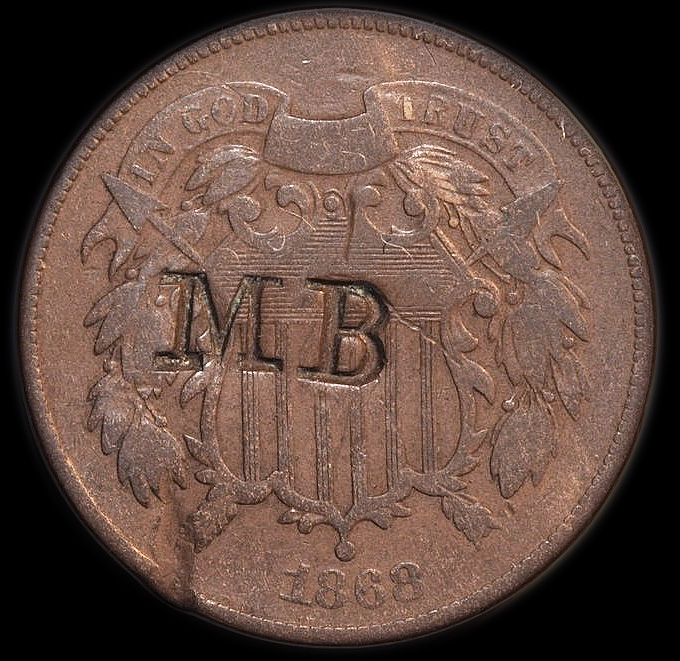 "Buy the Book Before You Buy the Coin" - Aaron R. Feldman - "And read it" - Me 2013! ANA Life Member #3288 in good standing since 1981, ANS, Early American Coppers Member (EAC), Colonial Coin Collectors Club member (C4), Conder Token Collector Club member (CTCC), Civil War Token Society (CWTS) member, Liberty Seated Collectors Club (LSCC) & Numismatic Bibliomania Society member (NBS), USMex, Member in good standing, 2¢ variety collector. See my want page: http://goccf.com/t/140440 |
| |
Replies: 13 / Views: 1,164 |
|




 Posted 05/29/2022 08:55 am





