| Author |
 Replies: 32 / Views: 2,755 Replies: 32 / Views: 2,755 |
|
|
|
Moderator
 United States
56855 Posts |
|
|
Bedrock of the Community
United States
19626 Posts |
Agree with John1 (above).
One of the foundations of numismatics is that it is a collective human pursuit. Unfortunately (fortunately?) there isn't a single, infallible numismatic 'tribunal' responsible for passing judgement on all matters concerning errors, varieties, etc., etc. The numismatic 'body of knowledge' has evolved over hundreds of years. That body of knowledge was (and continues to be) built and expanded by people with a passion for numismatics and having a full understanding of minting methods/processes/technologies over time. The body of knowledge underpins all of numismatics--as we understand it and navigate it. The sources noted by John1 offer a good starting point for those wanting to learn more and sharpen their skills.
|
|
Pillar of the Community
 United States
9014 Posts |
John1 and ijn1944 have given you good information and explained things very well. As John1 explained, the mint does not make any announcements of errors, and or varieties, at least that I am aware of. These are mistakes on their part and are not typically proud of it.  There are folks on this site and other sites, that have been doing this for decades and we try to learn from these folks. You have to understand, most here, are doing this service, of their own time and receive nothing for it, just trying to help others that are new to the Coin World. As far as professional attributors, I am not sure who is taking submissions right now, but here are a few that you can check with. VV http://www.varietyvista.com/ Coneca https://conecaonline.org/ Wexler https://doubleddie.com/ cc https://coppercoins.com/ Brian's Variety Coins https://www2.briansvarietycoins.com/attributions-makecents-
|
|
Valued Member
United States
324 Posts |
The mint will occasionally acknowledge errors, but they don't announce them first. There are probably thousands of error collectors who have the knowledge to tell you what is or isn't an error, but there are just a few who's viewpoint is USUALLY above reproach. Personally, I would work with CONECA, and if you want names, Mike Ellis and Ken Potter are my go to guys.
|
|
Pillar of the Community
United States
3207 Posts |
grading and error classification from still photos is itself subject to error, it's much better having the coin in hand so it can be angled to see how light reflects off it
in general, any ambiguous anomaly on a coin is assumed to be something commonly seen on coins because the odds favor that
|
|
Pillar of the Community
United States
5898 Posts |
Quote:
...According to the information from the 3rd picture, that's a DD with MD... There is no information posted with the third picture. (This is only part of what has been confusing about this thread.) Quote:
...If the pictures of his lips being doubled aren't clear to you then I do not know what to say silv lol insanely obvious Based on this one image, his lips are showing MD, not hub doubling. There is a big difference. As far as attributing whether a coin is a variety (which is what you are really asking about, not errors) that is done by sites or groups of professionals with a trusted level of knowledge and experience. Makescents gave a good list of such sites. IMHO, CONECA seems to be trying to use a "Peer Review" approach to attributing new varieties. Attributing by consensus instead of a single individual determining what is a new variety. It may seem cumbersome and slow to some but it's a new approach that takes some getting used to. Words of encouragement are one of the major food groups.
We need to consume them regularly to thrive and grow.
|
|
Moderator
United States
108033 Posts |
Is there a 'final authority' on coin errors? Most likely not because each 'error' or variety are a matter of the opinion of the person judging it at that time. As more time passes and more evidence is gathered about a particular one in question becomes available the opinions change and adjust to the new information. Now, There are folks out there the have studied the coin producing process and understand how they are made and how errors, varieties and types come about. a few have been mentioned here: Mike Diamond - he is the lead (head?) error coin specialist, is lead author of Coin World's weekly "Collectors' Clearinghouse," which delves into how errors and varieties are created in U.S. coinage. https://www.coinworld.com/authors/m...diamond.htmlMike Ellis - was a member of the board of governors of the American Numismatic Association. Ken Potter - a noted error-variety coin columnist and author https://koinpro.tripod.com/ErrorVarietyList.htmThen there are other sites to which we can visit to do 'our own attributions' with the help of people that took in coins from people like us and evaluated them then compiled a comprehensive list of these errors and varieties. these sites were listed up above by -makecents-: I personally like VV the best and is my first go-to stop. Edited by Dearborn
04/20/2023 11:44 am
|
|
Pillar of the Community
United States
2365 Posts |
It's been said many times that if the Mint discovers errors, those coins are destroyed. However, with the millions that are minted it's entirely possible that errors go into circulation to be found by collectors. You may also want to research variety vs error. Here's an explanation that I found that will answer your question: Quote: Who is the final say in a DD or MD or DDD and who truly knows? Certain errors such as MD vs DD's are clearly known due to mistakes, so to speak, in the minting process. https://blog.providentmetals.com/mi....ZEFjm3bMLIUI see that our other folks have given you many sites to review to help you understand the process and so forth. Have fun! Edited by dsking
04/20/2023 12:13 pm
|
|
Bedrock of the Community
United States
62064 Posts |
It looks like a doubled die and the area on the left side could be Machine Doubling. This could happen on these coins possibly with even different Machine Doubling. Machine Doubling is a striking event. The doubled die is a die creation doubled die creation. Machine Doubling can be different from strike to strike: 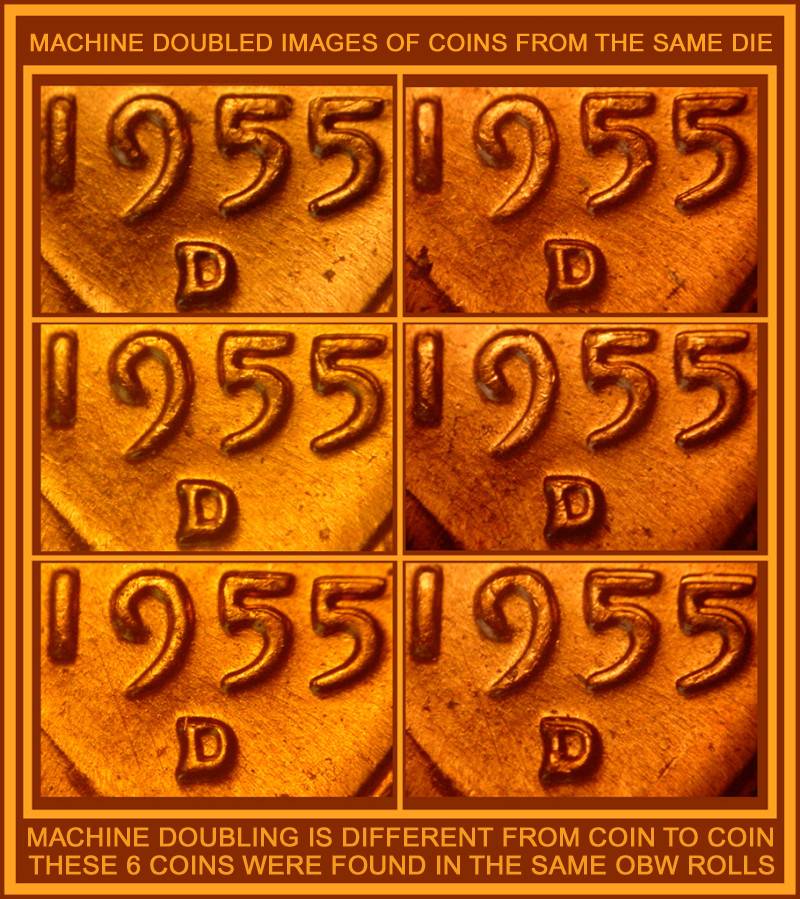 But the doubled die would always be the same. So the doubled die is the collectable part of this coin. The Machine Doubling happens sometimes often on doubled dies: 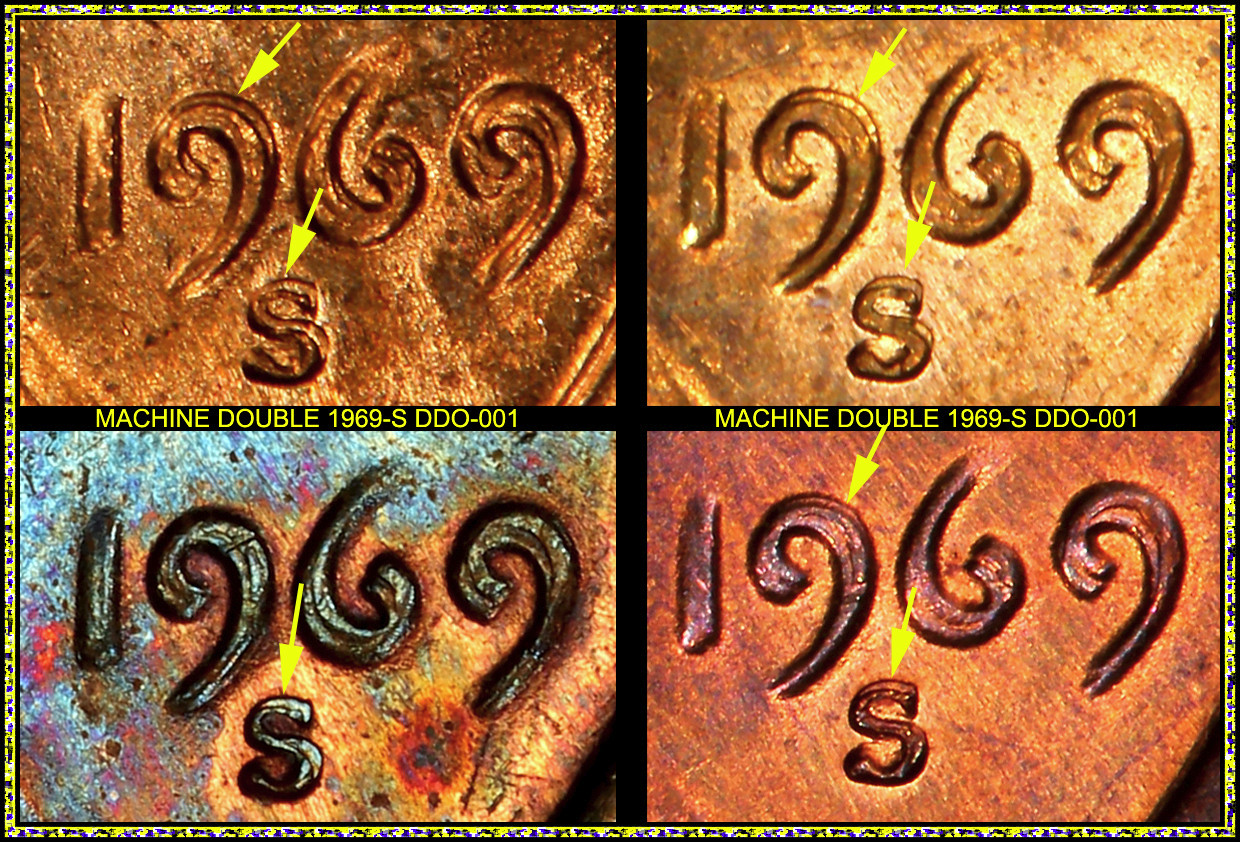 Note on these 4 different coins that were submitted to PCGS. Note the yellow arrows? Those are the devices with Machine Doubling. Note the mintmarks are all affected. Note that one a doubled die, the U.S. Coins during that time had a two step process that added the mintmark to dies post strike. So the date could be showing Machine Doubling and the hub doubling. But the mintmark is just showing the same Machine Doubling differently from strike to strike. That is what I'm seeing on your coin. |
|
Pillar of the Community
Canada
6244 Posts |
Quote:
Apparently at some point during the die run the dies clashed, were removed from the coining press to abrade the dies in an attempt to remove the die clash marks, and then the dies were returned to the coining press to continue production. We know that the doubled die was eventually discovered and removed from production. Was the doubled die discovered at the time that the dies were abraded, but put back into production until a foreman could come to inspect the error? There was an extremely heavy demand for cents at this time so it is possible that this was a factor in putting the die back into production before a foreman inspected the coins and ordered the die removed from use. If this is the case, the abraded Stage B specimens could prove to be far rarer than the earlier stage coins. Also, are there any specimens out there showing the die clash marks before they were abraded away? I have this from long, long time ago. I suspect was Wex who wrote this (Scott can confirm or deny). So this example is for 1955 1 Cent DDO. You put in question who are authorities for varieties or errors. The quote here show you who study the coins are experts. They employ physics, mathematics and chemistry and also a very good knowledge of a Mint productions by years. What you show me it is a local photo of the forehead. I saw this many times (quarters, .Morgan's and halves) Analyzing only a small isolate part of the coin it is not a good approach and the result will be wrong. The forum friends here give you all you need to learn what are the coins.. And for your knowledge: I have all the Mint reports to Congress and never, ever they mentions about No of errors, or No of Dies use for a denomination. Every estimations is base on the type of variety, error and geographic distribution. PS: Your Romanian aluminum coin was a man made at the Mint facility in time. The employee was catch and was for a time in very cool place (20 years) |
|
Pillar of the Community
United States
808 Posts |
pnewman, first welcome to the coin ccmmunity! I started looking at coins three years ago, and so far I personally looked at thousands of coins, and found 20 plus coins with errors of some sort. I am still learning and it can be frustating but hang in there! The members who have responded to you are the cream of coin community and have given you wonderful information! It takes time to learn about coin collecting. Have fun and remember Rome was not built in a day. Regards and good hunting.
|
|
Valued Member
United States
316 Posts |
Well said Allcoinsaregood.
|
|
Valued Member
Canada
333 Posts |
|
|
Valued Member
 United States
58 Posts |
No intention of being upset I guess I just had seen so many mixed reviews and was genuinely curious if somebody has the final say and how the discovery goes. Frustrating researching and finding the same but also contradicting answers. So I figured I'd ask who has the say in it all and got tons of great information. So thank you all
|
|
Pillar of the Community
United States
9014 Posts |
Quote:
So thank you all  I did not respond to what I saw in your pics. My humble opinion. 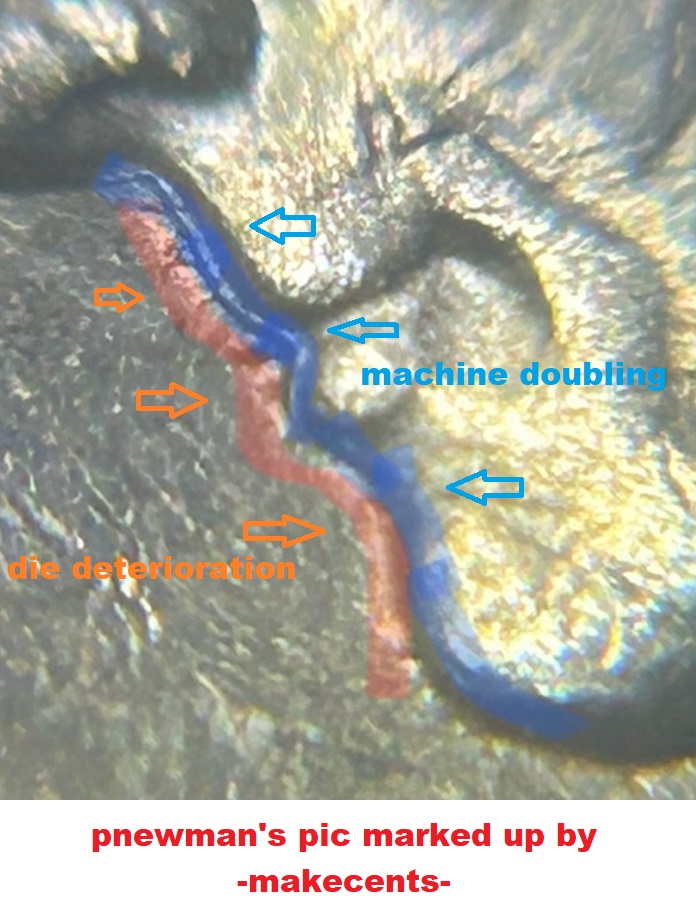 -makecents-
|
| |
Replies: 32 / Views: 2,755 |








 First Page


 Posted 04/20/2023 08:14 am


